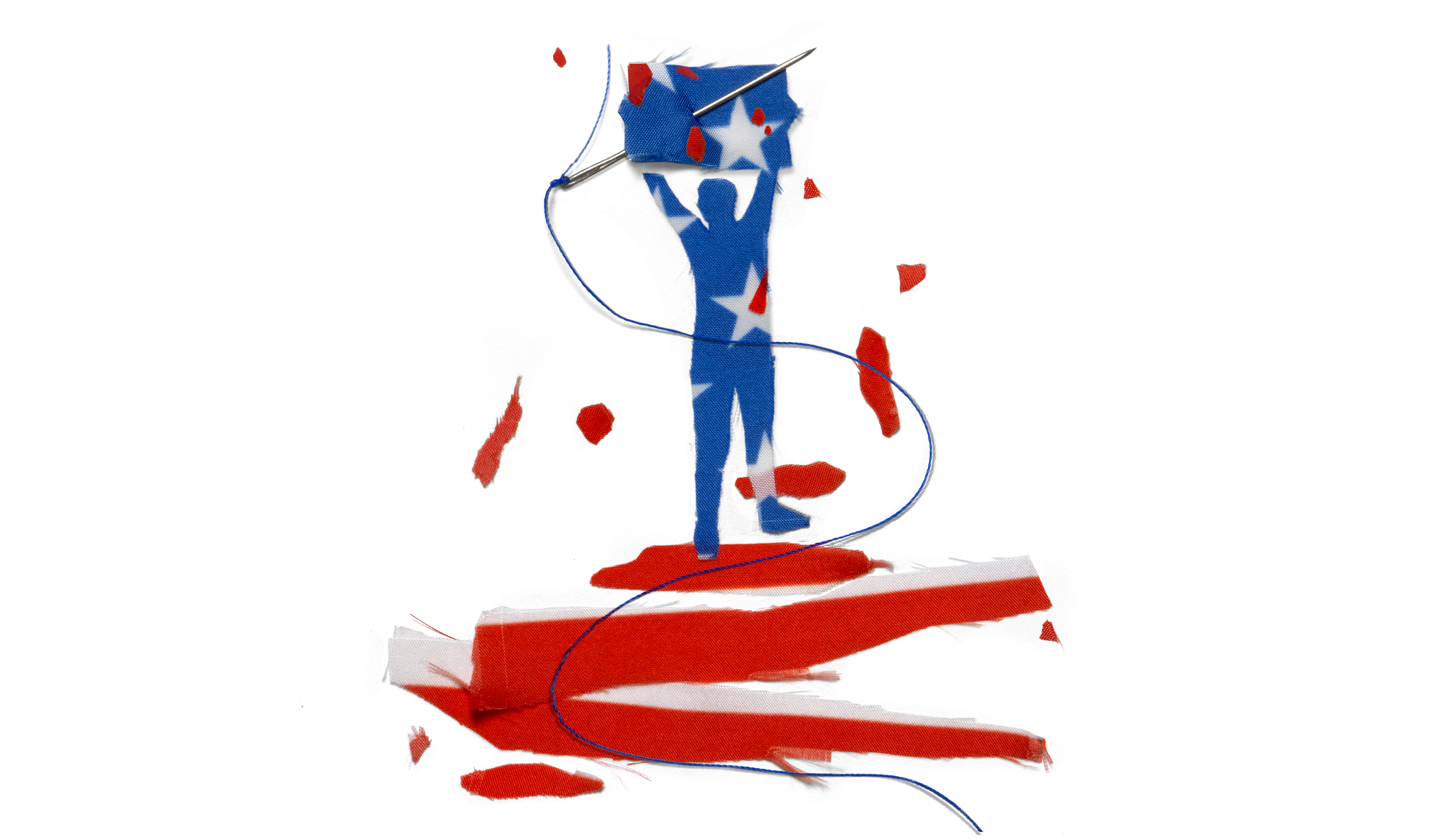

Living through times of unrestrained violence calls for both outward resistance and inner resilience. One Nashville-based Jungian analyst and psychoterapist would like us to think about these things. Set the timer America, your session is about to begin.
Words by Tony Caldwell
Illustration by Doug Chayka
May 11, 2026
—
Originally Published in Issue No. 13 of The Bitter Southerner Magazine
We’re living in a time of systemic mental, emotional, and bodily violence. Violence that, by design and with great intent, seeks to dominate the body, mind, and spirit is, by definition, evil. In such moments, it’s wise to look backward, to past sages, for advice on protecting our health and wellness as we find our way forward.
How are we to proceed?
How do we access joy while carrying heartbreak? How do we grieve without succumbing to grief’s downward pull? How can we inspire our communities when we are often paralyzed by fear? How, in the midst of cultural betrayal, are we to trust? How, not able to unsee what loved ones have become, are we to hope? How do we look at our children without our eyes betraying our deep concern?
How do we bear witness and learn to hold the sorrows of the world?
When John Lewis was approaching the Edmund Pettus Bridge, he looked at the officers who were about to assault him, and he kept walking. He saw the hatred, violence, and bloodlust of these men, but simultaneously he could envision the Beloved Community. In this way, John Lewis was a dual citizen; he had a foot in both worlds — the world as it is and the world as it could be.
My friend, the tireless Tennessee-born activist Shane Claiborne, puts it this way: “We must daily build a new world in the shell of the old one.” He advocates constantly manifesting a vision of a new, just, and compassionate society within the broken systems of the current world.
Rev. Dr. Martin Luther King Jr. memorably prophesied victory in a speech in support of the Memphis Sanitation Workers Strike the night before his death. King said God had taken him to the mountaintop and, like Moses, given him a glimpse of the Promised Land. So, though he was surrounded by threats, King insisted: “I’m happy, tonight; I’m not worried about anything; I’m not fearing any man. Mine eyes have seen the glory of the coming of the Lord.”
Like Congressman John Lewis, Dr. King kept walking into the line of fire, seeing both the forces intent on silencing him and the Promised Land — the world as it is, and the world as it could be.
To be an activist, one must also be a mystic, like John Lewis and Dr. King, a dual citizen. We can, and must, learn from their modeling how to tap our inner wellsprings.
Psychiatrist and Holocaust survivor Viktor Frankl said a man can endure almost anything, except the lack of meaning. Finding purpose, our “why,” is a psychological necessity for surviving profound hardship. Without a “why,” one is tempted to give up, the ultimate loss of agency. We can make no sense from madness, violence, and mass unconsciousness, for they contain no meaning. In times of great meaninglessness, we must be the meaning makers.
Resistance is not just an outward action. Inwardly, we must resist the domination of our minds and the colonization of our spirits. We are the guardians of our souls.
I can also tell you from 30 years of activism and the attendant burnout, secondary trauma, and compassion fatigue, there is power in deeply crying, crying the tears of the world from the loneliest and most grief-stricken place within you, allowing all of you to cry, you at every age you have ever been, allowing yourself the natural and appropriate response to seeing what the world has become.
Resilience is commonly described as an isolated inner toughness, but it also thrives in community, partnership, and solidarity. Charles Darwin believed that the individuals who were best adapted to their specific, changing environment were more likely to survive. But the philosopher and teacher Jiddu Krishnamurti warned us: “It is no measure of health to be well-adjusted to a profoundly sick society.” Borrowing from both men, may we seek to adapt strategically to reality in a way that preserves our well-being while never giving in to assent or assimilation.
Destructive energy seeks to define all that it touches, starting with our own encounter with it. It draws us into a reactive dualism: winner and loser, dominator and dominated. Of course, we want and need to win; we absolutely must win. But when we are pulled into those energies, we are pulled into the vortex and are defined by that which we resist. We lose our agency, stuck in a reactivity we cannot escape.
The Hindu scripture Bhagavad Gita speaks to this. In the Gita, the deity Krishna instructs Arjuna to go into battle against his kinsmen without being attached to the outcome, which is, to say the least, counterintuitive. Ultimately, Krishna taught Arjuna to resist while remaining rooted in the true and transcendent Self, not just his small egoic and socialized self. Arjuna’s leadership then emanated from this broader identity. Arjuna learned to respond, not react, lest he be defined and dominated by reactivity.
The prolific author and Jungian psychoanalyst Dr. James Hollis says that when we wake up, there are always “two gremlins” at the foot of our bed — fear and lethargy. We must resist these inner forces. We must conserve our energy, even as we are pregnant with moral outrage and chronic disbelief.
In my own practice, I have become convinced that loving one’s enemy is often more about our own survival, energy conservation, and sanity than about moralism and forced reconciliation.
Lastly, in 2019, when I was providing on-the-ground group therapy with children who came home from their first day of school to empty houses, their parents taken midday by ICE to holding cells in Louisiana, I felt a message arise in me and I spoke out loud to these traumatized and disoriented children. It’s the message we all need to hear as we are trying to make meaning from suffering: “This feels bad because it is bad. This feels wrong because it is wrong. This feels evil because it is evil. You are not what you feel right now; you are the one feeling what it is like to be treated so horribly. Everything you feel right now is proof that your heart works the way it should.”
A couple of days later, I was moved to tears to see several of the older children standing in the town square, holding protest signs and standing with such dignity among people who, without eyes to see and ears to hear, neither perceived their worth nor validated their pain. It is my hope that you, as well, stand in your dignity, knowing that your pain is your joy inverted, that your pain is in proportion to your love, that your depths of sorrow are proof of your humanity, and it is your eyes that bear witness and cry the tears of the world. ◊
Tony Caldwell is a Jungian psychoanalyst and psychotherapist living and practicing in Nashville.
Doug Chayka is a freelance illustrator based in New Jersey and Berlin, Germany. He has also taught illustration at Ringling College of Design, and Savannah College of Art and Design, and on an adjunct basis at Pratt Institute, City College of New York, Rochester Institute of Technology, and The Illustration Academy.