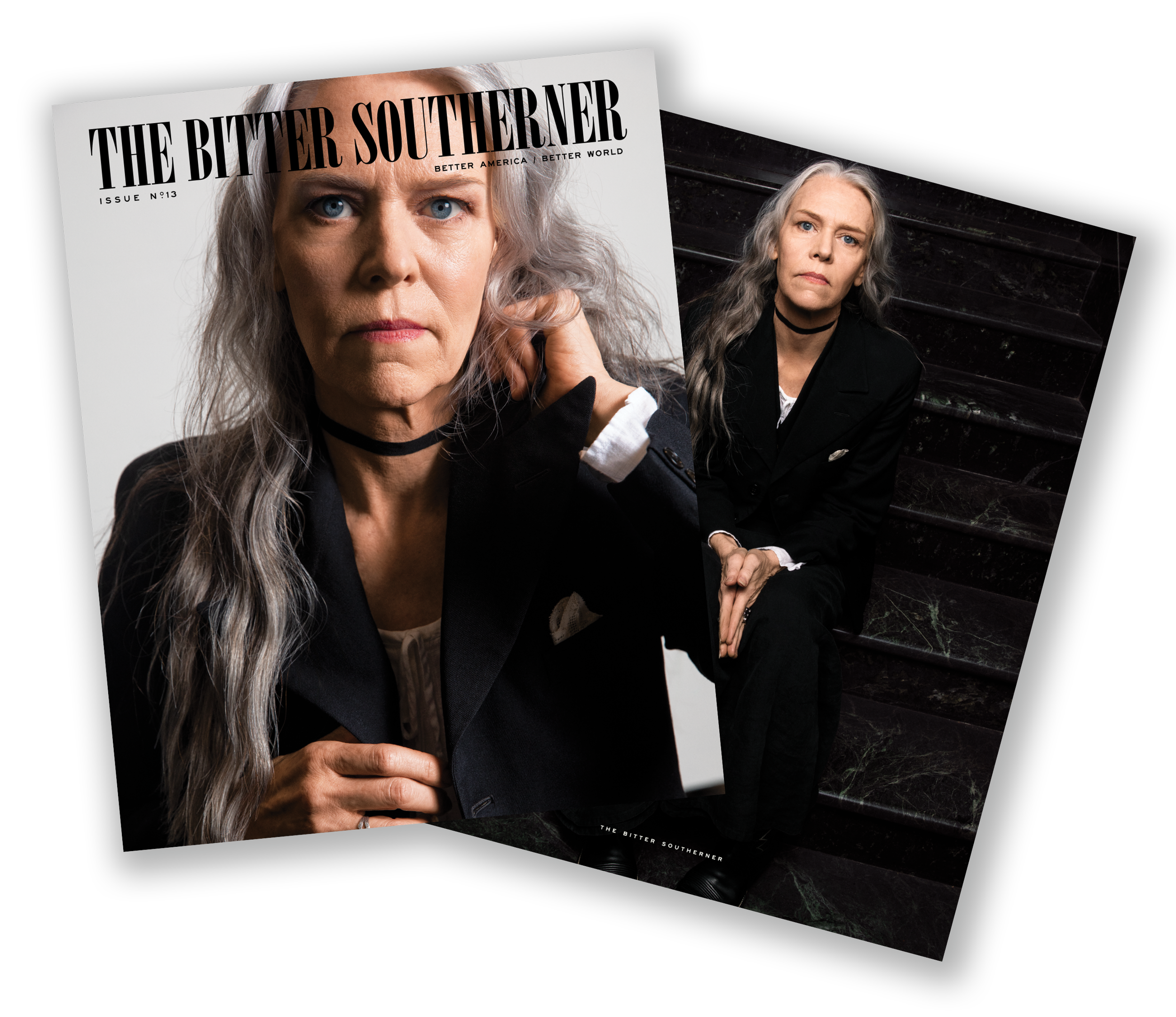

Words by Jewly Hight | Photos by Landon Nordeman
April 1, 2026
—
Originally published in Issue No. 13 of The Bitter Southerner Magazine
A few months ahead of the 2020 presidential election, singer-songwriter Gillian Welch took to Instagram and shared a black-and-white Depression-era photo taken by Dorothea Lange when she was documenting dustbowl migrants for the WPA. There are no people in this particular image. Instead, it captures a hand-painted sign propped against a gas station air pump, the text one righteous, run-on sentence: “This is your country dont let the big men take it away from you.” In her post, Welch ruminated on the message’s implications: “It reminds me to be ever watchful for the destructive hand of greed. It reminds me not to take our rights and freedoms for granted. It reminds me that I vote with purpose in order to safeguard those rights that are an unalienable part of our democracy.”
“God, I’ve had that photograph tacked to my wall since I was about 17 when I went away to college,” she marvels at her kitchen table in East Nashville on a recent January afternoon. It wasn’t merely aesthetic appeal that inspired Welch to hang up the Lange image in her dorm room at the University of California Santa Cruz, where she studied photography before famously finding her longtime musical partner Dave Rawlings at Berklee College of Music. “Part of its magic was understanding that the people who saw that sign were the people who would have needed to see it. It was not on a billboard on the side of a big fancy building. That resonated with me. You don’t need to shout it for the entire world, but you need to give hope to the people who need it, who you can speak to.”
Asking one of this century’s most highly revered singer-songwriters about a years-old social media post might seem beside the point. In actuality, it’s a way of getting to the heart of Welch’s outlook. She and Rawlings deploy folk idioms, references, and signifiers with such shrewdness that fans spent a 2025 Reddit thread parsing what message the duo intended by combining Woody Guthrie’s “This Land Is Your Land” with “I Hear Them All,” a grand expression of empathy that Rawlings co-wrote, into a live medley. One poster observed why interpreting a Welch/Rawlings performance is such a subtle art — “I don’t think I’ve ever heard them talk about politics” — and several others concurred. When I relate this exchange to Welch, she’s not surprised. “I am a fighter, but in a very quiet way,” she responds. “I will never be the one with the bullhorn.”
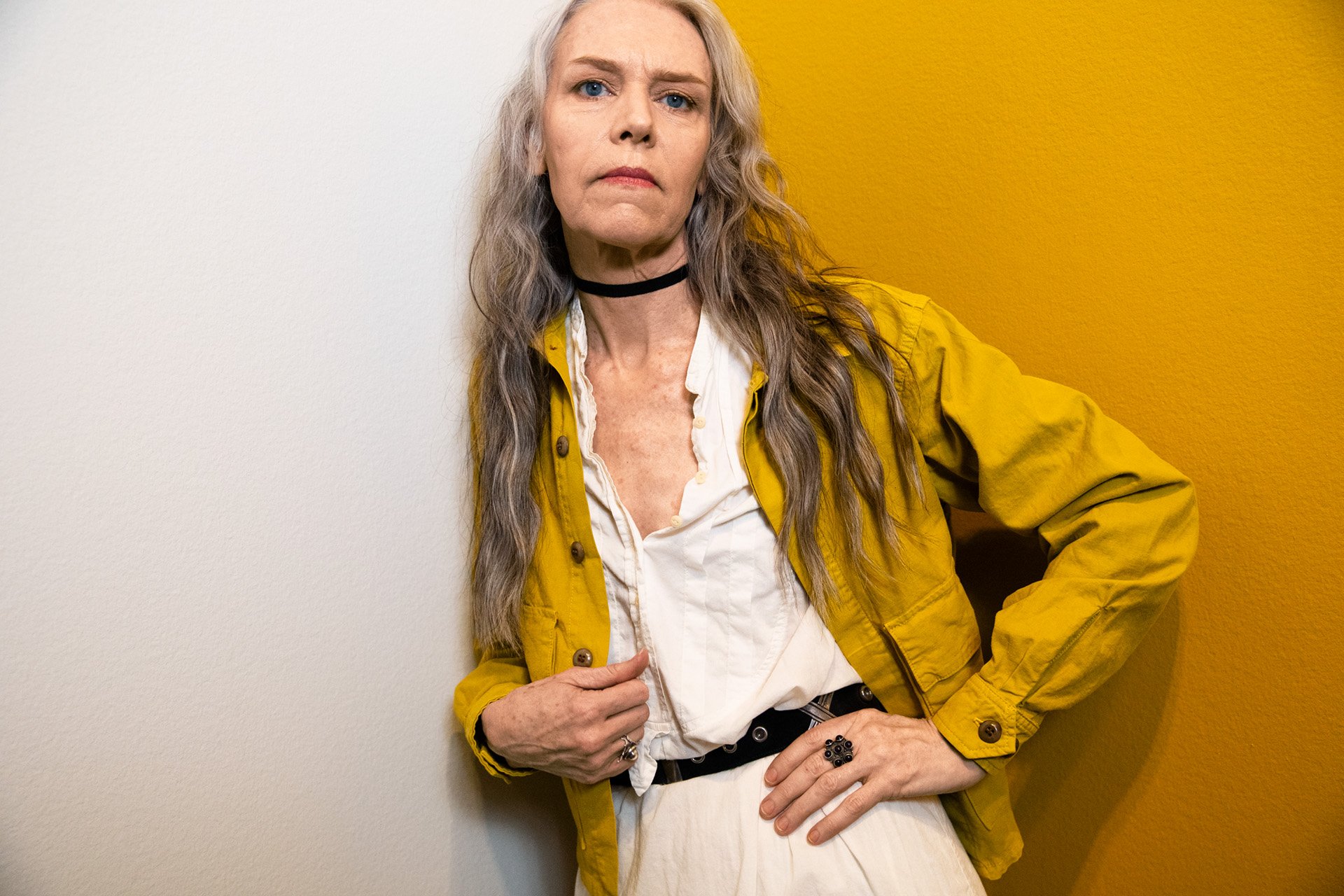
(Top Photo) Gillian Welch in The Mabel twill field jacket by imogene + willie, available at imogeneandwillie.com, with a white cotton imogene + willie shirt from Libby Callaway’s vintage collection. 1940s Taxco silver belt by Hector Aguilar and black twill ribbon choker by Gillian Welch. Photos taken at Frist Art Museum in Nashville, Tennessee.
The perception that loomed over Welch and Rawlings when they released their first two albums under her name in the mid-to-late ’90s was that they were so preoccupied with the sensibilities of a bygone era that they had no interest in speaking to the present. But that was a superficial and premature appraisal. By the time the O Brother, Where Art Thou? soundtrack was released, they were part of revived popular interest in roots music. The third Welch full-length album, 2001’s Time (The Revelator), took American history as a jumping off point for engrossing, elliptical postmodern musings, here they’d established a whole new ideal for virtuosic, intimately revelatory, and original old-time music-making.
Even back in Welch’s mid-’80s undergrad days, her UC Santa Cruz comrade Peter Nevins — who went on to create prints and posters for her music — noted remarkable patience and attentiveness in her nascent outlook. She seemed able to inhabit her moment fully and grasp that the broader patterns of American cultural life were made up of many such moments. “These different trends just kind of wash up against her rocks, and she’s just still gonna be there,” Nevins observes. “That to me is the strength she brings, this timeless perspective that’s so valuable in an era of mass communication and turmoil. She’s Captain Attention Span, and that is such a rare and valuable thing these days.”
Consider “Hard Times,” one of Welch’s many contributions to the American folk canon. It’s been part of her and Rawlings’ repertoire since 2011, when President Obama was in office, and it’s a song of strained but determined resilience. Lending a bluesy lilt to the melody’s sighing descent, Welch sings of a farmer who keeps himself and his mule going until the day’s hard labor is done with this refrain: “Hard times ain’t gonna rule my mind.”
A decade and a half on, she’s struck by the emotional response the song has been getting from audiences. “I’ve never heard so many people sobbing in the shows,” she says. “It’s not like someone says to me, ‘Yeah, I cried a little.’ I’m literally hearing people breaking down. The shows have had this feeling of a refuge — a place to grieve, a place to cry, a place to feel joy. People are really hanging on for dear life.” Never has there been a greater need for Welch’s profound regard for humanity.
In the past, many a music critic got hung up on contrasting her music with her cosmopolitan origins. They overlooked the guiding artistic values she first embraced under the care of her parents, Ken and Mitzie Welch, who maintained successful showbiz songwriting careers during and beyond the golden age of television.
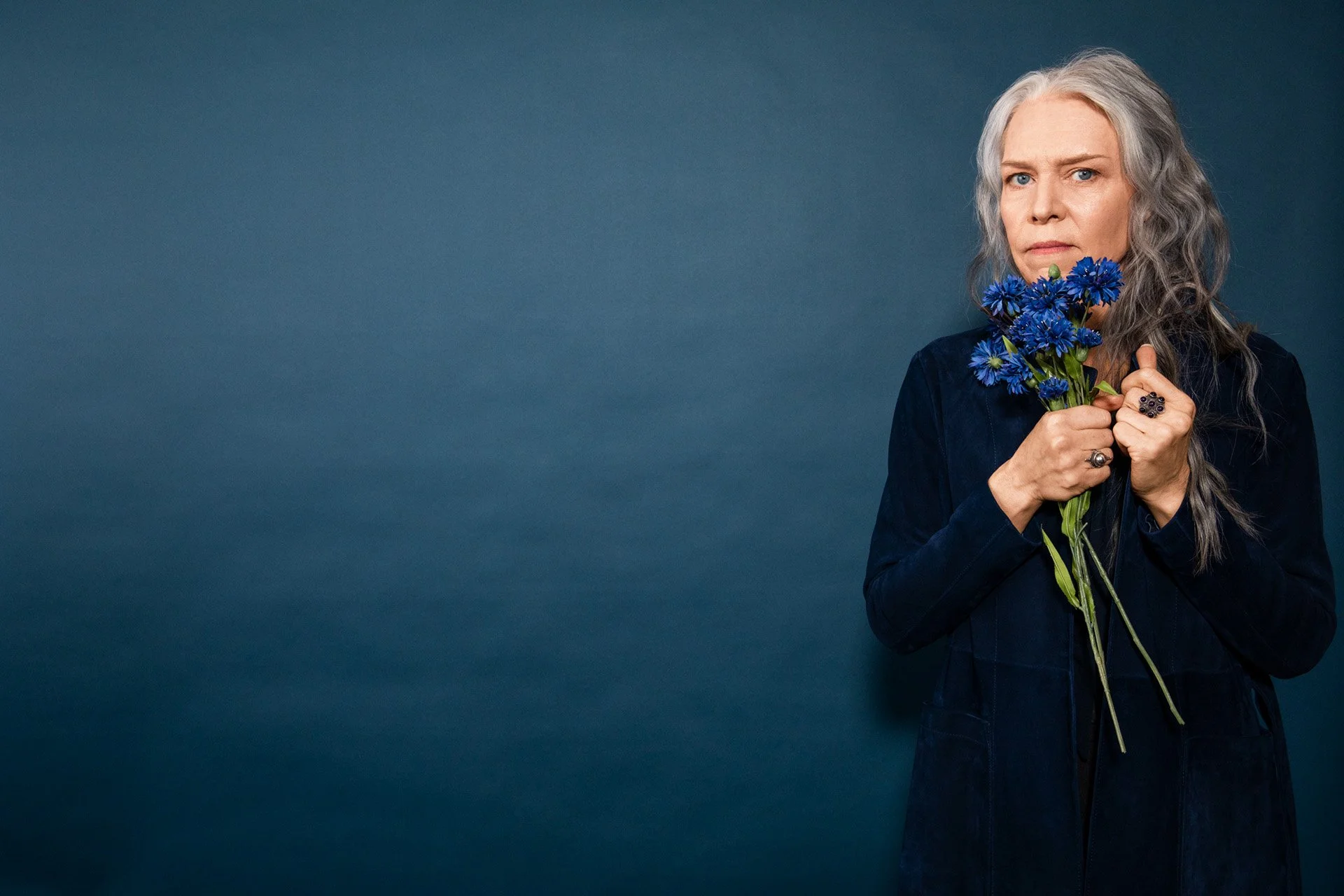
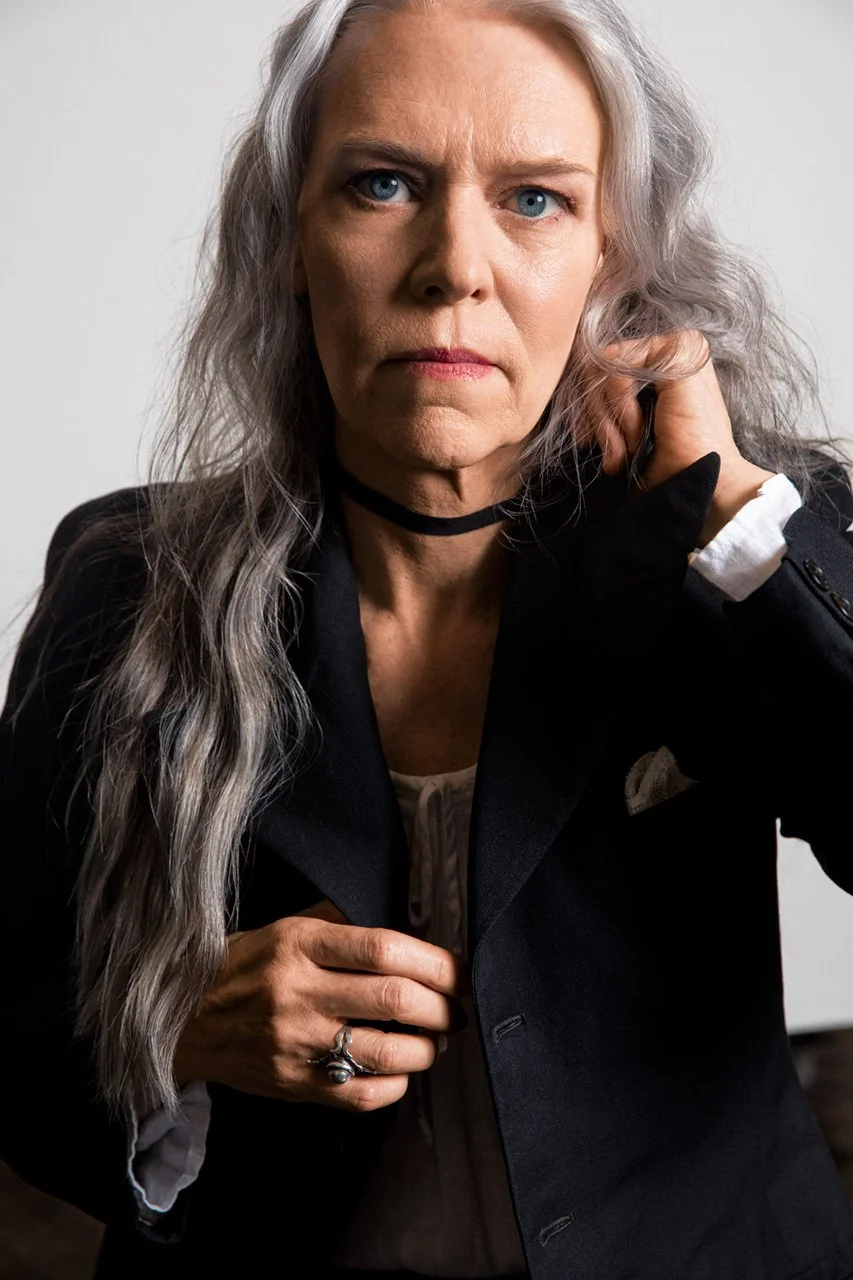
Gillian in The Shelby Italian suede duster in sapphire by Savas, available at ateliersavas.com. She wears her own rings by California street artists, c. 1980s.
Nearly every room in the Welches’ Los Angeles home but hers had a keyboard or two: A grand piano in her parents’ office, a more compact spinet upright in her older sister’s room, and, in the living room, a harpsichord and an antique pump organ. “I was a little bit of a freak just for gravitating towards the stringed instruments and not doing the piano thing,” says Welch, the lone member of the household with a preference for guitar. “My thing was I wanted to be able to take it with me. I think I was a bit of a traveler, a bit of a tumbleweed from the very beginning.”
As professional composers and accompanists, her parents weren’t the types to dissuade her from pursuing her artistic inclinations in favor of a 9 to 5. “Their only worry when they saw me spending every day after school locked in my bedroom playing guitar, was I was shy about playing in front of other people,” she recalls. “They knew I really loved music, but they didn’t think I had the drive to perform publicly. Because all the people they knew, like Barbra Streisand, like Carol Burnett, from very early on, they were driven to get out there.”
But young Gillian cultivated another skill with great usefulness in the entertainment business: She started deflecting attention from herself with elaborate storytelling. She also took in the egalitarianism of her parents’ partnership, a fairly unique dynamic for a couple who came of age during the postwar era. “I think my mom was a self professed women’s libber,” their daughter observes. “And she was absolutely committed to raising my sister and I with the understanding that no man could do things we couldn’t do.”

Gillian absorbed the most formative lesson of all from watching the Welches tailor their work to the needs and desires of their famous employers, The Carol Burnett Show chief among them: “I saw how painful it was for them when they had something they really felt was the correct artistic response, if for some reason that was thwarted. And so I think from a very early age I understood that you had to strive for complete creative control.”
Mitzie and Ken sent Gillian to a private school that certainly prioritized that. Beginning in 7th grade, in 1979, Welch attended Crossroads School for Arts & Sciences with the scions of other Hollywood entertainment figures. At that point, the classrooms were still housed in a rundown former warehouse, but as Welch told Vanity Fair, “What was going on was creative. It was like a think tank.” And from there, she landed in the UC Santa Cruz art department, cultivating the philosophy that she’d carry from one artistic medium to another. “What appealed to me with the photography was quietly looking at the world,” she explains. “When I took photographs, which I still do, it was mostly about light and environment. I was really a landscape photographer. And when I committed myself more to songwriting, it really became about the internal landscape in my head.”
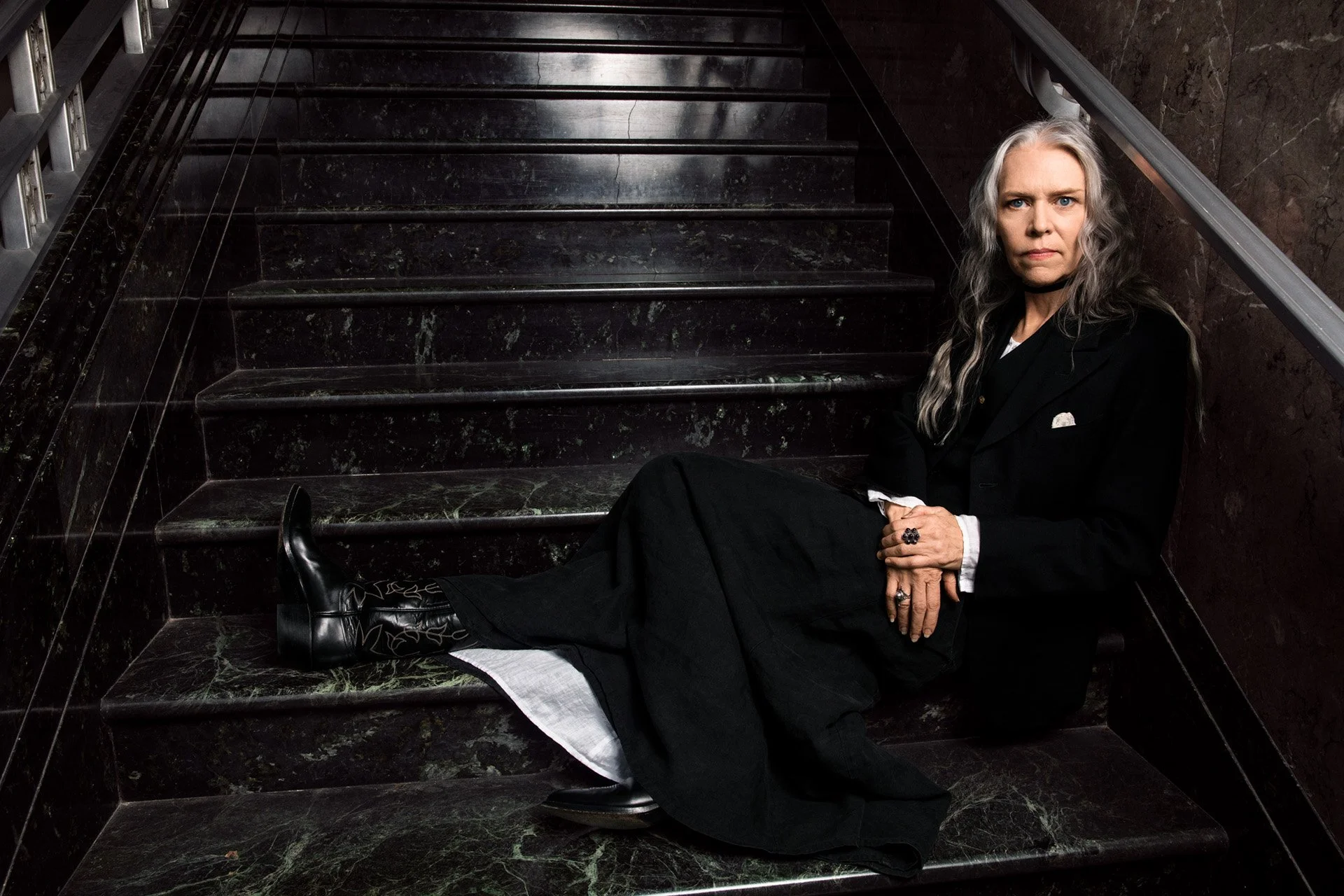
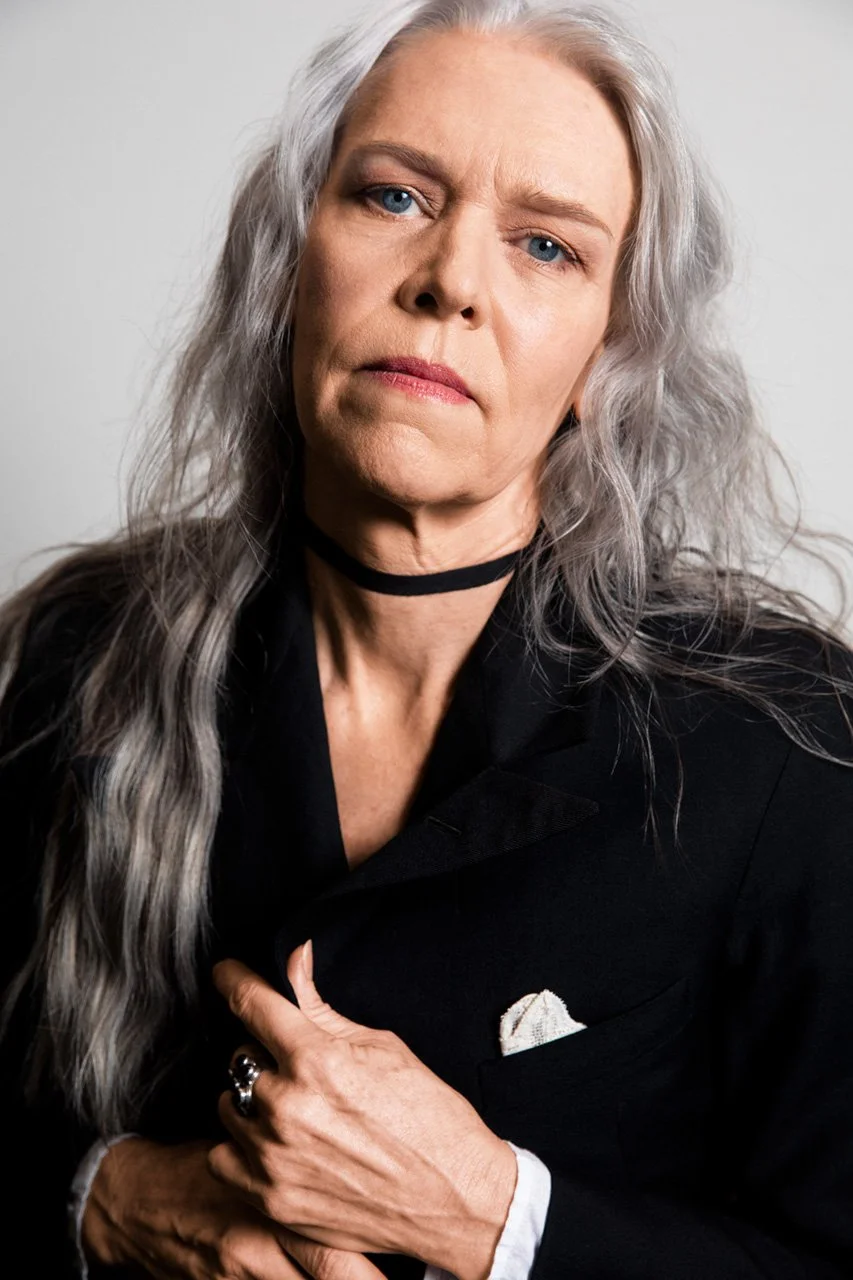
Gillian’s black wool jacket and vest, both 1920s Paris vintage; white linen chemise, ArmStreet, Ukraine; black skirt from Sisters of the Black Moon, Austin; boots, Texas Traditions, also Austin.
She was a sophomore when Nevins arrived to begin his freshman year, set up his stereo, and announced his presence by blasting the tangled, spiky abstractions of Pink Floyd’s “Interstellar Overdrive” from his dorm room. “That’s on for about 10 seconds,” he recounts. “Then this face comes around the frame of the [open] door. She’s got these round glasses on, and she’s like, ‘You just got here. How do you know Camper Van Beethoven?’” Welch thought the new kid was listening to a version of “Interstellar Overdrive” by Camper, a band with considerable buzz in the local scene. When Nevins admitted that he, in fact, didn’t know the group, she invited him to an upcoming show anyway.
That was the first of many times that they went to see college rock bands that were laying the groundwork for indie rock in the late ’80s, including R.E.M. and the Meat Puppets. Soon they were jamming in the stairwell and at friends’ houses. They even amused themselves by working up half a dozen numbers from the metal mockumentary This Is Spinal Tap. “I was Nigel [Tufnel] playing lead and Gillian was David St. Hubbins,” says Nevins. Imagine hearing Welch deliver the outlandish, macho innuendo of “Big Bottom”: “My baby fits me like a flesh tuxedo/I love to sink her with my pink torpedo.”
Welch and Nevins also shared an abiding interest in traditional acoustic music, as played by its originators or reinterpreted by later adopters. This was hardly a peak era for folk music, but that made it all the more tantalizing. “It really felt rebellious to love this music that no one else was listening to,” reflects Nevins. “It really felt like the counterculture for us, at that point, was to listen to someone like Doc Watson. That represented total freedom, to be so free from convention.”
The online Grateful Dead archives contain an envelope that Welch decorated and mailed in to request tickets. Nevins remembers admiring it and estimates that they trekked with friends to as many as 10 Dead shows around California. Even though they were a generation removed from the original Deadheads, they were drawn by the flexibility the band found in old songs and styles and the open-ended sense of lineage, or as Nevins puts it, “that the music didn’t begin in the ’60s, that they just cottoned onto what was already happening and that we were doing the same thing, seeing it as part of the continuum that we’re still part of.”

Over the years, Welch and Rawlings have sometimes peppered their sets with Dead originals like “Dire Wolf” and “China Doll,” and they’ve also worked up their own renditions of numbers the Dead absorbed from older sources, including “The Monkey and the Engineer” and “Oh Babe, It Ain’t No Lie.” All those and more will be in the set list on the duo’s upcoming tour reprising the Dead’s 1981 live album Reckoning.
One of Welch’s recent reads is the book Here Beside the Rising Tide, a 2025 Jerry Garcia biography that doubles as an assessment of the Dead’s role in shaping American counterculture. Its author, journalist Jim Newton, interviewed her as part of his research and sent her a finished copy that she has found “liberating.” “I felt this great weight lifted off me, because I’ve been quite blue,” she says. “It’s been a difficult time to be a human. And I suddenly remembered, Oh yeah, I’m counterculture. I’m not supposed to feel comfortable with what’s going on.”
Newton characterizes the Dead as not explicitly political, in the sense that they weren’t on the front lines of Vietnam War protests or campaigning for leftist candidates. “But that defines politics too narrowly,” he writes. “These were inherently political days. Culture and politics swirled together. Getting high was political. Dancing was political. An Acid Test was an evening of fun and experimentation but, importantly, also an act of defiance. If one considers politics broadly — as protest, as the clash of values and ways of living — the Dead were at the center of California politics in 1966.”
In the face of then-gubernatorial candidate Ronald Reagan’s championing of middle-class respectability, they flouted a thoroughly unconstrained ethos. That’s an illuminating lens to apply to Welch’s own oeuvre, too. Her work may be low on freewheeling psychedelia — outside of Rawlings’ rash, elegantly hurtling guitar runs — but so much of it depicts the sidestepping of domesticity and convention.
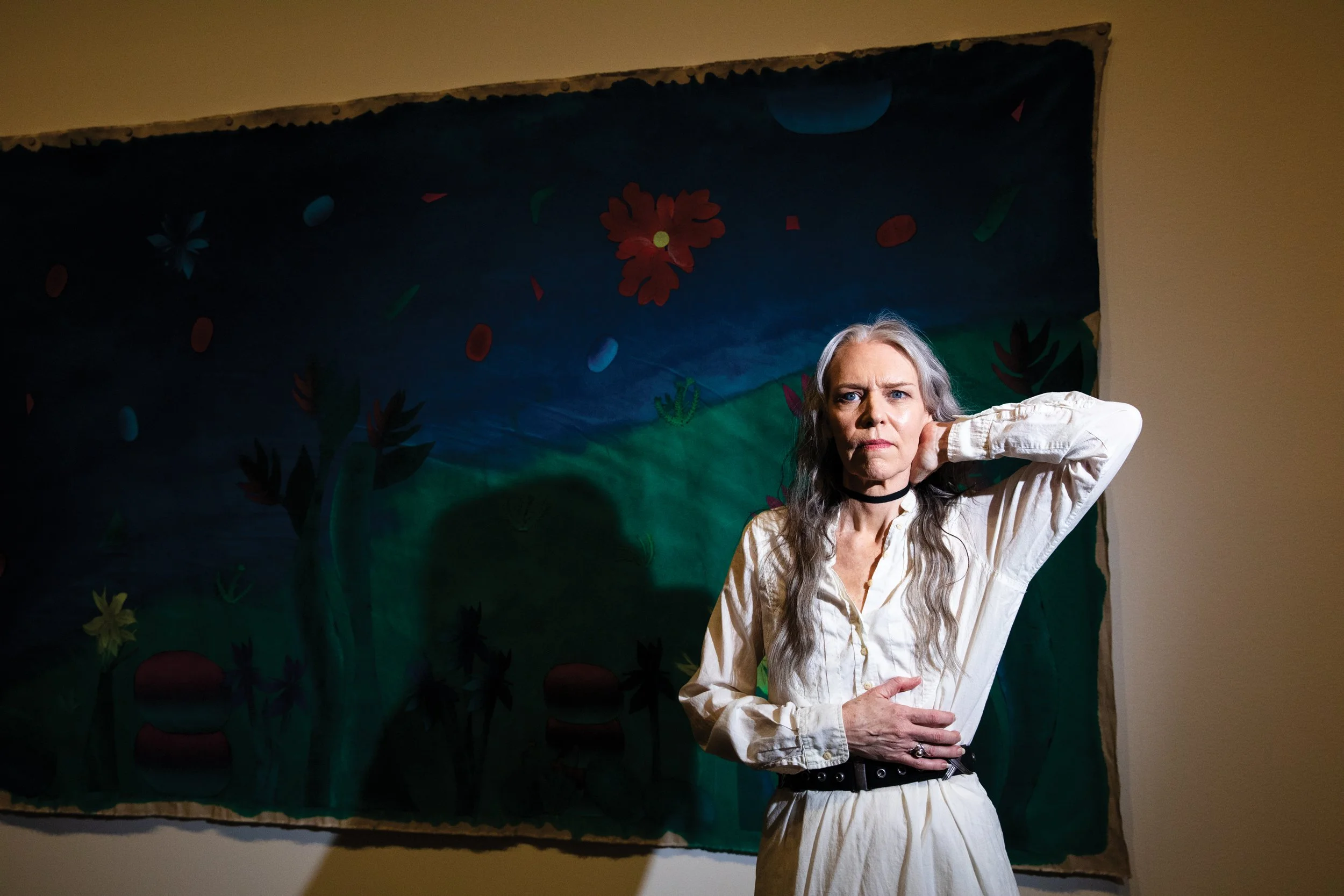
Gillian in front of “Water Meadow” by Yanira Vissepó in a white cotton shirt by imogene + willie from Callaway’s vintage collection.
When Welch gives me a tour of the book collection lining one wall of the living room, she points out beloved volumes by James Joyce, James Agee, Zora Neale Hurston, Simone de Beauvoir, Kenneth Patchen, Maya Angelou, Henry Miller, Frank O’Hara, Carl Sandburg, and Thomas Wolfe, the namesake of the literary prize bestowed on her in 2018 by the University of North Carolina Chapel Hill. (The award’s been around for a quarter-century, and she’s the only songwriter who’s won it to date.) She has her own analysis of her relationship to literature: “The narratives I read tend to be happening in America. That’s where I kind of need to be in my head for my art. And I find myself gravitating towards the people who were writing between World War I and World War II. People were trying to deal with the chaos and the pain and the loss and wondering if they could be hopeful that it wouldn’t happen again, or wondering if they had seen the worst in mankind and knew that it was always going to happen. This incredibly painful yet optimistic time.”
In her mind, one author on her shelves stands apart, and that’s Jack Kerouac. “Other people move me to write better,” muses Welch. “I would say he sometimes prompts me to live better. He moves me to action, to make sure I’m moving through the world like a free person.”
Kerouac helped map out the spontaneous, uninhibited cultural scene in which the Dead and many of their bohemian contemporaries thrived. No matter that the women in his defining novel, On the Road, served mainly as supporting figures for adventuring male protagonists to turn to for comfort, nurture, or pleasure — and, ultimately, leave behind. Welch laid claim to that sense of mobility, and her musical trajectory itself has a certain contrarian quality.
Though Berklee has come to be known as a place where bluegrass and folk musicians can go for specialized conservatory training, that wasn’t the case when she enrolled. Of the three male duet partners she tried during her songwriting studies, she stuck with Rawlings, the one who “had the worst initial blend” with her vocally. She sounds a bit mischievous complicating the origin story of their celebrated partnership: “The two other guys, I think if you’d heard us, you would have said, ‘Oh, they sound better.’ But that is not the be-all and end-all of it.”
When I interviewed them together several years back, Rawlings joked that moving to Nashville in the early ’90s to pursue a career as an old-time acoustic duo “seemed like a terrible idea.” Long gone were the Appalachian harmony-singing brother duos they revered. Contemporary country music was booming, and superstars like Garth Brooks, Reba McEntire, and Brooks & Dunn had hit pay dirt with the gimmicks and grand gestures of arena rock.
Country stars did cut some of the songs Welch and Rawlings wrote, but so did lots of bluegrass, folk, and Celtic acts. Though Emmylou Harris’ version of their song “Orphan Girl” preceded Welch’s own recording of it, the latter is definitive. She delivers it more like a ballad of unencumbered aloneness and individuality than a keening lament for the absence of kinship. Welch climbs up to her high lonesome range, only to leap off and claim her identity on the way to the ground: “I am an orphan girl.”
In a 2024 interview, I asked Rawlings and Welch to reflect on what it meant when songs of theirs began entering the canon. “The highest compliment is another musician deciding to play your song,” Welch said, echoing a common sentiment.
Rawlings chimed in, “I would actually say that the highest compliment is when you’re walking by a campfire somewhere and another nonprofessional musician is playing your song.”
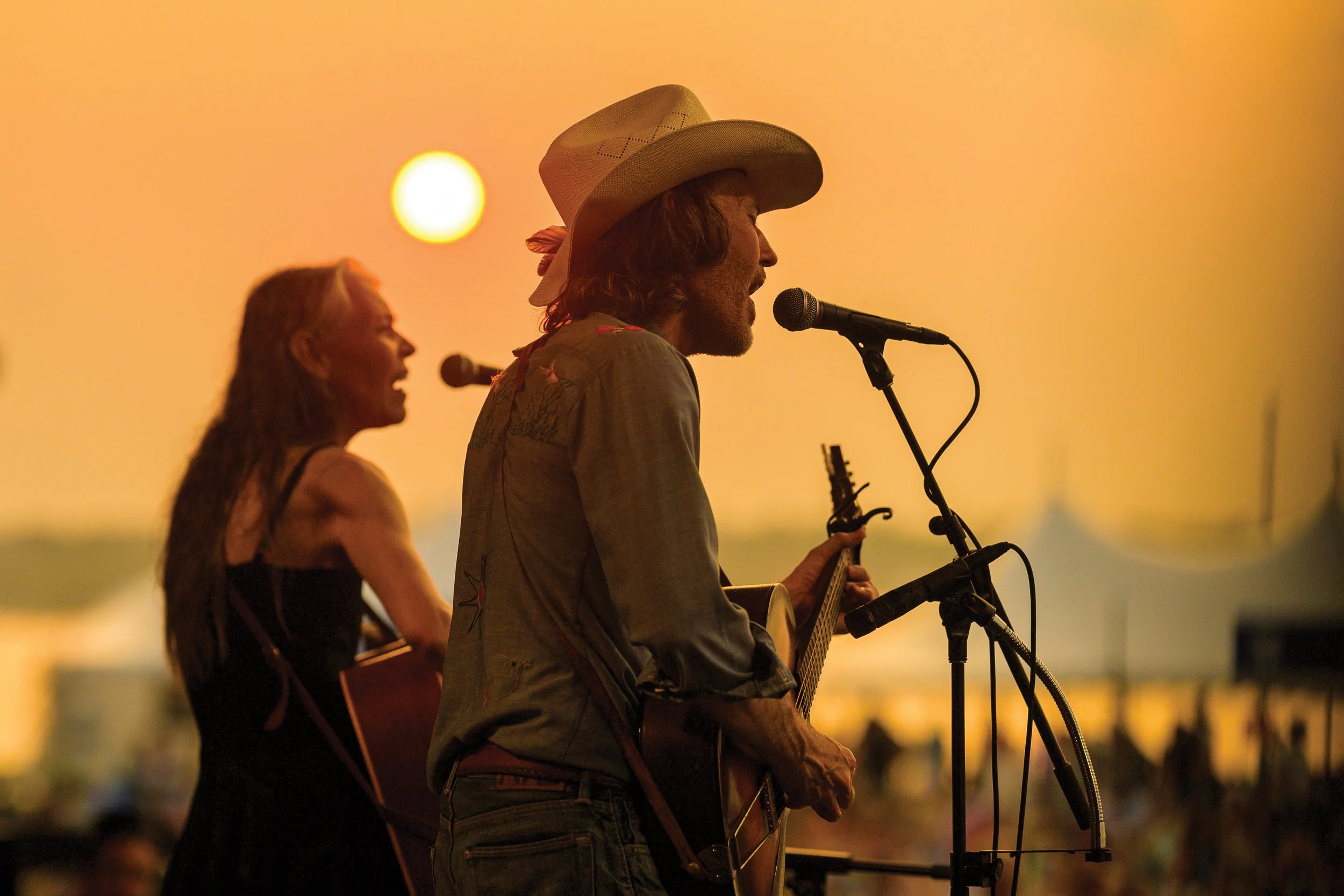
Welch and Rawlings performing on the main stage of Newport Folk Festival in 2024. Photo by Adam Kissick.
They told me that the week they released the first album they’d recorded together, 1996’s Revival, they traveled to play a festival and snuck a much-needed nap before their evening set, only to be awakened by a familiar tune. “We heard these young girls come in and one of them sang ‘Orphan Girl,’” Rawlings remembered. “And we thought, What the heck?!”
“It was one of the craziest experiences ever,” Welch agreed. “Like, how could they possibly know this?” Even if they’d learned the song from Harris’s version, Welch clarified: “It’s still almost magic to me that the songs go out into the world and they do things and they have these lives, lives that we rarely know.”
The success of their compositions also put the autonomy they sought in their own creative lives within reach. Welch and Rawlings once recounted to me the tale of a thwarted, early attempt to fly to Boston for a booking. Since harsh winter weather prevented the plane from landing, they couldn’t perform.
In their telling, that’s when they began to practice the principle of self-sufficiency. Says Welch, “Basically, we decided, ‘It’ll be the two of us, and we’re going to have a box that has our stuff in it, and we’re going to have the car and we’re going to be able to get where we need to get ourselves.’”
When Almo Sounds, the label that released their T Bone Burnett-produced outings Revival and 1998’s Hell Among the Yearlings, went up for sale in 2000, Welch and Rawlings were able to buy back their master recordings and start their own tiny label, Acony Records, thanks to the proceeds from prominent performers recording their songs. From then on, they worked toward making the means of music production, start to finish, their prerogative, buying historic Woodland Studios, which originated as a movie theater in the 1920s and got converted into a recording facility in the ’60s, in time for landmark Nitty Gritty Dirt Band, Neil Young, and Charlie Daniels Band sessions.
Never again did Rawlings and Welch place their projects in the hands of an outside producer. Rawlings has helmed three albums under Welch’s name, three under variations of his, and two credited to the both of them, not to mention their archival demo collections. Rawlings went so far as to set himself up with a delicate, vintage mastering lathe at Woodland and co-found a vinyl pressing plant called Paramount in Colorado, everything required to curate precisely how their records sound.
“It’s fairly vertically integrated,” he quipped.
Welch offered a bit of self-analysis: “I think we’re really stubborn people, and we really don’t like to be stopped by external forces.”
“Or forced to compromise in some way that we don’t like,” Rawlings concurred.
That’s the sort of snappy, intimately synchronized repartee they’ve developed, aligned as they are in their shared vision of writerly and sonic satisfaction.
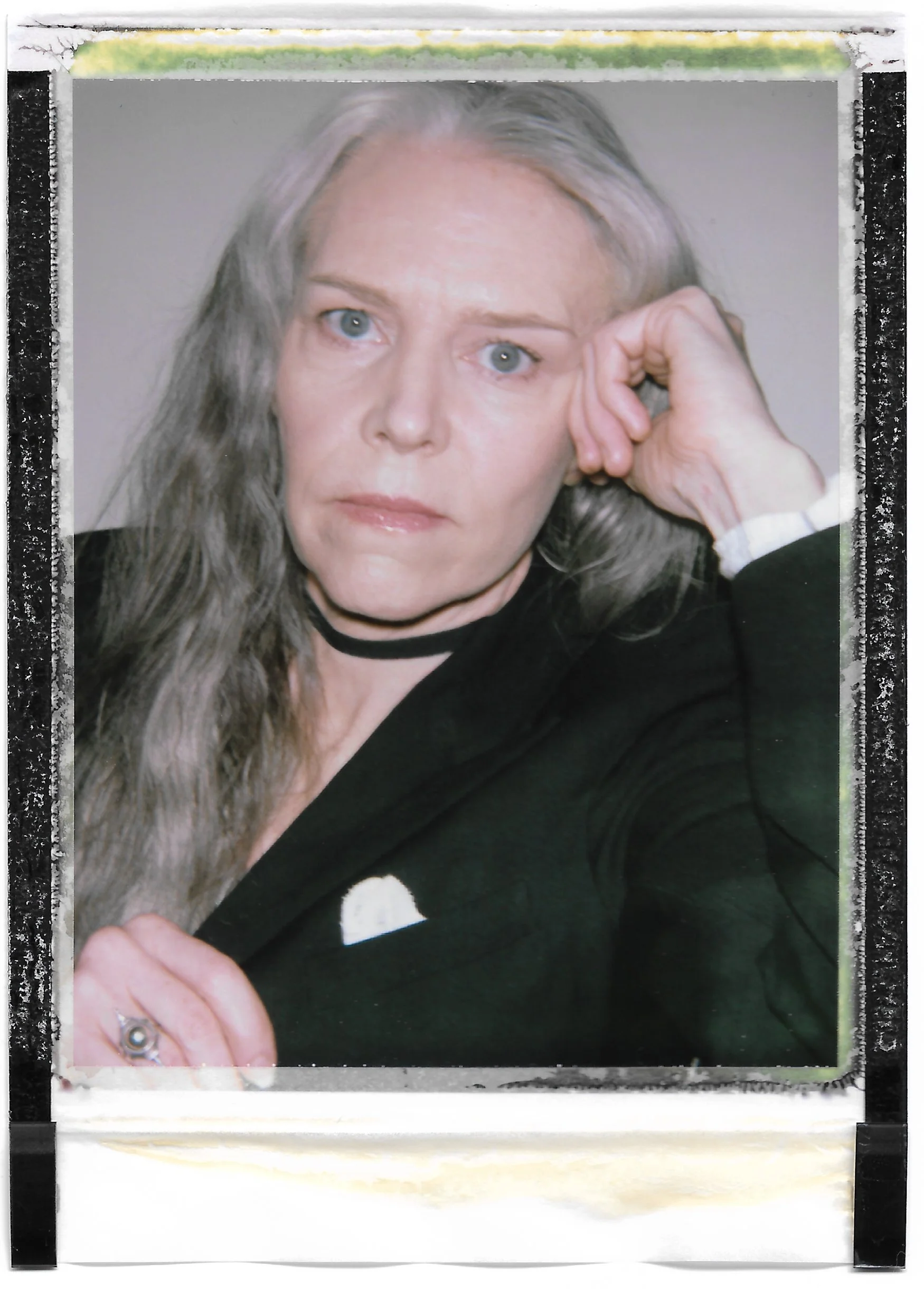
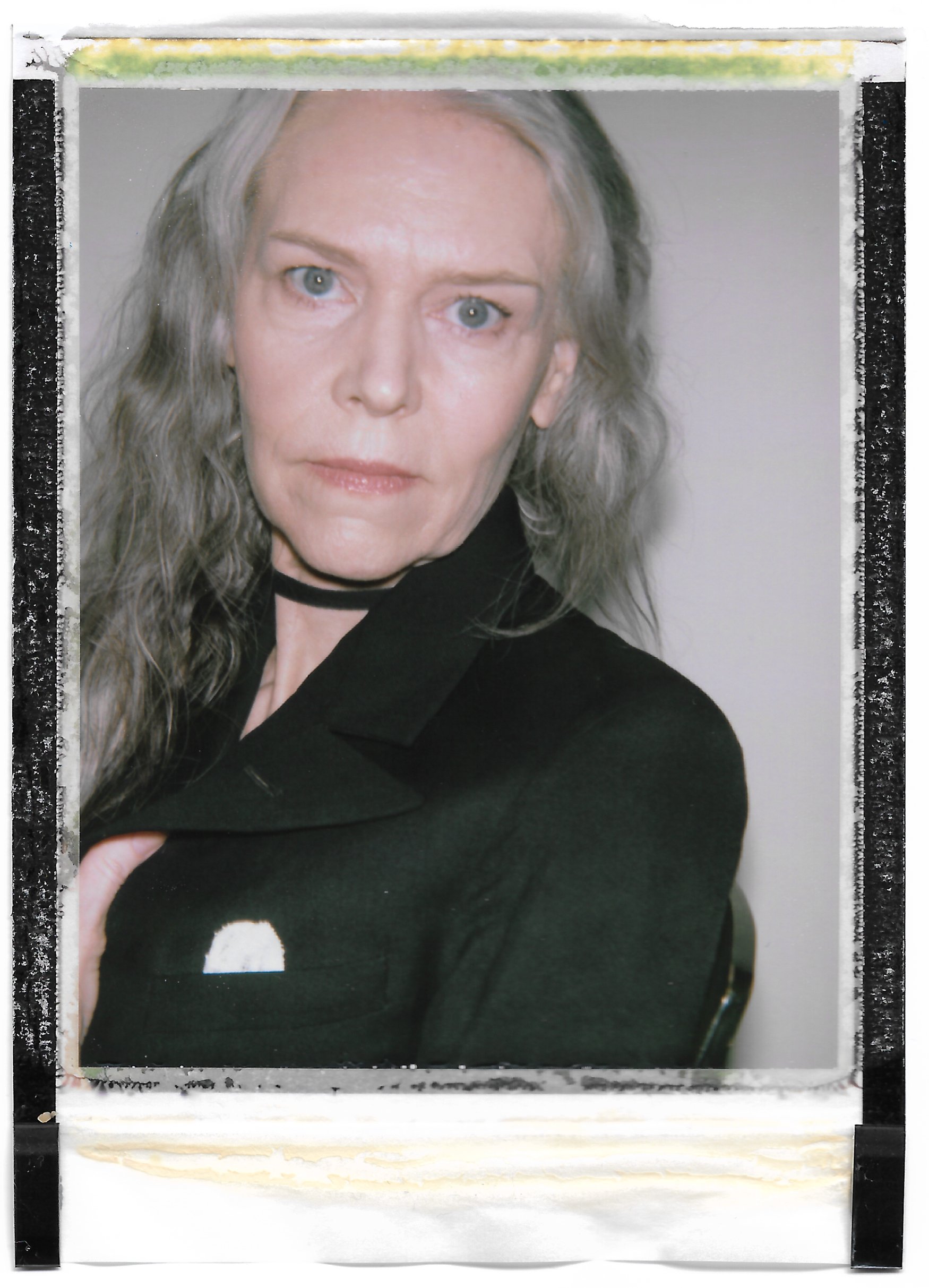
The closest thing to a protest song they’ve come up with to date is 2001’s “Everything Is Free,” the next to last track on Time (The Revelator). Written when illegal downloading was rocking the music industry, it’s a lilting elegy to expectations of fair compensation for musical labor. “Everything is free now, that’s what they say,” Welch sings in muted horror. “Everything I ever done, gonna give it away.”
“I was crying when I wrote that song,” she tells me now. “It really washed over me that we may not be able to be professional musicians anymore. If we weren’t going to get paid for it, we’d have to find another way to make money.”
In the final verse, she slyly lays out a resistance strategy: refusing to participate in the system and reserving her music for private pleasure instead. She threatened, “If there’s something that you want to hear, you can sing it yourself.” That was Welch drawing the line she and Rawlings would hold ever after. She paraphrases the stance as: “You cannot take my music away from me, but you guys don’t get to hear it. I’m always going to be sitting in my living room singing and playing. But I’ll only go do it out there if I can actually be a troubadour and have this be my life and make a living wage.”
In the streaming era, when the bulk of listening happens on Spotify and other platforms that pay musicians a pittance, Welch has ample evidence that the song “still speaks to artists who realize there’s very little hope of them being compensated for their art.” Whole new generations of indie artists have taken up “Everything Is Free” as a critique of capitalist exploitation — Phoebe Bridgers, Courtney Barnett, and Father John Misty among them, not to mention all the TikTok covers accompanied by text like “keep resisting.” Many entries in Welch’s catalog have a modest resoluteness that also inspires people to use them in social media clips responding to timely tragedies.

It pleases Welch when songs prove to be malleable in meaning. “I love that Dave and I kill ourselves working to make things just so,” she says, “and then we put them out there into the world and they can do anything and mean anything to anybody. That’s why we work so hard on them.” But there is one way of interpreting the spirit of their music that bothers her: “If someone were to think that our songs are maudlin or pessimistic, I would be shocked. Because I hear them as strong, quiet. I think if you really digest those narratives, there’s an incredible undercurrent of perseverance. When we’re singing those songs, we think the people are going to make it through.” Lange had a similar perspective on the people she photographed weathering the cruel deprivations of the Depression. “I many times encountered courage,” she told a Smithsonian archivist. “Real courage. Undeniable courage.”
There’s another point upon which Welch is insistent: she and Rawlings haven’t walled their material off in the past by depicting characters in the throes of displacement, hardship, and economic precarity. She throws out hypothetical questions: “Do people not still have children who die tragic early deaths? Of course they do. Do people not still take narcotics to try to ease the pain for a moment? Of course they do.” “One More Dollar,” her song about the inner turmoil of a migrant worker caught between the necessity of toiling for meager but essential pay and a longing to be back with the people they love, has powerful resonance at a time when when ICE raids — blatantly driven by racial profiling and often targeting businesses staffed by immigrants — have created life and death stakes nationwide.
Welch’s singing, initially squarely in the austere Appalachian tradition, has developed a miraculous blend of leanness and litheness over the years. Her recordings of “Dark Turn of Mind,” on 2011’s The Harrow & The Harvest, and “Here Stands a Woman,” on 2024’s Woodland, are fine examples; she applies her reedy instrument to supple slides, bluesy bends, and insinuating phrasing. What comes through in Welch’s vocals is a sense of bearing up beneath the weight of the world.
When I describe this quality, she confirms that she feels it too, and points to the influence of Jerry Garcia’s singing. Recently, she tried to turn a friend on to the Dead, and received a disappointing reaction. “They just sound really tired to me,” the friend commented dismissively. That left Welch feeling at least partially justified: “I said, ‘Well, yes, of course they’re tired. They’re touring musicians. They’re exhausted. But don’t you hear that [Garcia’s] constantly pushing up against that incredible weight?’”
So many folk and country songs pine for the idealized and unchanging old home place and the saintly, nurturing mother figure who waits there. But there’s an equally long tradition of ballads of the rambling, rootless, implicitly male troubadour. The Dead served as colorful embodiments of the latter role, and Nevins, Welch’s college buddy, could see her migrating toward it before she’d formally chosen music as her vocation.
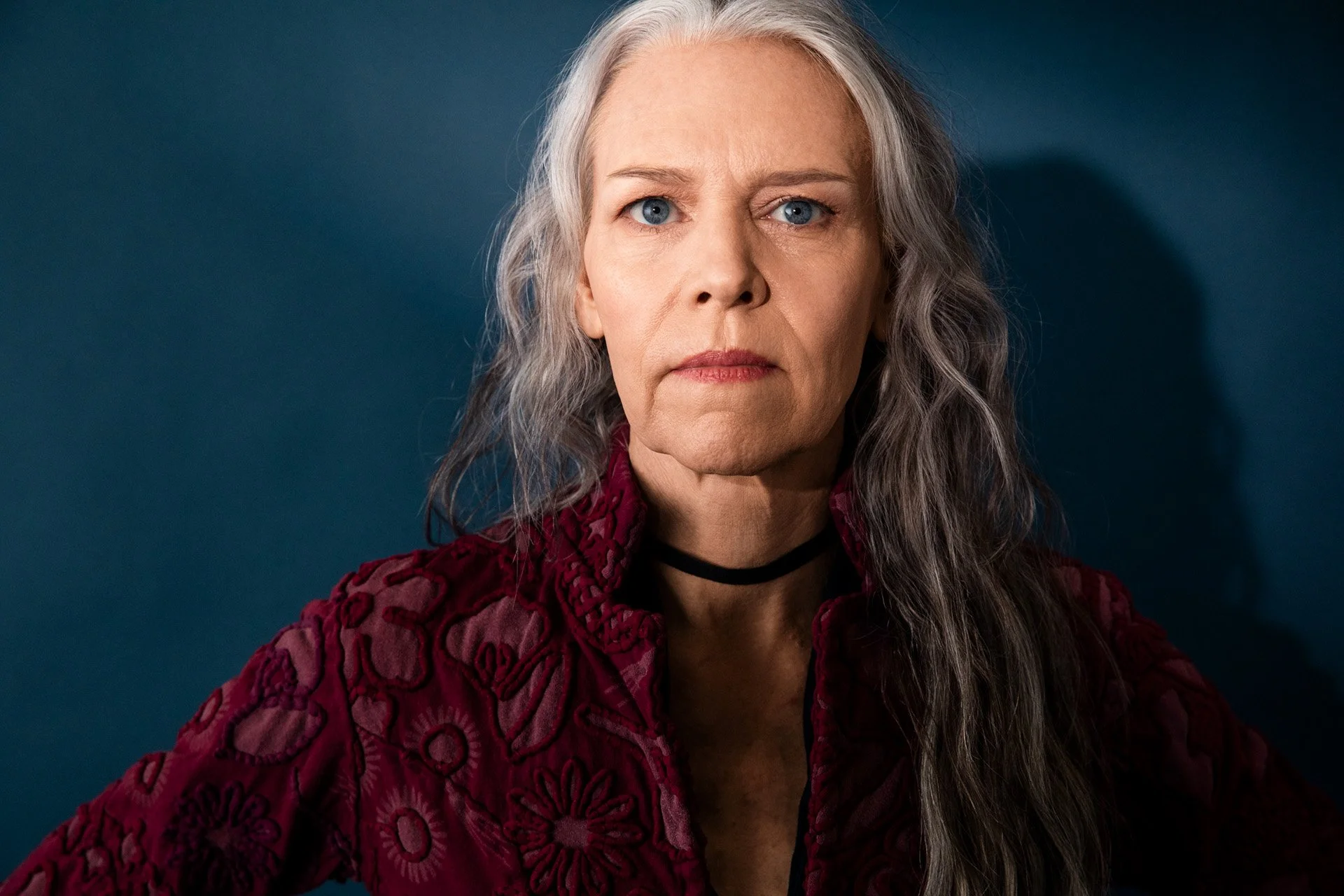
Here, Gillian wears a vintage Alabama Chanin jacket, hand-embroidered in organic cotton.
Welch and Rawlings inhabit scenes and lineages brimming with examples of mixed-gender duos that foreground the real or imagined romantic dynamic between them. Think: Johnny Cash and June Carter Cash; George Jones and Tammy Wynette; Conway Twitty and Loretta Lynn; Buddy and Julie Miller; Tanya and Michael Trotter of The War and Treaty; Norman and Nancy Blake. But that’s not how Rawlings and Welch have presented their own partnership. Outside of “Howdy Howdy,” an endearingly down-to-earth expression of lasting closeness, few numbers in their catalog could be considered love songs. What Welch and Rawlings have always emphasized about their bond is the shared taste, “deep artistic investment,” and truly egalitarian give-and-take at its core.
Seldom do they write characters who stake their lives on stable domesticity. The shambling folk-rock number “Look At Miss Ohio” is more their speed. The song zooms in on a beauty queen resisting pressure from her parents and society at large to settle down and marry. Miss Ohio is well aware of the script for properly performing feminine respectability, but she feels the pull of an unfettered life. And with the pivotal line, “I wanna do right, but not right now,” the matter’s closed.
It’s not a stretch, I suggest, to hear echoes of Welch’s own fortitude in the song. “I am a really stubborn person, and I really don’t like to be told what to do,” she affirms. “That enters into ‘Miss Ohio’ as well, not being confined by any sort of social expectations.”
Even so, Welch has been ruminating on the notion of home quite a bit in recent years, especially after the pandemic lockdown and 2020 Nashville tornado — which ripped the roof from Woodland Studios — reduced her and Rawlings to singing some of their favorite old songs in the living room. And when they eventually returned to touring the West Coast, she was overcome with “the deepest homesickness for Tennessee that I’ve ever felt.”
“I think it’s quite important that Nashville is really the only home I ever chose,” she elaborates. “I was probably born an artist, but I became the artist I am in Tennessee.” And when she hears others fantasize about moving to other countries in order to escape U.S. politics, it’s “hard for me to imagine that,” she says. “I am quite literally rooted here.”

That’s more than a metaphor for Welch these days. “The native flora and fauna here have really seeped into my soul, to the point where I’m a pretty serious native gardener at this point,” she says. “It’s actually one of the things that has probably kept me sane through the last few years.”
At a party a few months ago, she met a number of conservationists, including the head of Tennessee State Parks. “I was so happy that I was able to say to them, ‘Over the last couple months, usually the only good news I hear has been another 200 acres saved and preserved by the Land Trust for Tennessee and another 200 trees planted by the Nashville Tree Conservation Corps.’”
Welch does her part to plant trees herself, but she also admits to struggling on a near daily basis “with the question of if I’m doing enough to make the world a better place.”
What she’s certain about is that “music is a profound force for good. And it makes me really happy that people come to our shows and they have a tremendous sense of community. I think it’s just important to remember the higher aspects of human nature, it’s not hopelessly damaged. It’s not compromised by technology and tragedy.” ◊
Jewly Hight is a music writer based in Nashville. Over the last two decades, she’s contributed to NPR, The New York Times, the Los Angeles Times, Billboard, and countless other outlets; written a book about visionary women’s voices in roots music; contributed essays to other collections; created a podcast that tells the story of the Black-led movement to make space for R&B and hip-hop scenes in Nashville’s live landscape; and appeared as a talking head in numerous other podcasts, shows, and documentaries. She was the inaugural winner of the Chet Flippo Award for Excellence in Country Music Journalism, is currently Senior Music Writer for Nashville Public Radio, and competes in trail ultramarathons all over the Southeast.
Landon Nordeman a photographer living and working in New York City, began his photographic journey working at newspapers in Virginia. Since then, assignments have taken him around the globe covering subjects such as sea turtles, barbecue, Easter, the sheep of New Zealand, the martini, the Oscars, and the World Dog Show in Helsinki. His current series of photographs “Last Night,” which was shown at the Leica Gallery in 2025, will be exhibited at the Museum of the City of New York this coming November, as part of the museum’s photography triennial, New York Now: After Dark.
Styling by Natalie Chanin. Hair & Makeup by Meg Boes. Photos taken at Frist Art Museum in Nashville, Tennessee.
Featured in Issue No. 13