
Americans have always moved away. These days, Lindsey Tramuta writes, record numbers are leaving or planning to leave in search of health care, civil rights, freedoms, even safety. Does exiting the United States mean you’ve given up? Not necessarily.
Words by Lindsey Tramuta
3/14/26
—
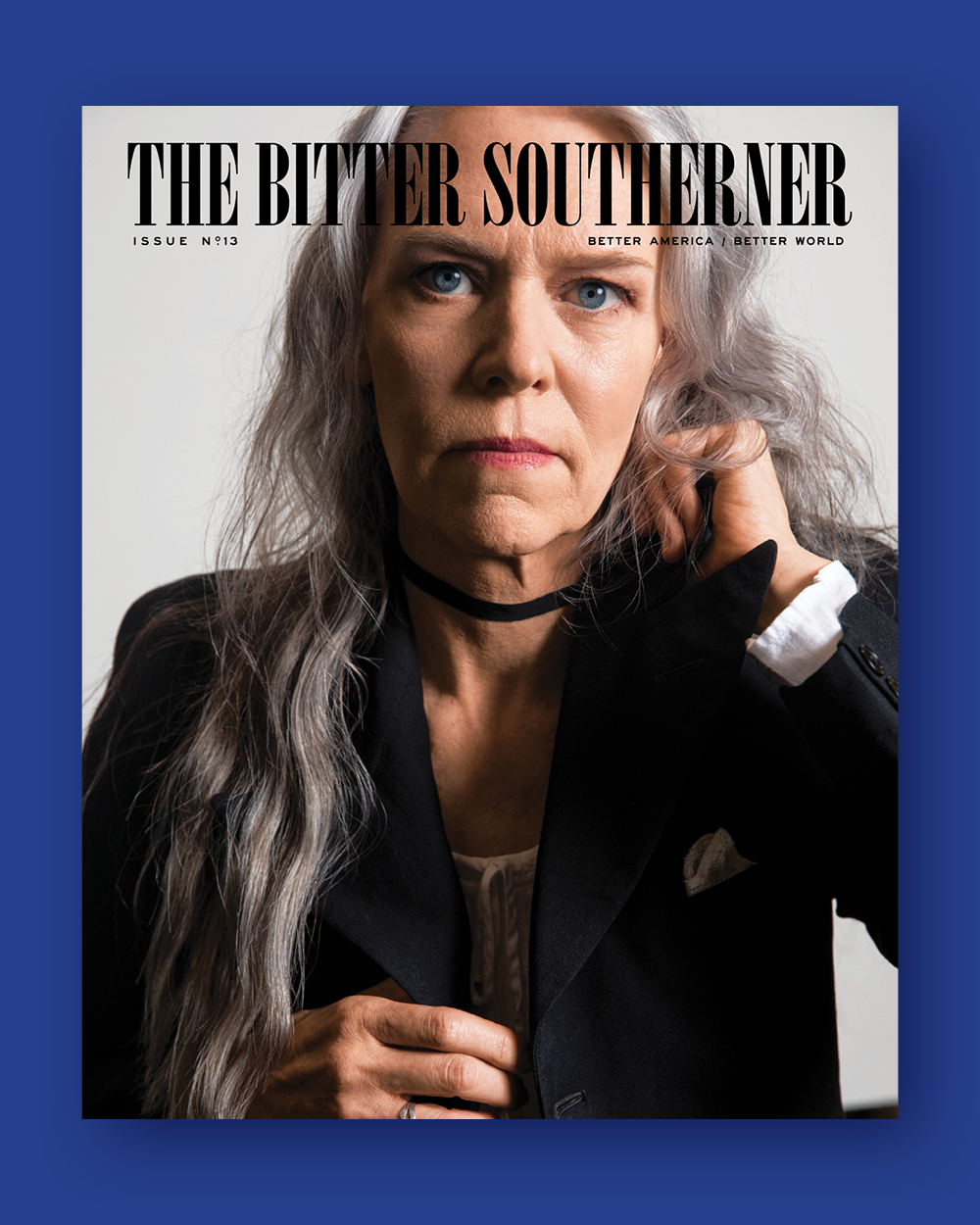
Originally Published in Issue No. 13 of The Bitter Southerner Magazine
Gillian Longworth McGuire left Knoxville at 17, but when she closes her eyes, she can still hear the cicadas in her old backyard. Her mother now lives only a few miles from the house where McGuire grew up. “They’re so loud on a summer night that when I call home, I can hear them through the phone.” That pulsating hum, along with memories of drinking sweet tea on languid summer days and — during return visits to her parents — dropping off her son, now a 29-year-old adult, for camp at the children’s museum where she attended kindergarten, stayed with her through her years working for NGOs in Washington D.C. and Niger. Even when she and her husband moved to Rome, thoughts of Buddy’s bar-b-q and Big Ed’s Pizza materialized without effort — places that are as anchored to her family’s personal food culture as newer favorites like biltong and amatriciana.
When McGuire’s husband retired from his job at the United Nations, after three decades of living overseas, they considered emigrating back. “We looked at houses in the Knoxville neighborhoods near where I went to high school,” she explains. “But after spending strict pandemic lockdowns in our Rome apartment near the Colosseum, we realized that Italy was where our life was.” They bought and began to fix up a house in Venice and are staying put. They may no longer enjoy the shield of diplomatic privilege, finding themselves herded through bureaucratic obstacles and red tape like other immigrants, and they live in a nation and region both led by a far-right government, but the payoff is clear. In Italy, “health care is a constitutional right,” she explains. “I never have to worry that I will lose this little house next to the Arsenale that we have worked so hard to have because one of us gets sick.”
McGuire didn’t leave the United States because she was unhappy. She left because a different life became possible, taking her to unexpected places. But unlike the hot takes proliferating amid a growing surge of interest in moving abroad given the political chaos at home, her story reveals that leaving doesn’t sever belonging.

Americans, among the most geographically scattered people in the world, have a history of leaving, regardless of who occupies the White House. Some departures are driven by necessity, others by longing, ambition, or a sense of adventure.
For most of American history, these moves were inward. Among the most notable periods of relocation was the Great Migration from the Jim Crow South, when some 6 million Black people fled codified racial violence and oppression, settling in western, midwestern, and northeastern cities.
Historian John Hagan, author of Northern Passage: American Vietnam War Resisters in Canada, posits that more than 50,000 American men and women fled to Canada during the Vietnam Era. While many invariably returned home, it remains one of the largest and most significant periods of politically motivated emigration in modern American history.
American elites, however, had been looking further afield for hundreds of years. No sooner had they been freed from British rule than coastal Americans turned their attention to France, where I live. According to the French Museum of Immigration, between 8,000 and 10,000 of these expats, among them merchants, ship captains, and landowners, were already in France by the First Empire in the early 19th century. Advancements in navigation had made it easier to reach this nation, where they were drawn to the quality of life, the reputation for luxury, fashion, and the arts. This continued well into the 20th century. Post WWI, a wave of African Americans, several hundred thousand of whom had fought on French soil during the war, made their way back to France to flee racism pervasive across the United States. It was during this time that the great jazz artists found a welcome audience and a home for their talents, alongside Harlem Renaissance writers and artists. They all came for peace of mind and to build different lives, at least for a time.
In the late 1940s, James Baldwin famously left for Paris and Istanbul to escape the daily violence of racism and homophobia, and to write beyond the chokehold of America’s gaze. Nina Simone fled the United States’ brutality, too, in the 1970s, first to Barbados, then Liberia for two years, Switzerland to put her daughter in school, and finally to France, where she arrived alone and virtually penniless. She had been targeted for her political outspokenness and activism and found safety here, although her demons never left her in true peace.
Then, of course, there were the departures, especially to Paris, that we continue to romanticize. Ernest Hemingway, Gertrude Stein, and the Lost Generation left Prohibition behind for the hedonistic creative community in Paris, where they could pursue their art freely and unlock other parts of their identities. This, too, has always been part of the American story: the belief that reinvention is possible, even far from the homeland. Their sagas — along with modern stories like Frances Mayes’ Under the Tuscan Sun and Elizabeth Gilbert’s Eat Pray Love — have nurtured the well-worn trope of finding oneself abroad.
I landed in Paris in the summer of 2006 as a 20-year-old student of French literature, enamored with the language. This was years into anti-American, anti-war, anti-Bush sentiment in Europe, and I discovered, perhaps later than some, earlier than others, how my homeland was perceived elsewhere. Like many young Americans who go abroad with a sort of arrogant innocence, my understanding of the world and America’s role within it was limited and largely uncritical. Looking back, I can see that my education was anchored to a story of national greatness — I knew there was a litany of moral failings, but by and large, I never doubted the country’s commitment to upholding the founders’ democratic vision.
With every passing year, and with prolonged exposure to other perspectives on the American narrative, the willful ignorance of America’s sins — and the myth of exceptionalism that has helped obscure them — became both more glaring and more intolerable.
In the 20 years I’ve lived in Paris, I’ve lost count of how many times I’ve been asked by other Americans whether I still feel American. But lurking behind such a question is another, one that reveals more about the person asking it: “You’ll move back, though, someday, right?” This has always seemed to me less an inquiry of genuine curiosity than a need for reassurance that they didn’t somehow misinterpret the great narrative of American exceptionalism. It’s OK to leave to observe what else is out there, but to stay away is to abandon ship.
German poet and essayist Hans Magnus Enzensberger left Wesleyan University in 1968 due to the ongoing war in Vietnam, suppression of civil rights, and American meddling in armed struggles all over the globe. In his resignation letter, he warned against “hold[ing] onto the idea that these crises are unfortunate accidents, due to faulty management and lack of understanding: tragical errors on the part of an otherwise peaceful, sane, and well-intentioned world power.” He could have been describing me in 2006.
In a few short years of living abroad, though, the veneer was gone. For the French, the American way of life elicited equal parts disdain and utter fascination. Technological innovation and musical prowess were a source of great envy and admiration. And consumer products and brands, though initially met with resistance, found their place throughout the European landscape. Vitriol toward U.S. foreign policy, however, was widespread and understandable — unilateralism, overt militarization, and regime-change intervention chief among them.
Living abroad and traveling were the most surefire ways for me (for anyone) to get an unfiltered view and a more accurate picture of my home country, as James Baldwin believed was only possible from another place entirely.
The unraveling happened slowly, then all at once. I remember shaking my head as I read the news of the 2007 Virginia Tech shooting in Le Monde at my perch at one of my neighborhood cafés and caught the attention of the middle-aged Parisian next to me. “Comment c’est possible dans un pays aussi puissant que les États-Unis?” How is it possible in a powerful country like the U.S.?” she asked, rhetorically, with genuine dismay. I told her I was a high school student at the time of the Columbine massacre and had befriended an American in Paris who lived through it herself. She looked at me with horror. We sighed together. There would be so many exchanges like that one over the years — over the fractured medical system, over police violence, and an almost pathological refusal to challenge structural racism and classism in America. The problems in my adopted home were unmistakable, too — France clings tightly to its own exceptionalist narrative and has mishandled repairing the damage left by its imperialist past. But there was enough in the country’s cultural and social framework, especially as I struggled with a chronic neurological condition which requires ongoing treatment, that made it the place I wanted to build a life.
“Once you realize that the way you have looked at the world — the way you viewed your country, your history, your life — has been muddled, you begin a process of shedding layers of skin,” wrote Suzy Hansen in Notes on a Foreign Country: An American Abroad in a Post-American World, a book that deeply influenced my process of questioning and unpacking what America is, isn’t, and has always been. “It’s a slow process, you break down, you open up, but you also resist, much like how the body can begin to heal, only to fall back into its sicker state,” Hansen observed.

What I came to understand is that the scaffolding that once held up the promise of American life has been deteriorating for decades.
Millennials and Gen-Xers, the most educated and diverse generations, grew up being told they were the future of American progress, and yet the country has made it harder for them to build stable lives. On the whole, they carry more debt, and barely half are out-earning their parents at age 30. The average American today must earn 70 percent more than six years ago to comfortably afford a median-priced home, which clocks in at $427,844, according to a December 2025 real estate report. The National Bureau of Economic Research suggests we can thank the Great Recession of 2007-2008 for stunting early careers, skyrocketing student loan debt, widening wealth gaps, and making the longstanding American promise of upward mobility an empty one.
Years of wage stagnation mean that working hard no longer guarantees savings, homeownership, family security, or a brighter future — among the very reasons that have historically motivated foreigners to come to America. Now, as many reach the age when earlier generations were buying homes and starting families, they’re facing the worst inflation of their adult lives and the lingering effects of the pandemic. Basic milestones feel out of reach and, as Derek Thompson and Ezra Klein argue in their 2025 book, Abundance, the building blocks of life — housing, healthcare, groceries, transportation — are leaning that way, too.
And of course, the United States is the only industrialized country without some form of universal healthcare. Even after years of Affordable Care Act expansion, roughly 8 percent of Americans (nearly 27 million people) were uninsured in 2024. That figure is predicted to rise this year as Republicans roll back ACA supports, including enhanced subsidies. Worst of all, despite spending the most on health care, the U.S. ranks last among wealthy nations on numerous health outcome measures. American well-being, according to the 2026 Global Social Progress Index, lags behind former Communist Balkan countries and all of its G7 peers. The decline in quality of life is a distinctly bipartisan problem that no leader has addressed.
If we’re being clear-eyed about it, America has, historically, been brutal to many of its citizens. For some, that treatment is far more recent and unfamiliar, inspiring the desire to find happiness, safety, and security elsewhere. And while it’s tempting to believe this sense of urgency can be wholly blamed on Donald Trump, he was, in reality, an accelerant to a necrotic system.
When the middle class began to crack in the years following the 2007 economic collapse, the old American instinct to migrate in search of opportunity shifted. If leaving was something Americans did domestically, the horizon shifted further afield.

While there is no firm or reliable data on the number of Americans abroad (the U.S. government only loosely tracks them), the Association of Americans Resident Overseas estimates that 5.5 million of us are scattered across the world. The reasons for this are nuanced, but they reflect a cultural reversal of an old narrative in which America was the promised land of economic opportunity, social mobility, and in many cases, safety from persecution, violence, and even natural disasters. Fueling the migration reverie today are not merely baseline grievances but fundamental impediments to those promises — to a fulfilling life and to living out the American Dream as it was marketed to us, however mythological it may always have been. It sees people moving to the very parts of the world their ancestors once left behind.
A recent Gallup poll found that 40 percent of women aged 15 to 44 would leave the U.S. if they could — a figure that has quadrupled in the last decade. This slice of the population also has the lowest confidence in American institutions.
That frustration is inspiring many to take action. Ireland’s Central Statistics Office reported a 96 percent jump in American emigration between April 2024 and April 2025. France has likewise reported an increase in long-stay visa requests from Americans, and in the United Kingdom, 6,618 U.S. citizens applied for British citizenship in the 12 months leading up to March 2025 — the highest number since records began in 2004. Germany, which allows descendants of Nazi-era victims to apply for and reclaim citizenship, processed 48 percent more applications from U.S. citizens at consulates across the U.S. in 2025 after Trump’s inauguration than in 2024.
Firms that help people obtain second passports and residency permits confirm the trend. Basil Mohr-Elzeki of Henley & Partners has said Americans went from about 4 percent of the firm’s clients in 2018 to roughly 40 percent in 2025.
Jen Barnett and her partner, Brett Andrews, moved to Mérida in Mexico’s Yucatán state within the year following Trump’s first term. Together, they had drawn up a list of essential values and criteria they wanted to find in the country where they would settle — a list that would eventually inform the creation of their company, Expatsi. Today, the company helps American citizens — many of them people of color, living with disabilities, or LGBTQ+ — select the most suitable destination to emigrate. “Our site exploded after Roe v. Wade was overturned,” Barnett told the publication Le Devoir. Women want to start families in places where their children’s reproductive rights will be respected. “It’s torture for them,” she said.
But it isn’t only the burnt-out and disillusioned who are researching a big move. Scientists, professors, and researchers across once-illustrious American institutions have watched their work politicized or quashed, providing advantageous grist to nations like Canada, France, and Ireland, which have publicly welcomed them through academic pipelines and talent visas — 80 years after the U.S. made a concerted effort to welcome exiled European researchers after World War II.

In the first year of the pandemic, I observed the great American crash out from afar: the wake-up call that millions didn’t need to die from Covid, that they were trapped in a capitalistic hamster wheel, and that an almost religious devotion to individualism over the common good was making everyone miserable. “There are so many TikToks of Americans living abroad who have realized how toxic work culture/capitalism is, and I wouldn’t be surprised if this is how a new generation decides to leave,” tweeted the feminist journalist Jessica Valenti in 2022. I saved it in a bet with myself: Her premonition would come to pass.
Around the same time, I started fielding more and more inquiries from Americans about visas to France and read stories of Americans giving up everything to leave. Abbigail Nguyen Rosewood, a novelist born in Vietnam who immigrated to the U.S. with her family, wrote about returning home to pursue the Vietnamese Dream and to be free of anti-Asian hate. The one-time Congressional-hopeful and anti-Trump resister Laura Moser left Houston for her grandfather’s former neighborhood in Berlin, the source of her Jewish family’s trauma. And I read about Dr. Judy Melinek, an esteemed forensic pathologist, who moved with her family from California to New Zealand during the pandemic to be part of a culture that respects and prioritizes science. In Paris, I befriended a photographer and former Marine who, like many Black Americans before him, saw the city as a refuge where he and his husband could create and build a future without fear.
Last fall, I discovered that Jennifer Lunden, whose medical memoir-meets-reportage American Breakdown examined the impact of the industrial revolution and late-stage capitalism on the nation’s health outcomes, left the U.S. for France due to chronic illness. As a dual U.S.-Canadian citizen, she could have moved north. “Canada just feels too close — geographically and psychologically. When Donald Trump threatened to make Canada the 51st state, most Americans, including me, initially dismissed it as typical Trump bluster,” she wrote in her newsletter. “But the Canadians didn’t, and conversations with several Canadian friends helped me understand the threat is real.” Finally, she concluded with the most human truth of all: if she had to uproot her life and leave everything she knew and loved behind, she at least wanted an adventure. “It helped temper the grief.”
I’ve become obsessed with stories of American migration and its implications, so much so that for the last 16 months, I’ve published interviews in my own newsletter, The New Paris Dispatch, with Americans who have settled in France (though I don’t plan to stop there). Most came for a culture that prioritizes living, as Gertrude Stein wrote of France in 1940. “The reason why all of us naturally began to live in France is because France has scientific methods, machines, and electricity, but does not really believe that these things have anything to do with the real business of living. Life is tradition and human nature.” At least half told me they had only enough money to get them across the ocean and cover a month or two’s living expenses, at best.
Still, leaving does require some form of privilege. You have to have a passport, enough money for a plane ticket, contacts on the other side, the resources to hire an immigration lawyer, and, in many cases, a second nationality that can serve as a plan B. The ability to become disillusioned from a “safe” distance, as many of us have, is itself a type of privilege.
What’s different in the last two years is the ease with which Americans can find writers, historians, and good Samaritans sharing their tips and hard truths online for planning to move. An entirely new genre has emerged that’s part survival manual, part dispatch from beyond a deteriorating state. Those resources aside, the process is anything but easy and frictionless. Still, there is a sense of possibility.
And none of this is done without enduring persistent criticism that those with means have a responsibility to stay and fight, particularly during turmoil. It is a fair point, and one that many of the people I’ve spoken to over the last several years carry with them as a form of privilege guilt. But the premise also assumes that the only two options are to stay and resist or leave and disengage. The Americans I’ve interviewed over the years haven’t stopped caring. The distance has brought clarity about what they’re fighting for and against. They vote absentee and volunteer to get other Americans to vote; they donate; and they organize in diasporic communities. What Americans considering leaving are often wrestling with isn’t whether to fight but how to sustain it without being crushed by it. What if you’re drowning in medical debt? How easy is it to advocate for others if your own rights are being stripped away? And is it possible to be part of a resistance if you’re burnt out or sick?
Once they’ve chosen to seek stability elsewhere, they must also confront the reality that there is no safe harbor from rocketing populism in many parts of the world. There is no utopia where the ills of your home country get blocked at the border, unreplaced by another nation’s struggles and existential threats. In many cases, American challenges — business-destroying tariffs, threats to NATO allies, unregulated tech, and various risks to national security — affect nations across the globe. This is a crucial truth that all Americans dreaming of escape or in the midst of leaving must accept with their whole heart, or live with disappointment.
It is something Kelso Wyeth, a former artist liaison for Gagosian in New York and current freelance creative consultant, born and raised in Chattanooga, has weighed heavily with her husband as they’ve taken the administrative steps to move to Antwerp, Belgium. “I love the American South deeply and am proud to know its complex cultural riches [I would say I often feel more Southern than I feel American], but I never felt like I recognized myself fully in the U.S. and the only deep homesickness I have felt has been for Antwerp.” They are moving more to contribute to a thriving art and creative community they have come to know and love over 15 years of visits, and less to flee political chaos, though she realizes they may be trading one form of right-wing dominance for another. Last year, Belgium elected its first Flemish nationalist prime minister, and extremists have threatened to start a racial civil war.
“I always come back to the hope that structural differences around social support can make a measurable difference in quality of life, even if the power of the far right increases,” Wyeth told me. “Whereas in the U.S. we see so many instances of private support picking up the tab on what should be provided by the state, many conservatives in Europe still believe in the state’s obligation to provide social protections.”
Everyone’s situation is unique when it comes to self-exile. But there is a common thread, believes the historian Ruth Ben-Ghiat. “When you exit your homeland, you enter into a state of waiting. Waiting for things to get better; waiting for the tyrant to die or, if elections still exist, be voted out; waiting for freedom to arrive so you can return to beloved places and people.” Even if only to visit.
The question wrapped up in all of this isn’t where to go to live in total harmony but where to go to live with dignity, for as long as we can. Maybe one day, the pendulum will swing, and the United States will become the place it keeps promising to be. Maybe some of us will make our way home. Until then, we wait for a future we can’t quite imagine and aren’t sure we believe in. ◊
A Paris-based bilingual culture and travel journalist, podcaster, and author, Lindsey Tramuta has contributed to the New York Times, Bloomberg, Condé Nast Traveler, and other international publications. She is the bestselling author of The New Paris, The New Parisienne, and most recently, The Eater Guide to Paris. She writes and publishes the newsletter The New Paris Dispatch.
Eagle photo by Don Mennig