
Words by Ben E. Mims
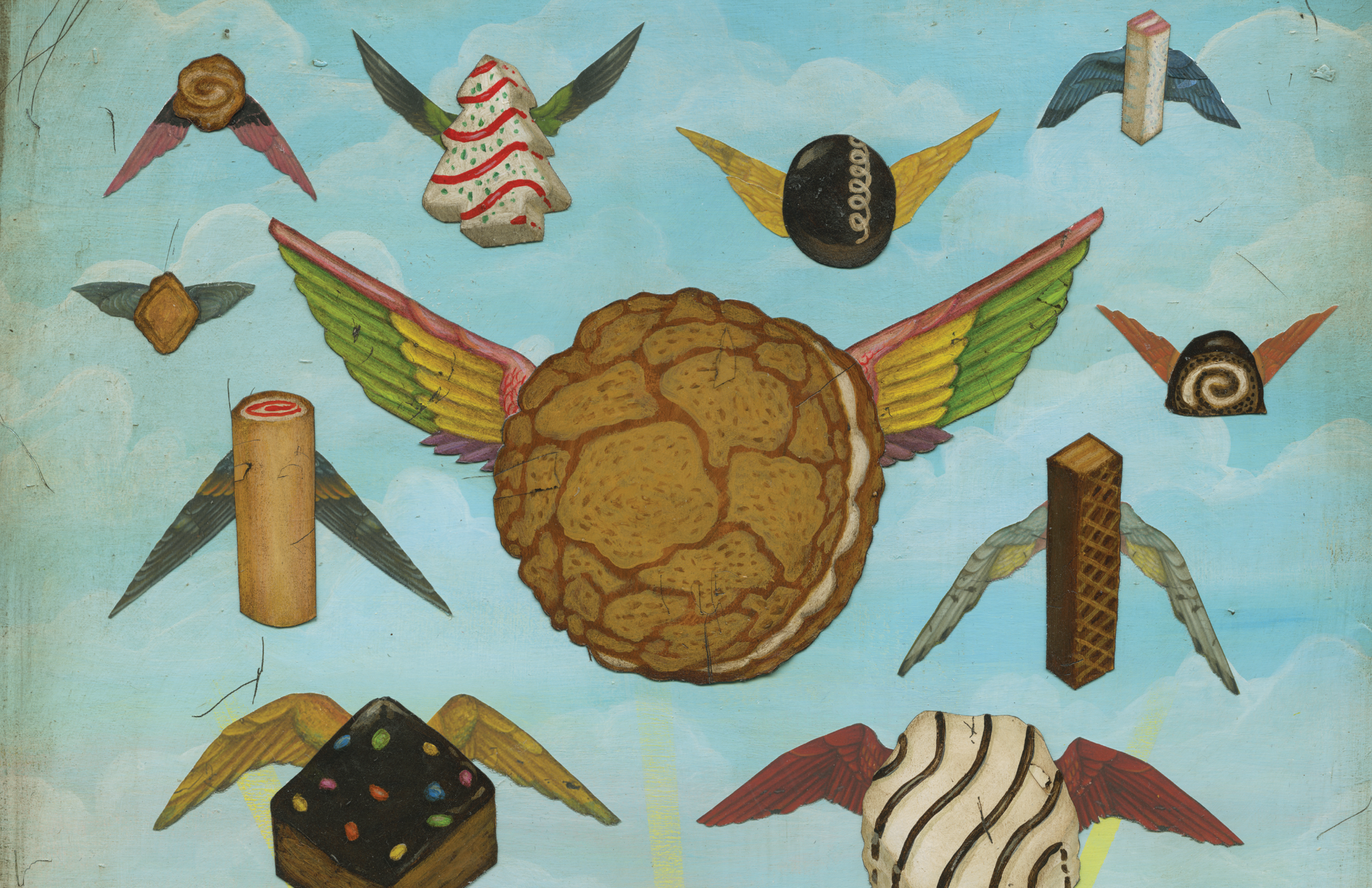
Illustration by Jason Holley
April 28, 2026
—
Originally Published in Issue No. 13 of The Bitter Southerner Magazine
What is going on here? Where are we? … my friends and I wondered aloud as we drove around what Google Maps told us was the Little Debbie Park in Collegedale, Tennessee. All we could see was a brand-new but vacant entertainment pavilion with arbors stretching out in several directions over concrete sidewalks that led right back to themselves. Only once we parked along the road — which also led to a retirement community down the street — and walked around a bit did we realize, Oh, OK. Maybe we’re here.
The first clue was what looked to be a light brown UFO made for mice wedged into the ground. After walking closer, we noticed a white band around its equator. “This must be the Oatmeal Creme Pie!” Indeed, it was, but one painted and crafted with so much realistic detail that it looked like a natural formation, carved eerily over millennia from the Tennessee limestone. I swiveled my head to the right, and there sat two crisscrossing planks, one level with the ground and the second tilted over it and aiming for the horizon. “Oooh! Nutty Buddy bars!” I screamed. I raced over to the bars, hopped on one and walked across it like I was on a balance beam. After six little steps, I jumped off. That’s it. Fun’s over.
There was a tilted Cosmic Brownie climbing wall, too, with chunky protrusions standing in as both the sprinkles and the wall’s grip holds. But after spotting that, we looked around and found … not much else. Each treat-cum-play structure felt like it was a football field’s length away from the other. The Christmas Tree Cake that stood at the entrance to the park was undergoing renovations, perhaps, since it was clumsily covered in a tarp, but no signage indicated what exactly had happened to it.
The best/scariest sight of all was a statue of Miss Debra herself — cast in bronze. No doubt it had been crafted with attention to realism, but her smile sneered like a grimace, while her innocent eyes stared down with the emptiness of a great white shark’s. They peered upon the tray of Swiss Rolls she held in her hands. We all shuddered.
I later learned that the snack cake playground is part of a 10-acre park that includes walking trails, an arboretum, and water features. Charming for the locals, I’m sure, but no Pigeon Forge. Not even Walley World.
So we got back in the car and solemnly drove down the road to the Little Debbie store.

I had driven from Atlanta to my friends’ house abutting the Cherokee National Forest just east of Ocoee the day prior. I was worn down from visiting with my 14 year-old niece and her preteen brother and sister (Love them!) and was ready to talk about adult things with people my own age. After admiring the scenery on a short hike through the woods and a driving tour up Chilhowee Mountain, we brainstormed what to do while I was visiting. My hosts insisted there was not much else nearby that didn’t involve more mountain trails, and, as I hate hiking, I quickly set about brainstorming alternative excursions. I had done some research (i.e. watched a TikTok video two days before) and had become aware of Little Debbie Park and a store selling all Little Debbie treats across the road. As someone who idolizes Christmas Tree Cakes, once I saw a statue of said confection in the TikTok, I knew I had to see it in real life.
The store, bizarrely, isn’t called the “Little Debbie Store” as it should be, but rather, McKee Foods Bakery Store, named for the family that owns Little Debbie.
The McKees own three other brands with their own signature sweets: Sunbelt Bakery (chewy and soft-baked breakfast bars), Drake’s (Boston Creme Yodels and Devil Dogs), and Fieldstone Bakery (Donut Sticks and Honey Buns). But seemingly their entire store is Little Debbie products: Clearly they’ve figured out which brand keeps the lights turned on. From the outside, you’d think you were walking into a cash checking business, but without the fun painted window graffiti. As my friends and I stood in front of its dark glass doors, praying they’d open to a snack cake store and not a dungeon, I thought: Why is this store not advertised as ‘THE Little Debbie Store?’ It would be the biggest draw in the country!
As we walked in, I spied dozens of boxes of every imaginable Little Debbie treat — both seasonal and not — overflowing shelves that filled the center of the room. The perimeter was lined with merch: t-shirts, baseball caps, blankets, any swag you could possibly desire. I immediately felt the urge to run at the boxes of Little Debbie cakes (Why? They weren’t going anywhere.) in that uniquely American way where we see something sparkly and fun and we just have to have it NOW. I felt like I was on Supermarket Sweep, darting from side to side in each aisle looking for my favorites — Star Crunch! Nutty Buddies! Oatmeal Creme Pies! Oh my god, the Christmas Tree Cakes! In the middle of APRIL? Ahhh!!!!!
I grabbed all the boxes I could carry, more than I could ever eat in months, and then ran to the end of the store to look through the souvenirs. Was this heaven? I grew up with a “discount cereal dad,” so we were never allowed treats that were remotely as unhealthy or pricey as snack cakes. Naturally, like all kids deprived of something in childhood, I am obsessed with having it as an adult. I felt like I was on cocaine, fiendishly bouncing from shiny thing to shiny thing to capture them before they vanished in front of my eyes. Having such a wealth of Little Debbie delights at my disposal was too good to be true.
My friends and I left carrying so many boxes of cakes and shirts and hats that the store’s tissue-paper thin plastic bags nearly ripped open under the weight of it all. We drove back to their house and proceeded to sit in the living room and tear open boxes of each variety to sample them all. Familiar favorites were still just as good as we remembered from childhood, but the newer ones — particularly a lemon-flavored cake for Mother’s Day (???) — tasted artificial (as if it was ever going to taste like natural lemon).
But while we were sitting around getting a sugar high it hit me: the reason I was offended by the forlorn way the park and the outside of the store looked was because Little Debbie is to America what Parmigiano-Reggiano is to Italy or Champagne is to France — this is our regional specialty. Labels such as AOC (Appellation d’Origine Contrôlée) in France or DOP (Denominazione di Origine Protetta) in Italy are given to European foods with the historical and cultural value of being made in a specific place (i.e. terroir) in a traditional way that signals a certain authenticity and quality; think balsamic vinegar in Modena, the namesake blue cheese of Roquefort-sur-Soulzon, and calvados in Normandy. Why aren’t we making a bigger deal of Little Debbie? Posting signs for miles around, stamping official insignia on the packages, and making the local high school mascot a Zebra Cake?
Now, I know Little Debbie cakes may not seem a worthy comparison to the high-falutin’ foods of Europe, but if you consider the history of food in the United States, the only thing that we didn’t borrow from someone else — Indigenous, African, European, or otherwise — was the convenience foods introduced after World War II. Canned meat products, frozen TV dinners, boxed oatmeal and cereals, and virtually every convenience food in American grocery stores are, I would argue, what constitutes the most authentic “American” foods, at least as to what distinguishes our food traditions from those of other nations.
Is there anything about Little Debbie that is particularly “Tennesseean” or Southern outside of its physical location? Not really. Aside from the Pecan Spinwheels, most of the other cakes are traditional, generic Americana flavors (i.e. chocolate, vanilla, “creme,” and, well, sugar). But what the cakes say about the heartland of America is that our special regional delights often can’t be found on rolling hills, mountain vistas, or fertile valleys. Instead, they’re located in the most American of inventions — off freeways and in strip malls or in brick-clad buildings that look like Greek-revival nursing homes. They’re treats that offer some sweet respite among the endless concrete vistas and neon lights of fast food chains that have come to signify, for better or worse, the United States.
These snack cakes are all about function — delivering handheld, sweet nostalgia — the form surrounding them is irrelevant. Even in the varieties that are meant to be fanciful and eccentric — there is humility. Decorations are minimal, with the Cosmic Brownie’s sparse rainbow of sprinkles being the most flashy thing about any of them. They connote a homespun treat: neat, tiny, and just the right amount of indulgence. In the face of today’s hockey puck-sized cookies or cupcakes with syringes and shots sticking out of their frostings, these simple snack cakes are a reminder of how such treats should be enjoyed, with the abandon that lasts only as long as it takes to peel away the plastic wrapper.
And while this efficiency of design may be their calling card, it also represents nostalgia for a time before every manufactured food was engineered for maximum Instagram likes and influencer reviews. This makes me think of them fondly, and not just as something to pick up in a grocery store. When you visit anything’s place of origin, you get the context for why it exists. You hear the stories of the founders and you see the culture that influenced or birthed it. The Oatmeal Creme Pie was created by baker O.D. McKee in the 1930s as a 5-cent Depression Era treat. It makes you look at these convenience foods in a kinder light (i.e. forgive a few additives and food dyes). You realize that, instead of a calorie-laden sugar-bomb, when it is consumed as the occasional treat that it was when the Little Debbie mascot debuted in 1960, it’s just a tiny piece of cake to put a smile on your face. ◊
The author of Crumbs: Cookies and Sweets from Around the World and a James Beard Award-nominated food writer, Ben E. Mims has worked as a food columnist, editor, and recipe developer for major media outlets including the Los Angeles Times, Food & Wine, Saveur, Lucky Peach, Food Network Magazine, and BuzzFeed’s Tasty. He has written three cookbooks, and his work has appeared in the 2012 edition of the annual anthology Best Food Writing.
Jason Holley is a Texas born illustrator, educator, and exhibiting artist living in Los Angeles. His illustration career spans 25 years and his is widely recognized for his influence and contribution to the field. He has received awards from: SPD, AIGA, American Illustration, Society of Illustrators, BMG, D&AD, Communication Arts, and others. He served on the board of directors for Icon8 and Icon9. He has been a member of the faculty at Art Center Colege of Design since 1997 where he is an associate professor.