

Her journey from food to film, and to food in film.
Words by Fabienne Toback
October 7, 2026
—
Originally published in Issue No. 14 of The Bitter Southerner Magazine
It’s 2019, and we’ve been shooting in Benin, West Africa, for the past 10 days. We’ve almost finished filming episode one for the documentary series High on the Hog for Netflix — a groundbreaking two-season project that chronicles the history of Black Americans through the lens of food. We’re all crammed into the smallest of elevators, about the size of an extra-large phone booth. Suddenly, I realize that this project represents my journey from food to film, and to food in film — a full circle. Tired, sweaty, exhausted, we’re all smiling. I take a photograph and savor the moment.

I’m four or five years old. Crown Heights, Brooklyn, New York, this is where I was born, my neighborhood just off of Eastern Parkway and Washington Avenue. It’s moving day, the new apartment is large and empty, and I’m pointing out our respective bedrooms — and this is Daddy’s bedroom — unaware that my father is not a part of this move. The Brooklyn Botanic Garden is my backyard, and around the corner is the Brooklyn Museum, where “there’s cool stuff to look at.” I will live here alone with my mother, she’s white and Swiss, an immigrant, I know this by the wavy green lines of the Green Card in her wallet. I see it every so often when she takes it out, like today, to buy one of my favorite treats, a Jamaican meat patty. I’ve learned the hard way not to bite into it right away, and I slowly nibble around the fork-tined, orangy-tinged pastry, allowing the lava-hot interior to cool so I can truly enjoy the delicious, spicy meat-filled delight.
My familial heritage is North Carolinian and Barbadian on my father’s side, and Swiss. I hold three identities and two nationalities. Brooklyn held a mysterious sway over me, as each neighborhood felt like a different world — vast and wild. There were always new places, people, and foods to discover. The yearly West Indian Day Parade marched practically past my window, and I can still bring to mind the pounded plantain chips and the melody of the steel drums. It turned Brooklyn into an imagined tropical paradise. This is my New York, loud, colorful, and rough, sweaty and fragrant, the America that I knew, the America I loved.
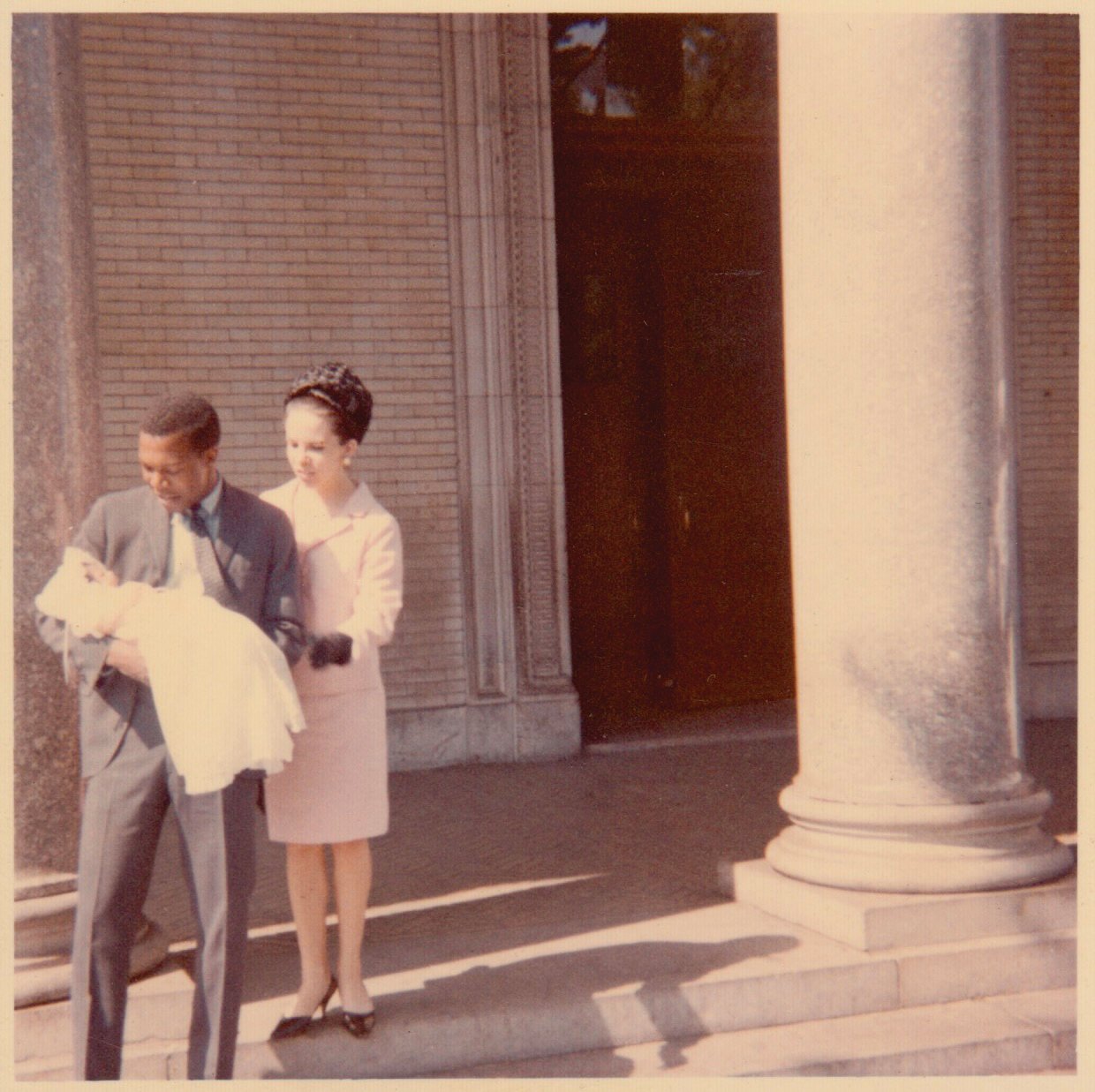
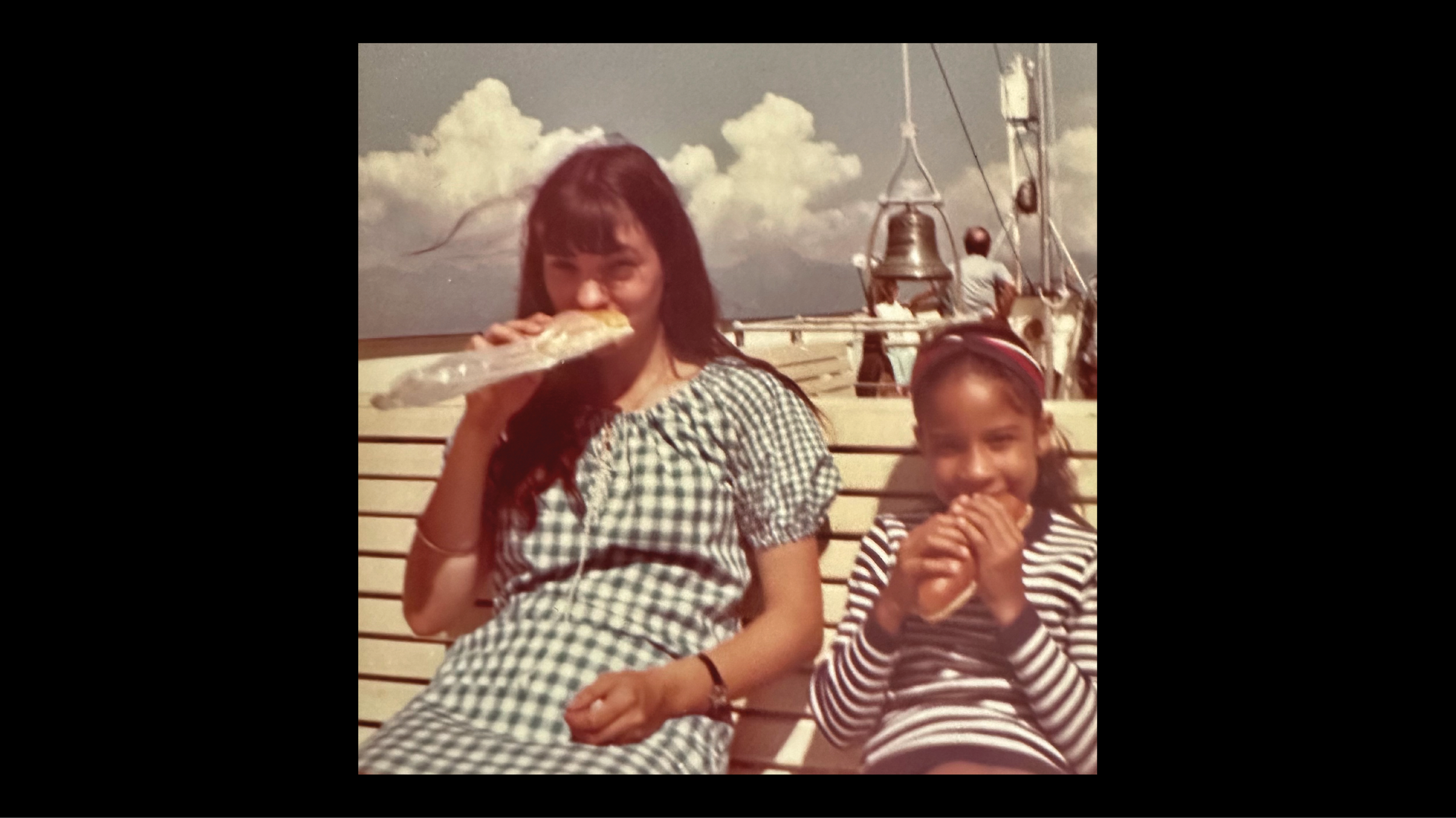
(Top) Fabienne (right) in striped shirt on a summer boat ride in Switzerland, eating either a jambon-beurre or Cenovis sandwich. (Above) Fabienne’s christening with her parents, Dennis and Véronique.
I went to an Episcopal school in Cobble Hill, where I felt a bit of the odd gal out — my parents were divorced, and we never went to church. My second-grade teacher, Mrs. Biggs, could split an apple in two with her firm hands. She projected a feminine strength that I admired, and to this day, I attempt her feat on occasion. Every so often, my mother would bake bread, which she rarely did because it triggered her migraines. One day my lunch was packed on slices of her parsley-rolled loaf, slathered with mustard and piled with sliced tongue. “Ewww! What is that?” squealed my classmates as they mercilessly teased me about the weird-looking meat. I choked down hot tears as I silently wadded the aluminum foil into a tight ball and tossed it in the garbage — rather go hungry than endure the shame. From then on, I yearned for peanut butter and jelly on plain white bread.
In third grade, a school bus would drop me off at my grandmother’s house, a brownstone on a treelined street not far from our home in Crown Heights. This was long before racial tensions rose between the Hasidic Jews and Black Brooklynites, who resided in the same soup of marginalized minorities and coexisted in fragile yet separate communities. At the time, my grandmother was still working in the administration offices of Kings County Hospital. Her sister, my Auntie, lived on the first level, and for the life of me, I can’t recall her proper first name.
Afternoons were filled with quiet reading and homework. I would nestle into the upstairs bay window and occasionally catch sight of a young Hasidic boy from across the way. He would peek out from behind his curtains, as curious about me as I was about him. It was also the year I read Anne Frank’s The Diary of a Young Girl, and I imagined parallels between them. At times, I thought about going to the backyard fence that separated our two worlds. Instead, we silently stared at each other, each unknown to the other. Ever since, this memory occasionally resurfaces. I wonder if the little boy ever thought about the little brown girl from across the way? Was he as curious about the life I led, and the foods I ate, as I was about his — from the succulent pastrami at Katz’s Delicatessen to Yonah Schimmel knishes, smoked whitefish, borscht, and matzoh ball soup? A certain empathy would well up inside me as I imagined tasting a part of his life, a life that I would never step into.

In the middle of fourth grade, we moved to the West Village. Our apartment was on Seventh Avenue and 12th Street, across the street from the Maritime Building, and the New Jersey skyline completed my view. My new school was around the corner. I loved it. Greenwich Village at the time was arty and eclectic; my classmates were from all over the world, and most were first-generation Americans. Here, I felt I truly belonged. My neighborhood offered freedom that was so new to me. I walked to and from school every day, and let myself in with the key on a shoelace that dangled around my neck — the symbol of independence, on display. Every Friday, my mother would give me a dollar, which would buy me a slice of pizza and a Coke at the impossibly tiny Famous Ray’s Pizza — just a sliver of a counter and a pizza oven, on the corner of 11th Street and Sixth Avenue — even to a fourth grader, the place seemed incredibly small.
Saturdays were filled with tedious errands; but, for the promise of an omelette or burger at Elephant & Castle, well, I could make concessions. I especially enjoyed going to Jefferson Market, which was around the corner, where I was charmed by Bill the grocer, who always had a half-smoked stogie clamped between his lips. I recently asked my mother about Bill. She said, “You know why he always gave us the best produce, meats, and free delivery? It’s because I would bring him Cuban cigars back from Switzerland.”
New York had it all, from the Sauerbraten, a vinegar-brined beef roast that we would trek to Germantown to buy, to the Bajan Salt Cod fritters, stewed collards, and rice and pigeon peas that my grandmother would make. I felt connected to all facets of my culinary heritage.
My life there was rich with diverse food identities reflected by the people I knew. From the Djon Djon, an earthy black mushroom whose taste is reminiscent of a dusty truffle, that my mother’s Haitian friend would bring back from visits with relatives, to the cardamom-spiced tea sipped with my mother’s friend Kurshid, an anesthesiologist from Pakistan, these flavors connected me to people that I loved and became parts of me. Even today, I will seek out your food to connect with you. Ukrainian, African, Mexican — understand, taste, connect, repeat.
Summers were punctuated by visits to family in Switzerland, where my other identity would bloom — born of a grandmother’s unconditional love, long hikes in the Alps, and lots of raclette. I continue to love Cenovis, a spreadable yeast extract that’s served on bread with butter, an acquired taste that transports me back to those wonderful summer days. I adored the open-air markets with fishmongers, butchers, and produce stacked as only the Swiss can do. The mountainous range on an Evian water bottle still reminds me of the view from Grandmother’s balcony in Lausanne. But no one looked like me, and though so much of my identity is indeed Swiss, replete with a regional Vaudois accent, I was always happy to come home to New York, my America.
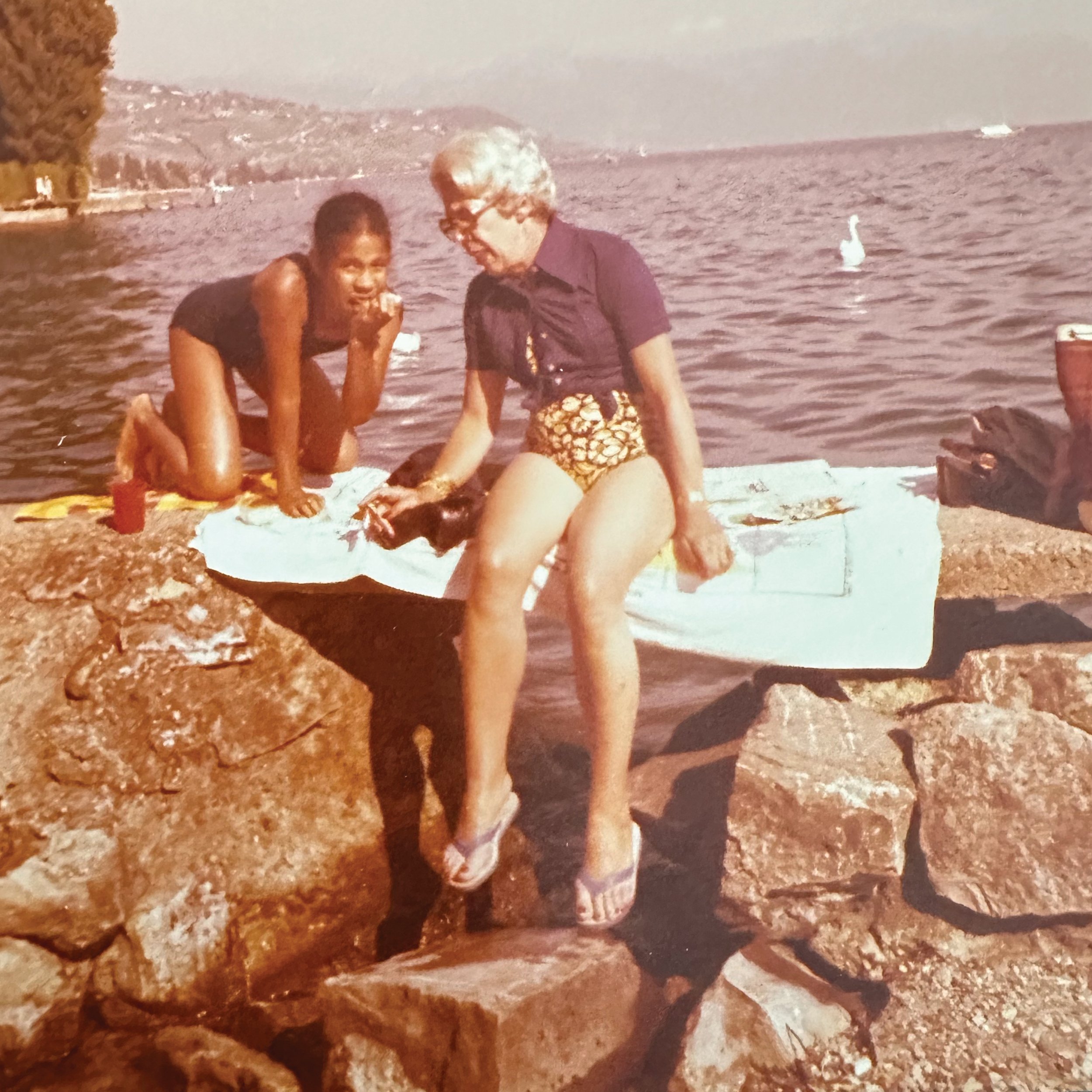
Fabienne at Lac Léman with her maternal grandmother, Martine Durring.

My junior year of high school, I transferred to City-as-School, where interests dictate curriculum. Mine were food, writing, and filmmaking. At the time, film wasn’t offered. But my writing classes were at NYU; and for cuisine, I applied for an internship at Le Périgord on East 52nd Street under the tutelage of Chef Antoine Bouterin. The restaurant, now shuttered, specialized in haute cuisine from France’s Périgord region. Truman Capote was reportedly refused service there for not wearing a tie and jacket. Rumor has it that the following week, he showed up again wearing the required tie and jacket, with Bermuda shorts. Georges Briguet, the owner, remarked, “Monsieur, you have such beautiful legs. I wish people had such beautiful legs as you.” Here, I learned to turn potatoes, carrots, and mushrooms into the uniform shapes not found in nature, sear delicate quail breasts, and appreciate the science that made for a crystal clear consommé. I constructed flawlessly symmetrical raspberry tarts, and made the crème anglaise for the îles flottantes, whose unheralded creator, James Hemings, would later figure in my professional life — a discovery that would create a lightbulb moment connecting my past to my present.
Becoming an entrusted contributor to this culinary precision felt sacred and important, and I relished the responsibility. Antoine adored me, and I quickly went from daytime prep to nighttime service. Henry Kissinger lived on the same block, and one evening he came in with Jackie Onassis. During the hectic dinner service, they popped into the kitchen. I’ll never forget Jackie’s face as she clapped in delight, “Oh look, wonderful, a woman in the kitchen!” The weight of where I was and what I was doing had importance. I felt like I was “representing” as a woman and thought, Hey, I could do this professionally, and it could mean something. I hadn’t yet thought about my role in the context of being a Black woman; that would come much later. Here, I was still mixed and only 17 years old.
Chef Bouterin eventually hired me as a paid apprentice. Saving half of my weekly paycheck, I was able to spend the following summer bopping around Europe with an Eurail pass. Upon my return to New York, I formalized my culinary plans and enrolled in the French Culinary Institute, FCI. I had far more experience than most of my peers, and breezed through the curriculum. Which is a good thing, as most of my nights were spent going out to nightclubs like Area, and the Palladium. On occasion, I would dine at the nearby Odeon, where Chef Patrick Clark was one of the first Black celebrity chefs. Let me rephrase that, he was one of the first celebrity chefs.
After cooking school, I worked in a variety of restaurants, mainly classic French or something like it. There was a brief stint on World Yacht, the first luxury dinner cruise, breakfast service at the Maurice at the Parker Meridien Hotel, and a vegetable station at Jonathan Waxman’s Jams, which was deliriously fast-paced. However, I was also becoming disillusioned with cooking professionally. I didn’t have the fight for being the only woman in an incredibly tough and competitive business. New York had also turned into a rough place, AIDS was on a rampage, my city was in disarray, and I yearned to see more of the sky without craning my neck.

I decided to move to California to pursue my other passion, filmmaking. I found work through a domestic agency and was hired as a private chef for the woman who had Scruples and told us to “take Manhattan,” author Judith Krantz, and her husband Steve Krantz (famously known as a producer of the first animated porn film, Fritz the Cat). They were kind, former Brooklyn, New Yorkers. They enjoyed my recent transplant status, connecting over our shared geographies, and we got along well. She followed a strict low-fat, high-flavor diet, and lunches and dinners were served formally. Steve knew of my film aspirations and was incredibly supportive, and one day he came into the kitchen and said, “We’re letting you go now, go work on a set, and learn.”
In the ensuing years, I worked through the many facets of the film industry, from on-set production assistant, climbing the rungs of production, to development at major studios; to directing documentaries and music videos, to producing in the early days of branded content. There are work gaps that exist when my roles as a wife and mother took precedence at the peril of my professional development. But, as the kids got older, my sense of urgency and desire to create something meaningful became more pressing. I felt the urge to tell stories that needed to be told.
Discourse around race was boiling as cell phones documented the torment and killing of Black bodies, and I was also changing. More and more, I was seeing the world around me as a Black person, rather than as someone who is mixed. Not because the Swiss inside me went anywhere; my interior would always remain an amalgam of my mixed identities. But I had to meet the world the way it was treating my sons. That was the most sound and true choice for all of our well-being.
Throughout the years, I had followed food media on the periphery. One night I had dinner with Jeff Gordinier, one of the nation’s most sensitive and insightful food journalists, who was then on staff at The New York Times. We rhapsodized about all things culinary. I think he was surprised by my lexical knowledge of food. Sometime later, he sent me a text with the cover of a book; his text simply said, “Read this, it will change your life.”
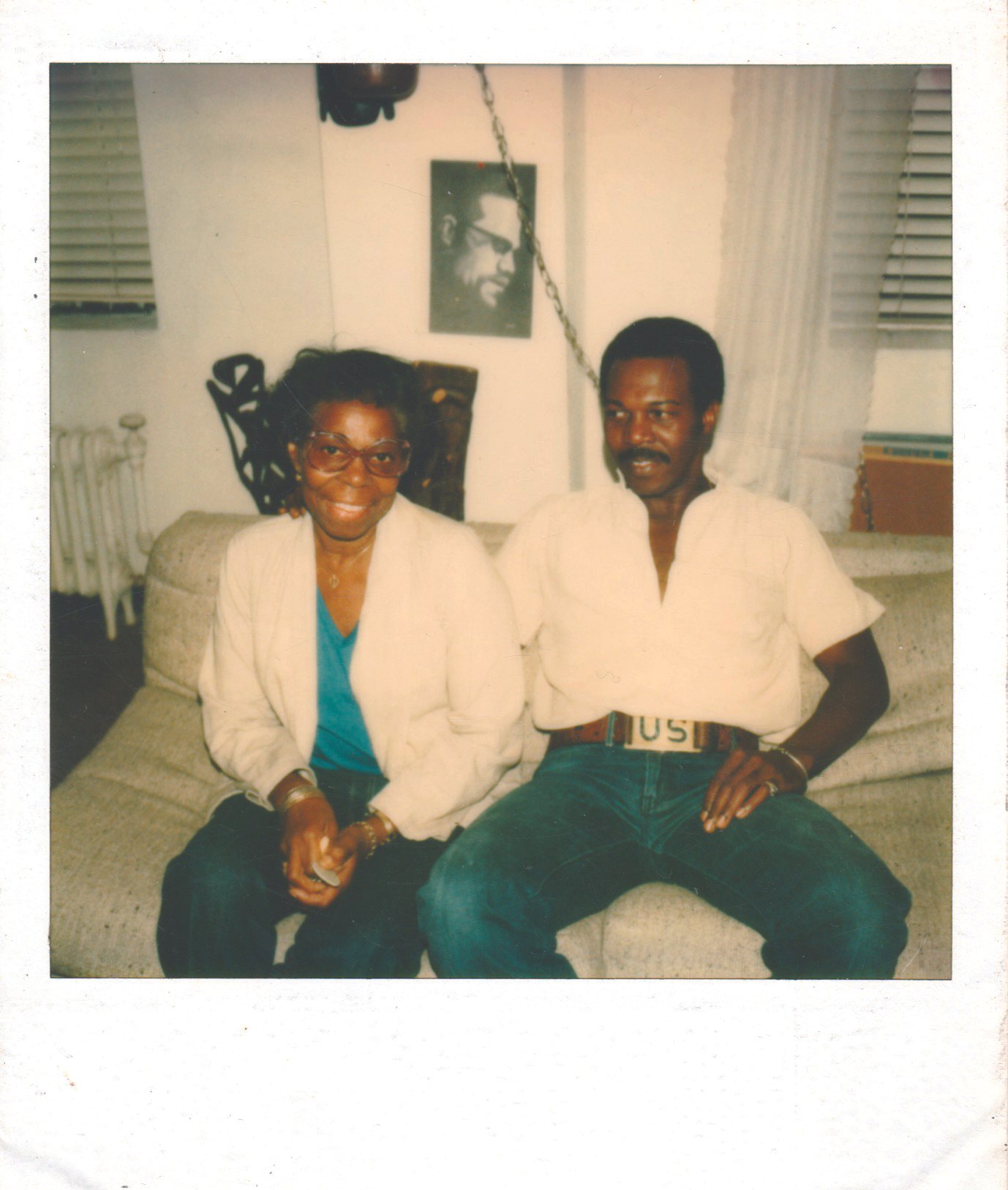
Fabienne’s father Dennis with his mother, her grandmother, Norrie Cotton.
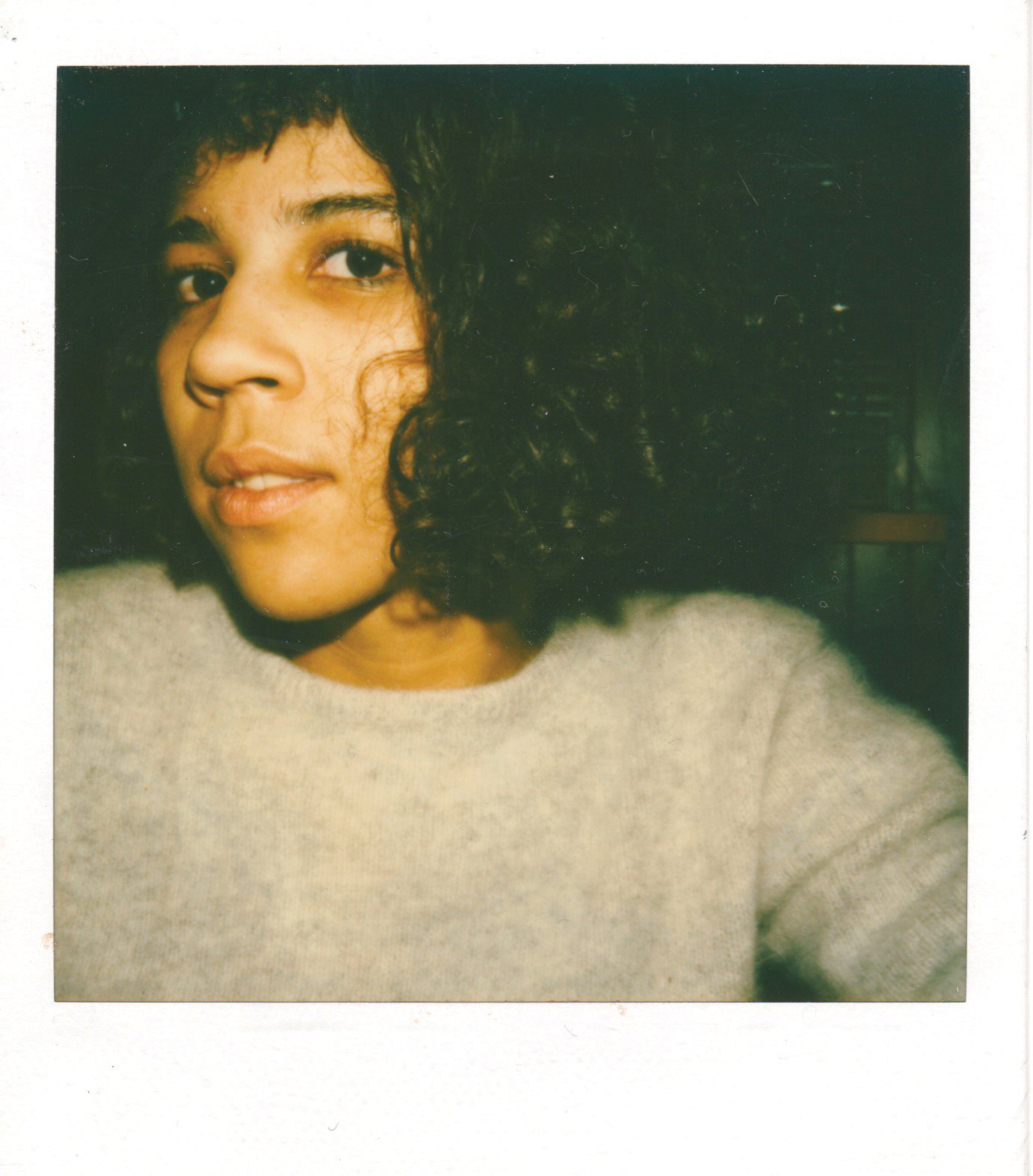
Fabienne at about 18 or 19 years old, probably at Area Nightclub. Photo by Maripol.

The book was Jessica Harris’s High on the Hog: A Culinary Journey from Africa to America. I wept; the book became a portal for a deeper understanding of my history, beyond just an inheritance of pain. It gave voice to all the innovation, resilience, and fortitude that brought me, us, here. I hadn’t produced anything so ambitious as a docuseries, but I knew this was a story that needed more telling. I quickly dashed off an email to Dr. Harris and gave the book to Karis Jagger, my producing partner; both agreed to my proposal. Jagger and I met with director Roger Ross Williams, whose previous film, Life, Animated, sensitively told the story of an autistic boy who found his voice through Disney movies. We also reached out to Stephen Satterfield, then publishing Whetstone Magazine. His lexiconic knowledge of wine varietals and food, coupled with his inquisitive and kind demeanor, made him the perfect host for the series.
As we pitched the concept, it became apparent that food carries different weights in different cultures. We originally used the inclusive pronoun “us” to describe the universal importance of food in family narratives. But then I noticed one executive’s blank look, and I remember thinking to myself, Oh, this dude doesn’t relate; this isn’t an “us” for him. Before our next meeting, we reframed the concept as “our” telling of the Black experience, and in that moment, I knew that if this got made, that perspective was going to make a difference.
High on the Hog, season one, came out on Netflix during the pandemic. It did what we had set out to do: for “us” to be seen, be celebrated, be recognized. That year, Jessica Harris was named one of Time magazine’s most influential people. After her decades of working in food journalism, writing over six books, she was finally getting the recognition she deserved. The series garnered a Peabody, an AAFCA, two NAACP, and two James Beard awards, plus numerous nominations.
It gave us the ability and permission to talk about slavery, land theft, food apartheid, and civil rights in ways that viewers could ingest and understand. We used food as the narrative thread to talk about the men and women whose stories are deeply woven into the fabric of our nation, whose stories needed a deeper telling: from Thomas Downing, a successful New York restaurateur and abolitionist; to James Hemings, enslaved chef to Thomas Jefferson, creator of the îles flottantes from my early pastry days, and the innovator responsible for bringing back the modern stove from France; to Georgia Gilmore, whose cakes and pies helped fuel the Montgomery Bus Boycott. We told their stories and said their names.
After the series came out, my very Republican mother called me crying on the phone. She was finally seeing me in a way that she never could before. I’ll be honest, at times I found her tears rather grating, but if it took a series about food to get her to look at what was going on in the world around her — even though her own daughter had always been right in front of her face — well, so be it.

We had found a springboard, and Boston-based GBH and PBS hired us to develop a series for the 250th Anniversary of America. We planned to look at our nation’s story through the lens of food and frame it before and after the signing of The Declaration of Independence, an ideal that we haven’t yet fully embodied, but one that gives us hope. We planned to present a nuanced story of survival and independence. A story of America, my America, our America.
We recognized the urgency of getting this project made, but it quickly came to a congressional halt. The clawback in federal funding for PBS was devastating and abrupt, upending not only my financial and professional life but also the lives of hundreds of colleagues. This wasn’t just a loss for me, but a greater loss for the audience who would have benefited from connecting with and understanding the vital stories and contributions of the men and women who make our nation run, who fill our bellies, and who sustain us. Food, the object of sustenance and survival, holds sway in a way that nothing else does.
In reflection, I ponder the following questions, some hypothetical, some not, of what gets lost when a collective is intent on erasing the history of generations of the very people who helped build their nation. From America’s earliest days, what if the Indigenous people hadn’t helped the early Dutch and British immigrants figure out how to grow foods that they could survive on? What if we hadn’t tossed the British tea into Boston Harbor? What if the enslaved had been paid for their labor, for their agricultural knowledge, for the rice that built the colonies’ wealth? Or the Chinese for the building of the transcontinental railroad? Where would we be had there not been a lunch counter to integrate or the women and men whose food helped fund and fuel the march for Civil Rights? What do we lose if we don’t see the contributions that all people who reside here have made to building our nation, from the systemic strains on the generations of farmers whose livelihoods are being obliterated to the ripple effects on the communities that surround them? Food is being weaponized by the denial of SNAP benefits to over four million people last year in California alone, through the forced removal of the people who are responsible for cultivating a third of the nation’s food. We all lose.
For me these questions are not just about food. I still intend to share stories that connect us, whether they are about the leaders who ensure the safety of future generations by raising climate awareness, or about the power and resistance that art and fashion can bring. We need to understand the humanity of all people, and, for me, film is the most effective path for connecting us.

Not too long ago, I took a couple of friends on a Brooklyn walkabout. We revisited my old neighborhood and bought some Jamaican meat patties, then walked over to the botanical garden. We settled under the shade of the cherry blossom trees in full bloom. I’ve grown patient and don’t need to nibble at the edges until the patty cools. Things around us have changed, but the meat patties persist and are just as delicious. Sense memory flooding back, I conjured and felt the joy and tenderness of the little girl eating her savory treat. This is my America, and I am still hopeful, hopeful that we will find our way forward, one bite at a time. ◊
A documentary filmmaker, Fabienne Toback is best known as an executive producer of the acclaimed Netflix documentary series High on the Hog, which earned her a Peabody Award, two NAACP Image Awards, and an AAFCA Award. Her work spans premium documentary, branded content, development, and short-form video for platforms including Netflix, PBS/GBH, The New York Times’s T Magazine, and Food & Wine, where she directed the 2024 video companion to “The City That Rice Built,” which earned a National Magazine Award. She is the co-founder of the branded content production company Noble Fork, and lives in Paris.
Featured in Issue No. 14