
Words by Roxane Gay
August 26, 2026
—
Originally published in Issue No. 14 of The Bitter Southerner Magazine
One of the most common refrains in journalism is that it is dying. This death knell has sounded for decades but, with each passing year, as legacy media outlets are gutted or sold to billionaires as playthings, the pitch of that refrain grows louder and louder. At the same time, the consequences of an ever-shrinking mediascape become more dire and urgent. A gaping void stretches wider and wider as media’s collapse proceeds apace.
The reasons for this gradual death are many and varied. Over decades, the way we consume media, and news in particular, has changed. First, it was newspapers, thousands and thousands of them reaching people daily or weekly. Next came radio and TV, then websites, online video, and now, social media. Each time, journalism has had to adapt, finding innovative ways to retain existing audiences and reach new, and ideally much-coveted younger, audiences. At the same time, media professionals have had to maintain journalistic integrity and encourage rising reporters to enter a field with little job security, inadequate pay, and often complicated working conditions.
As the media landscape has evolved, the business model has also had to adapt. For a time, newspapers and magazines could sustain themselves with robust circulations, classified ads, and advertising. Today, most media outlets struggle for subscribers. Craigslist, Facebook Marketplace, Nextdoor, and a range of other sites and apps have taken the place of traditional classified ads. Dating websites have supplanted personals sections. And as media diets expand, audiences dilute.
Many publications have tried to “pivot” to video, always a sure sign that layoffs are on the horizon. Then they “pivot” back to what they were originally doing, also a sure sign that layoffs are on the horizon. News outlets have created apps and podcasts and special sections, all hoping to generate enough revenue to actually report on the news and do it well. The New York Times has had some success with a popular cooking app and a games app where you can solve crossword puzzles or play the daily Spelling Bee and other games. But such diversions don’t translate into an audience for hard news or the rest of a paper’s offerings.
Alongside this industry collapse, we have seen public trust in journalism erode and “truth” become mutable. Though he didn’t invent the notion, President Donald J. Trump was the first politician to use the phrase “fake news,” which he has done for the entirety of his political career. He deploys the phrase anytime the media reports negatively on him or his administration or writes about realities he doesn’t want to face. A bad jobs report? Fake news. Inflation still on the rise? Fake news. Polling numbers under water? Fake news — of course. His most passionate constituents no longer believe anything journalists say that contradicts their worldview. They live in an artificial reality, the borders of which cannot be penetrated by the truth.
Bad actors on social media disseminate misinformation toward various ends — creating conflict and mayhem, influencing elections, manipulating stock markets — and the less media-literate among us believe — and then also disseminate — that misinformation. This is the world in which elaborate conspiracies like QAnon have thrived. This is the world where deepfakes and AI slop convince people that an imaginary, absurd alternate universe exists and, again, there is no convincing them otherwise.
To make matters even more fraught, legacy media outlets have often failed to accurately report on the perils and threats of the first and second Trump administrations; or they have obsessed over less important things like Hillary Clinton’s emails or Joe Biden’s age while ignoring similar issues from Republican politicians. When media outlets have had opportunities to lead, to offer their audiences moral clarity, they have chosen to do the opposite. In the leadup to the 2024 presidential election, for example, the owners of the Los Angeles Times and Washington Post withdrew or chose not to offer presidential endorsements, respectively, acts of cowardice and journalistic malpractice that were only possible because the papers’ billionaire owners have the wealth to absorb any financial repercussions for those decisions.
However, as traditional media sings its swan song, amid this unholy confluence of events, a new breed of journalists is filling the void. They operate, for better and worse, without the constraints of traditional media infrastructures. They are trying to connect with audiences who also want something different, something that feels more honest, and maybe even more human. These journalists are independent, usually individuals working without the support of a newsroom and all that entails, with or without formal journalism experience. They have creative freedom, but they don’t necessarily have job security. (Unfortunately, people working at traditional media outlets also don’t have job security anymore.) Many journalists are trying to determine when, not if, they will go independent and how they will make it work.
There is no one way to break free, and most people embarking on an independent venture are trying to figure out how to do it in a sustainable, remunerative way. When you’re solo, you are the researcher, writer, editor, fact checker, interviewer, copyeditor, proofreader, designer, publisher, and publicist. The more successful independent journalists can hire staff to support them, but it takes a lot of work, hustle, and luck to get to that position. There is, in fact, a finite audience for paid independent journalism. Readers and viewers can only support so much. And even finding an audience is a challenge unless you are bringing followers with you from a previous job. A publication with 200,000 subscribers will generally have around 5,000 paying subscribers. That can generate a substantial income, but it is hard work to recruit and retain people willing to pay for something they would prefer to get for free. There are no easy answers.
Nonetheless, technological advances make reaching large audiences possible for anyone with a little initiative, a laptop, and a smart phone. Independent journalists can use YouTube, TikTok, and Instagram for video journalism. They can produce and host podcasts that, with the click of a few buttons, can be widely disseminated. And though blogs are largely a relic (however beloved) of the past, newsletters have taken their place. Platforms like Substack, Ghost, and Beehiv, among others, offer the opportunity for independent creators to write and share their thoughts via email and the web with relative ease.
As a writer with her own newsletter, who also co-owns an independent magazine, The Rumpus, I think about these logistical challenges quite a lot. Sometimes, it feels like we are all circling the same audience, hoping we will garner enough attention to pay our staffs, our writers, and — if we’re very lucky — ourselves. There is no singular formula that works. The only thing we know to be true is that to sustain any audience requires frequent and prolific output, of consistently excellent quality that is unique and voice-driven. People are not necessarily subscribing to the writing independent journalists publish. They are subscribing to the person doing that writing or broadcasting or podcasting. They are investing in a brand.
The general public doesn’t always understand the difference between a writer and a journalist and now, an influencer. The distinction doesn’t necessarily matter to most people. When I am referred to as a journalist, though, I am always quick to correct. I bring integrity and rigor to my writing, but my work is subjective. I am not trained as a journalist, and, while I research and sometimes interview subjects and use other journalistic practices, I write from a place of informed opinion rather than objective fact.
The Society of Professional Journalists’ Code of Ethics identifies four characteristics of ethical journalism: journalists should seek the truth and report it, minimize harm, act independently, and be accountable and transparent. This code offers a useful framework for understanding whether or not an independent journalist is, in fact, a journalist or if they are simply someone with an opinion. In an oversaturated information economy, we tend to lose sight of how critical journalism actually is. Intrepid journalists keep us informed about the world we live in, locally, nationally, and globally. Investigative reporting has brought to light some of history’s most significant moments — the scandals, government overreaches, corporate malfeasance, and exploitation that would otherwise go unchecked. This reporting has, historically, had a significant impact because people could trust that the journalists were skilled, that they followed a rigorous process, that they were telling us the truth in a world all too often shaped by mendacity. It is beyond alarming that we are now in a place where all of that trust and good will has been eroded from both within and beyond the field.
Many independent journalists are refugees from traditional media. They have gone through countless layoffs and been downsized into working for themselves because there are no other options. Or, they are high profile journalists like Tucker Carlson, Megyn Kelly, Joy Reid, and Don Lemon, forced out of their respective legacy networks but able to trust that enough of their large television audiences will follow them as they establish their own media companies featuring, well, themselves. What they lose in reach they gain in control.
In Minneapolis, Georgia Fort was one of the most visible journalists covering the ICE raids and the ensuing protests. Years earlier, she covered George Floyd’s murder and those protests. After working in traditional media for more than 15 years, Fort set out on her own. She believes in the importance of Black media and telling the unvarnished truth. She is often reporting live, from the thick of things, offering her commentary while documenting what she is bearing witness to. She was arrested in Minneapolis at the same time Don Lemon was arrested in Los Angeles for covering a protest at a St. Paul church. Just before her arrest, Fort posted a video on social media. Her voice was tinged with fear as she shared that her children were with her as federal agents swarmed her home. She reported the news even as she was the headline, and she was able to get her story out without any gatekeeping, censorship, or resistance because of her independence.
Some independent journalists find their audience by being in the right place at the right or wrong time. They rise to the occasion when the opportunity arises and then continue doing so. Marisa Kabas writes the newsletter The Handbasket and has broken several important stories including the Trump administration’s freezing federal grants and student loans. Shortly after she published the story, it was reported with credit to Kabas, by the Washington Post. In her own words, Kabas said her job changed overnight. On The Handbasket, she covers not only breaking news, but topics that interest her — the encroachment of AI on journalism and everything else; the ongoing legal battle for trans youth to receive medical care at NYU Langone; the actions of DOGE and ICE; and even what it means to write in such a fraught sociopolitical climate. Working independently affords journalists like Kabas the freedom to follow where their curiosity leads, to write as journalists but also have the flexibility to express their own opinions and points of view, without apology. The trust they develop with their audiences affords them that freedom.
Technology journalist Taylor Lorenz, who has written for many publications including WIRED, The New York Times, Daily Beast, and others, worked at traditional news outlets for several years. In 2023, she published the book Extremely Online: The Untold Story of Fame, Influence, and Power on the Internet. She is one of those journalists who, herself, is also extremely online, in ways both good and not so good. While she is popular, she also deals with a significant amount of harassment. Lorenz left her job at The Washington Post, as a technology and online culture columnist, after she was accused of bias by way of an Instagram post about then President Joe Biden. She wasn’t fired and Lorenz says the accusation did not influence her leaving the Post, but the timing is interesting. Now, as an independent journalist, she writes her own publication, User Mag, where she explores the inner workings of the internet, the companies who shape our online experience, politics, and politicians. Like so many independent journalists, she has a podcast. She is often a pundit on cable news. In August 2025, she wrote an exposé for WIRED about the largely untraceable “dark money” funding Democratic political influencers. A lot of such funding circulates through the independent media world, across the political spectrum, which opens up complex questions about how independent many independent journalists actually are.
While most independent journalists have backgrounds in traditional journalism, there are other types of professionals like Heather Cox Richardson, a critically acclaimed historian and professor at Boston College, who writes the very popular newsletter Letters from an American. In her daily missives, she opines about what’s happening politically and, where applicable, offers deep historical context to current events, reminding her readers that history does, indeed repeat itself. She wields wide influence over millions of readers, while also hosting podcasts and writing books. What is interesting about Cox Richardson’s work is that she is unafraid to let her Democratic leanings shape her perspectives. She prioritizes historical rigor and a keen eye for the present-day details of her stories over bland objectivity. For more conservative readers, that might serve as a liability, but for her more progressive audience, it is welcome.
Then, there are the news aggregators and influencers, people who amass large followings simply by sharing news stories that interest them or are relevant to the current cultural moment. One such influencer is Aaron Parnas, who has 5.3 million followers on TikTok eager to hear him sharing … the journalism of others. His newsletter, The Parnas Perspective, has more than 830,000 subscribers. In his videos, he speaks directly to the camera, in a rather monotone voice, relaying the news, multiple times a day. Sometimes, he livestreams. I am far too old to understand the sway he has on his significant audience, but his influence cannot be dismissed. There is something about his “everyman” approach to political conversations that people find very beguiling. Parnas is one of the independent journalists who has been accused in media reports of taking dark money to fund his work. He is also a former conservative and the son of Lev Parnas, a former associate of Rudy Giuliani who pleaded guilty to fraud charges. Politicians seem unfazed by these details. His power and influence, particularly with young voters, are such that even Democrat leaders want to stay in his orbit and appear on his show.
In addition to independent journalists, there are publications that work outside of the mainstream media ecosystem and that create spaces where nontraditional writers can thrive. As an Angeleno, I have a lot of independent publications to choose from in the area. Knock LA, for example, published a chilling 15-part exposé, written by Cerise Castle, about deputy gangs in the Los Angeles County Sheriff Department. And then, there is L.A. Taco, an independent, Los Angeles-based publication founded in 2006. They write about the “taco lifestyle,” which includes reporting on the city’s very diverse culinary landscape, with all manner of taco and taqueria guides. Their other, equally ambitious beat, which began in 2018, is street-savvy journalism, reporting out stories other publications might overlook or refuse to touch. Their writers, some of whom have journalism backgrounds and many of whom don’t, report from within the thick of protests, document ICE raids, report on the conditions at ICE detention facilities, and bring attention to anything else that affects Angelenos at the intersections of power, oppression, and marginality. They have an app and an annual Taco Madness festival and were recognized for their work with a James Beard Emerging Voice award in 2020.
What’s most refreshing about L.A. Taco is how they balance their two editorial aims. In one of their newest features, the free “Daily Memo,” they report on the news of the day, update their audience about recent ICE raids in the extended local area, and share a roundup of relevant links. They also publish features like the favorite restaurants of restaurant dishwashers, the best restaurants in L.A. according to local dominatrices, and how the Sysco/Restaurant Depot merger will affect restaurant prices. Author Myriam Gurba wrote a frank, practical guide for how to survive sexual assault and gender-based violence. Unlike many publications, independent or otherwise, L.A. Taco writes about Palestine.
Editor-in-Chief Javier Cabral, like many of his peers, came to L.A. Taco from traditional (ish) media. Before all that, though, he got his start the way many of us did — by writing a blog, prolifically. In sixth grade, he experienced a significant growth spurt and shot up to 6-2. Wanting to slow his growth, he stopped drinking milk and eating meat and turned to veganism. Before long, he developed orthorexia — an obsession with healthy eating. To manage some of his fraught relationship with food, at age 15 Cabral started a food blog, “Teenage Gluster,” which explored “food, punk, angst, hormones, and a really really fast metabolism.”
Cabral grew up in Boyle Heights, East Los Angeles, and the San Gabriel Valley. He was never particularly enamored with school and mostly spent his hours in school waiting for the day to end. During his free time, Cabral was drawn to the punk scene and punk values, which he still prioritizes today. He and his family were homeless for a time, an experience which only honed his appreciation for pleasure, exposing the stark contrast between deprivation and abundance. What you need to know about Javier Cabral is that he is passionate about food and writing about food and the rich cultural tapestry of Los Angeles. He enjoys languorous five-hour lunches and recalling, in great detail, a specific meal he ate 15 years ago, from the food to the wine. “Growing up in dysfunctional homelessness like I did, the one thing I need in life is pleasure,” he said.
At 16, Cabral cold-emailed Jonathan Gold, the Pulitzer Prize-winning Los Angeles Times food critic, writing, “Hi, Mr. Gold. So, like, I’m in 11th grade and can’t find Food Writing as a major anywhere. How do I become a food critic and what’s the dark side of it?” Gold wrote Cabral back and over the years, they developed a close, mentoring relationship. Gold eventually hired Cabral as a food scout, and he continued refining his craft and eating his way around Los Angeles and elsewhere. Cabral’s rise in journalism is one of those irreplicable stories reflecting the way success is the right alchemy of curiosity, courage, creativity, and luck.
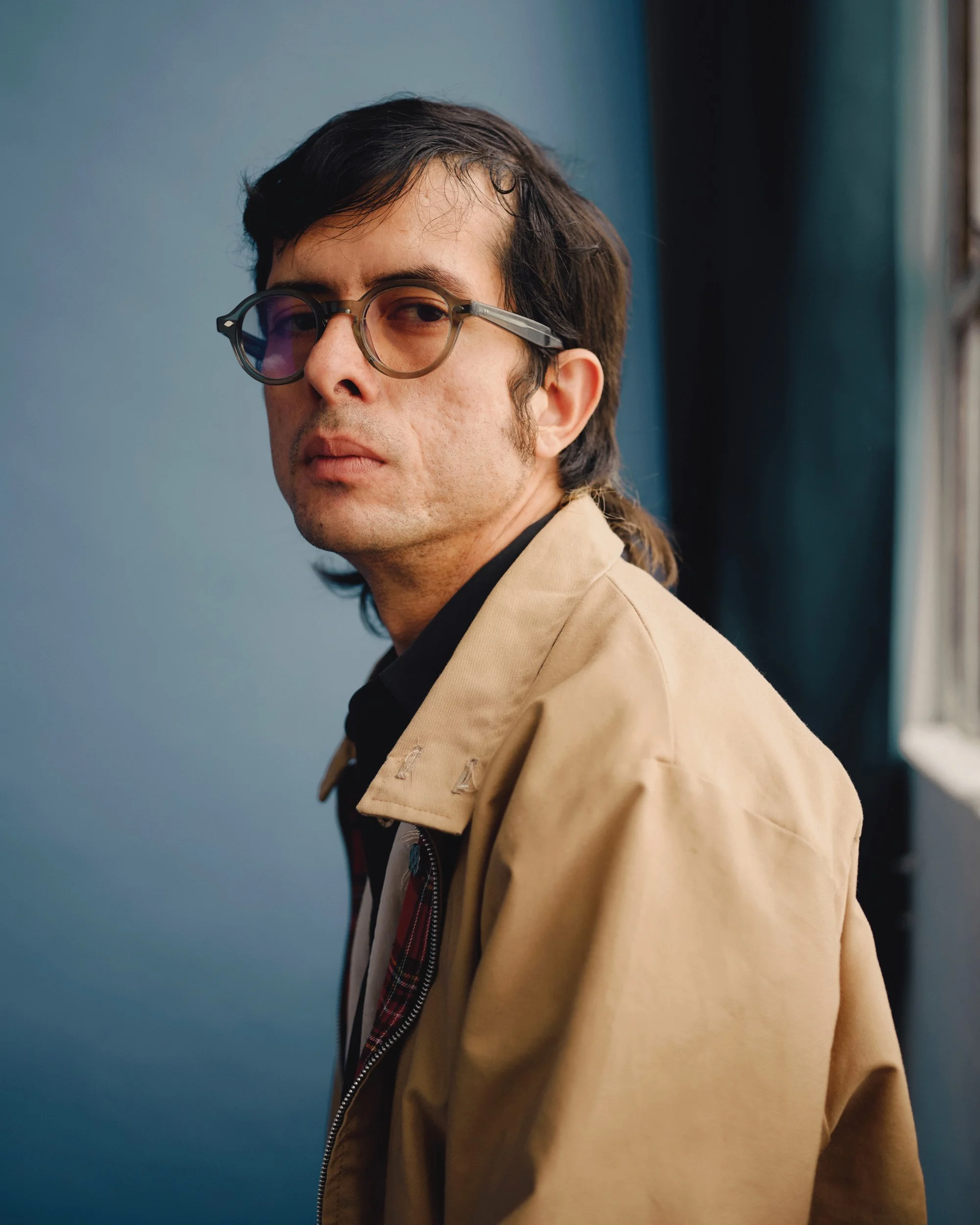
L.A. Taco Editor-in-Chief Javier Cabral. Photo by Erik Carter
Throughout his career, Cabral’s writing has appeared in many publications, including Saveur, Food & Wine, Bon Appétit, and more. He is the co-author of two cookbooks — Oaxaca: Home Cooking from the Heart of Mexico and Asada: The Art of Mexican-Style Grilling. He served as the West Coast Editor for Vice Munchies before it shuttered. Cabral splits his time between Puerto Vallarta, Mexico, where his wife, the immensely talented cooking writer and recipe developer Paola Briseño-González lives, and Long Beach/Los Angeles, where he lives. We met for coffee at Kissaten Corazón, a Japanese-style tea and coffee shop in Chinatown, which is adjacent to the L.A. Taco offices. Because of time constraints, we did not eat, but as we were planning our meeting, Cabral suggested X’tiosu Kitchen, a Oaxacan restaurant with Lebanese-influenced food in Boyle Heights. Across Cabral’s body of work, you will find many such gems — local restaurants run by people with a genuine love for food, community care, and authenticity.
Cabral crafts the loveliest sentences, evoking a sense of time and place and complexity. In a gorgeous essay about traveling to Mexico to better understand the country’s culinary heritage, he writes about taking the trip with his mother, how she emigrated to the United States, what he expected in contrast to what he experienced, and, of course, what he ate. “My favorite find was an agua fresca de pulpa de coco, the coconut drink of my dreams. A blend of coconut meat and coconut water cooled with rough shards of ice, it was lightly sweet and creamy, full of satisfying morsels of tender coconut. I bought it from a vendor who came all the way from Guadalajara, in the neighboring state of Jalisco,” Cabral wrote. When reading his work, you can imagine the texture of tortilla on the tongue. You can feel an unexpected burst of steam from biting into something piping hot. You can savor the complex blend of aromatics in an excellent stew. And alongside this sensuality, Cabral reminds his readers that eating food is not merely a pleasurable experience enjoyed in a vacuum, devoid of context. Food and our experiences of it are political and emotional.
“Food writing has always come from a very spiritual place; I have an existential need for it,” Cabral said. He also believes “food writing has to reward you. If I’m not making you hungry, I’m not doing my job. A good food story has to make you hungry, whether it’s hungry for justice if you’re writing about a taquero that got abducted or hungry for the mesquite grilled homemade tortilla I ate.” He strives to tell a good food story, not only about the tastes and textures of what he eats but also about who makes the food, where it comes from, and why.
During the February 2026 cartel attacks in Puerto Vallarta, Cabral happened to be there. He wrote about the “faint smell of burned debris” and the confusion, misinformation, and fear people were feeling. He also wrote about the calm after the storm, how uncanny it was. “Despite widespread rumors that cartel sicarios were going to start attacking homes and civilians at the strike of midnight last night — unless the forces responsible for the death of their leader ‘El Mencho’ were delivered to the cartel — Vallarta woke up to an eerily quiet morning,” he observed.
Unfortunately, Cabral doesn’t get to write about food nearly as much as he used to. As editor of L.A. Taco, he oversees nine fulltime employees along with several part-timers and freelancers. While his days are varied, he generally wakes up and sips an espresso before hunkering down at his laptop to edit all morning. He’ll enjoy lunch and a 20-minute nap. “The proper term is ‘nappuchino,’ because I always drink tea with lunch, which helps me reset without falling too deeply into sleep.” Then, he’s back to work, writing, editing, answering the never-ending onslaught of emails. “I’m still learning how to be a good editor,” Cabral said, “But being editor of L.A. Taco has been a redeeming experience for me. I was able to show myself I could rise to the occasion of being a leader and managing people.” And lead, he does. He is relentless in his pursuit of excellence but also tries not to take himself too seriously. “The moment I take myself seriously is the day I get complacent or full of myself,” he said. Over the past seven years as editor, Cabral has increased the publication’s web traffic and social media following, and amplified their profile. Today, L.A. Taco has enough paid subscribers to sustain the publication and even turn a modest profit. They recently hired a membership coordinator, their first non-editorial position. As they look to the future, they want to continue to grow and be able to do all the things an independent magazine dares to hope for — paying writers and editors a fair wage, telling the stories that matter, and making sure those stories get the attention they deserve.
Cabral is proud of the magazine’s independence. “Being independent means publishing whatever the hell you want. That’s what it boils down to. I like to say you have to be prepared to defend anything published in a dark alley if need be, because I come from the hood.” He navigates the emotional terrain of taking professional risks as best he can, drawing on his punk rock upbringing, the support of his wife who, in his vows, he called “the editor-in-chief of my heart,” and developing healthy habits to manage the stress and anxiety, such as daily hot yoga or pilates.
After more than 20 years, Cabral is walking the fine line between embracing his craft and feeling jaded about the state of his industry. Journalism is not easy work. Years of layoffs and waning online traffic, the encroachments of AI, a fractured media landscape, and what to do about those infuriating Google summaries that divert online traffic from the source, these things all take their toll. Cabral stays engaged with his work by remembering that what he does now was always his dream. “When I was in high school, I was like, ‘Man, I’d like to get paid to eat.’ Now I get paid to expose lousy cops that pull shotguns on teenage girls, but I also get paid to eat,” Cabral said. As an editor, Cabral looks for stories that are unique, authoritative, and written with style. “Every single story we publish, I want it to be like, it can’t exist anywhere else,” he said.
The media landscape is constantly changing. Publications have to adapt or become extinct. “It means not getting old and talking down to influencers because whether we like it or not, they’re here and they’re not going away. They have something we as platform writers need, which is eyes and exposure. The next stage of experimentation is going to be leaning into this new, funny term of newsfluencing,” Cabral said. “The future is getting over yourself as a writer.”
He also believes talent can be found in unexpected places and credits new voices for some of L.A. Taco’s organic growth. “Since I became editor-in-chief, I’ve published probably five, six dozen first-time writers that weren’t really writers. And as you know, there’s a lot of raw talent out there, but the raw talent needs guidance.” Cabral has expanded that vision beyond the publication with the L.A. Taco Media Lab, a nonprofit incubator for local, hybrid journalism. He also teaches a class at USC, “Bridging the Media Gap Between L.A. Influencers and Independent Journalists,” where journalism students can learn about where journalism is heading rather than where it once was. Javier Cabral’s dynamic work as both a writer and editor, remind us that it is not yet time to write the media’s obituary. While journalism is facing many, many problems, there may well be solutions if you have the humility, initiative, and temerity to create them. ◊
Roxane Gay’s writing appears in A Public Space, McSweeney’s, Tin House, Oxford American, American Short Fiction, Virginia Quarterly Review, and many others. She has been anthologized in Best American Mystery Stories 2014, Best American Short Stories 2012, Best Sex Writing 2012 — and in Marvel’s World of Wakanda series. She is a contributing opinion writer for The New York Times and author of the books Ayiti, An Untamed State, Difficult Women, and Hunger.
Featured in Issue No. 14