
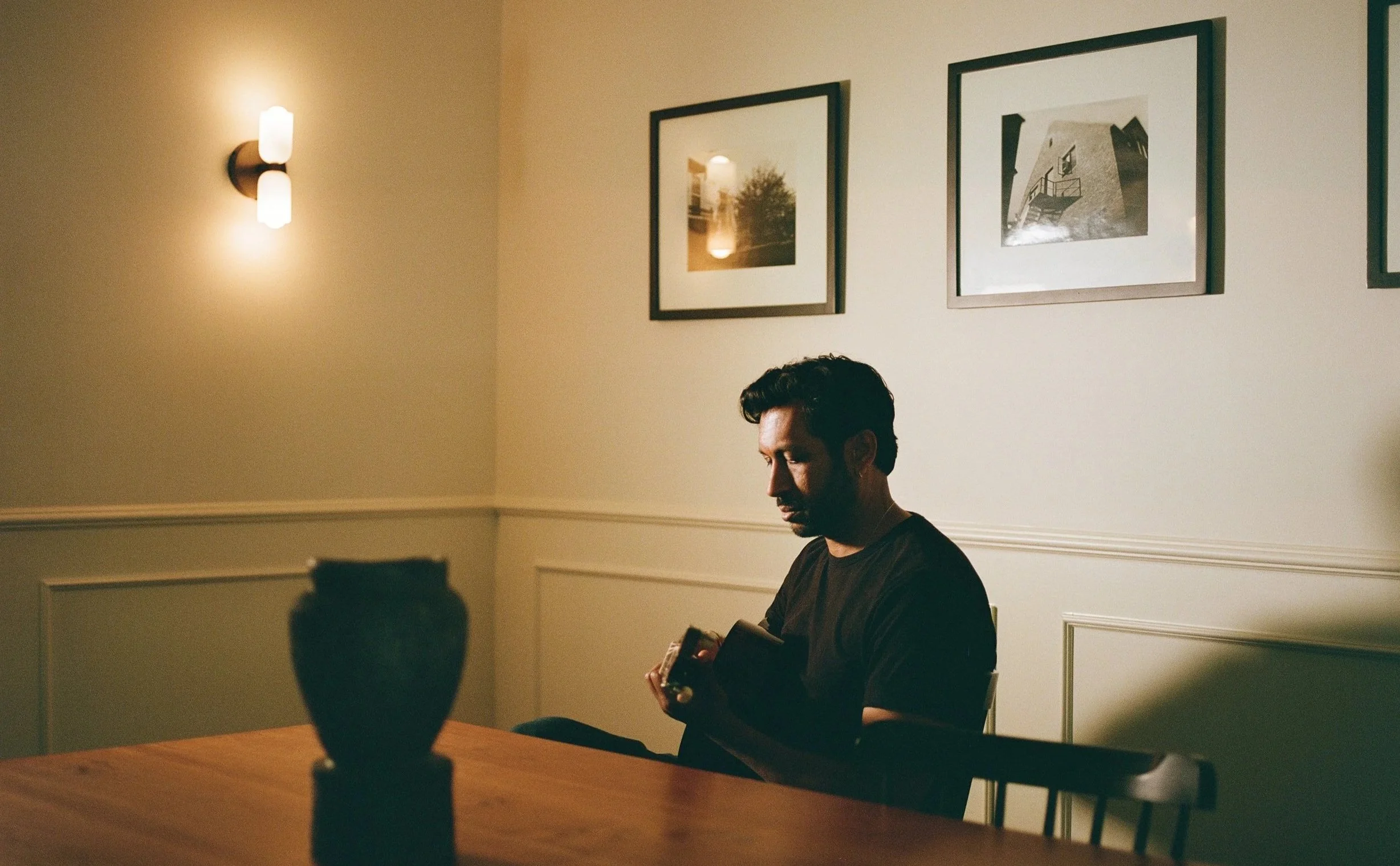

In his podcast Song Exploder, Hrishikesh Hirway is known for deconstructing the lyrics, music, and stories of other artists. In the spring of 2026, Hirway finally released an album, In the Last Hour of Light, under his own name. A hushed beautiful memoir in song, this is his story.
Words by Hrishikesh Hirway
Photos by Sheva Kafai
August 19, 2026
—
Originally Published in Issue No. 14 of The Bitter Southerner Magazine
Since my mother passed away, my father has developed a habit of texting old photos to me. He accompanies them with brief captions, like: “Kanta doing Asha’s hair while she looks at iPad.” Kanta was my mother, Asha is my niece, and the photo is a beautiful moment (if not a particularly beautiful photograph) between a grandmother and her three-year-old granddaughter. It’s from 2018, I think, but I’m not sure. I’m also not sure why my father was looking at this photo in particular. He’s 85 now, and I suspect he spends more and more time sinking deep into his memories these days. When he resurfaces, he brings back a pearl.
I keep my own photo albums on a shelf in my closet. Next to them, there’s a box with letters and postcards I’ve received over the past 25 years, and another filled with ticket stubs from movies and concerts. Not to mention the 30,000 photos saved on my phone. My father and I are very different from one another, but I suppose we share an inclination to get drawn into the past. These days, such artifacts have become more and more precious.
After my mother was gone, I realized I didn’t have a recording of her voice. Not her “real” voice, anyway — the one she told stories with and laughed with before a neurodegenerative disease started replacing her, cell by cell, with someone quiet and distant. She had been the parent I was more like. We shared a love of British mystery shows, spicy Thai food, and had the same eyes, nose, and temper. How many hours of my life had I spent listening to her? If you lined all those hours up, end to end, would it be months? Years? But when I found myself reaching for those memories, they seemed to be disintegrating around the edges. I couldn’t get a proper hold of them, and I had nothing recorded to turn to.
I opened the note I had saved on my phone called “Song Ideas” and typed: What of you still lives in me? What will die along with me? I’m forgetting the sound of your voice.
The fact that I had song ideas, let alone a place where I was saving them, was significant. It had been 15 years since I’d last released an album.
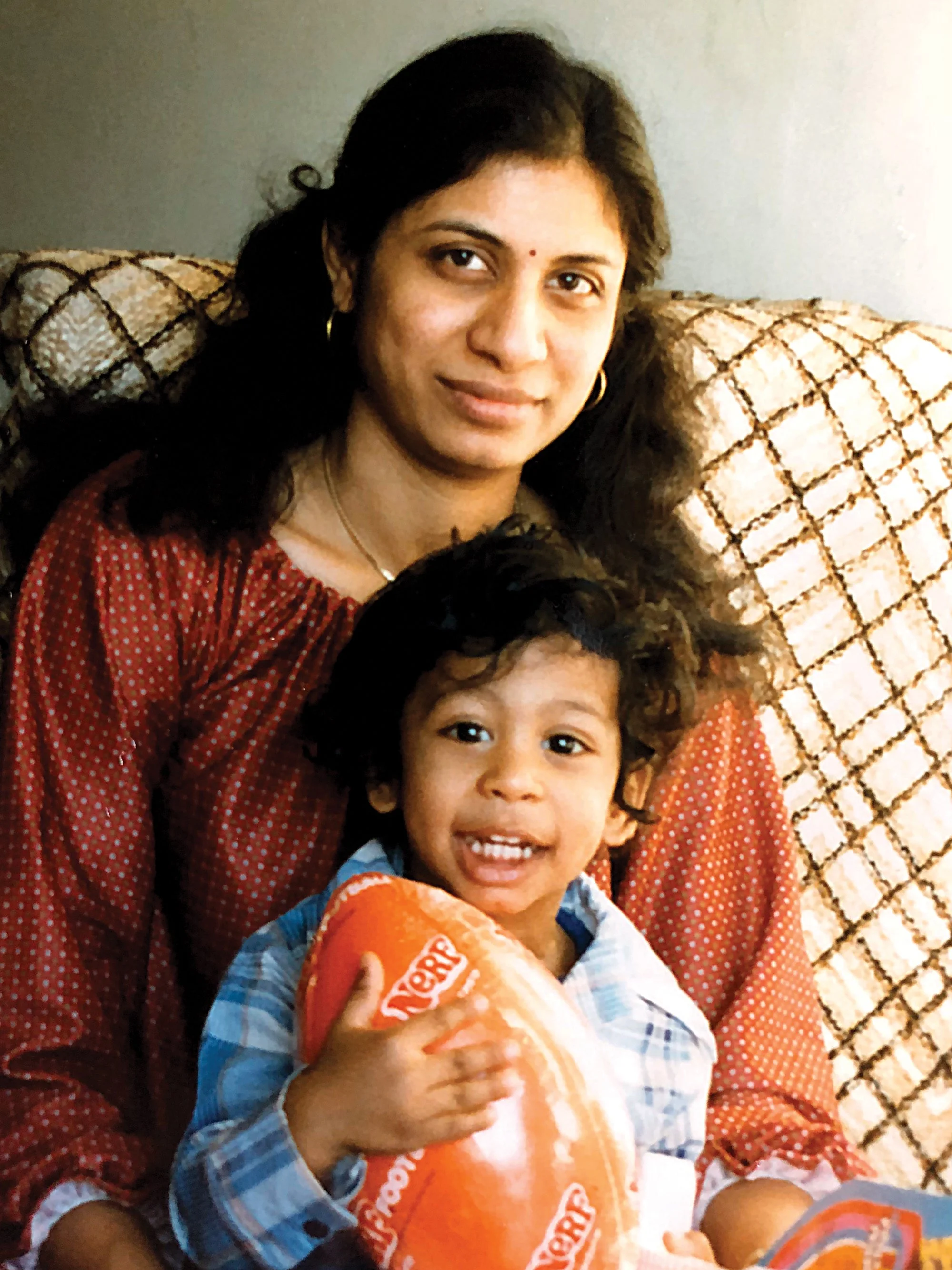
Hrishikesh, age 2, and his mother Kanta at home in Massachussetts.
I spent my entire 20s and the early part of my 30s trying to make it as a musician. I’d released four albums and played hundreds of shows, using the moniker The One AM Radio. Writing and recording songs was my passion, and I worked to make it my career. I remember how proud I was when I finally started paying bills with money I’d made through music.
I signed to a label, and worked there as the art director, too. That job gave me an insider’s perspective into the business side of the music industry, and I soon learned first-hand how I stacked up. In one meeting, I heard The One AM Radio and a few other small acts referred to as “baby bands” — despite the fact that I was working on my fourth album, and had been doing this for a decade. I left the label to focus solely on my music. I tried everything to make an album that would break through.
But it didn’t happen. The album had some success, but fell short of what I’d hoped. My drive to write songs began to cool.

While I tried to figure out where to go from there with my music, I started my podcast Song Exploder, talking to other artists about their creative process. The project was supposed to be a side hustle, but unexpectedly, it took off. The show was featured at the Sundance Film Festival, SXSW, Noise Pop Festival, and Moogfest. In 2016, the Sydney Opera House hosted a Song Exploder residency. It was even adapted into a Netflix documentary series, where I conducted my interviews on camera.
I began to wonder: Maybe this is what I’m supposed to be doing — telling the stories of other musicians, rather than trying to be one myself. One day I called my father, who knows nothing of music, and said, “Dad, I’m about to do an episode with maybe the biggest band in the world. Who would you say is the biggest band in the world?” “U2?” he guessed. “Yeah,” I said. “U2.” With this type of momentum, how could I justify spending time on something as meager as writing my own songs?
Ironically, I only found the way back to writing music by getting pulled into someone else’s. Through podcasting, I had met Jenny Owen Youngs, a songwriter in Los Angeles who frequently wrote with other artists and producers. She invited me to collaborate on a song of hers, and I couldn’t come up with a good excuse not to try. To my amazement, we wrote something. I felt a tiny ember within me spark back to life. I felt a connection to music again, and I asked Jenny if we could write together again — right after I finished the Netflix series. She agreed, and we set a date.
The week before our session, my mother died.
When I was in my 20s, I had thought the best artists were auteurs — creatives with a singular vision who needed no one and nothing but their own will. I wanted to be the songwriter, the producer, the mixer, the album cover photographer, and the graphic designer. If I couldn’t do all of that, I just wasn’t trying hard enough. I held on to creative control as tightly as possible, and my albums took longer and longer to finish. I would spend months on songs, working and re-working the lyrics, the arrangement, re-recording all of my parts and my vocals, in case there was a “right” answer that eluded me.
My podcasts dissected music in much the same way. In each episode, I would explain, “musicians take apart their songs, and piece by piece, tell the story of how they were made.” I assumed that all the instruments and all the vocals were recorded in isolation so that each layer could be perfected, then edited into a sort of genetically modified super-song.
But, looking back, I’m not sure that technical perfection is the most productive way to write songs that resonate with listeners.
Around 2009, I bought something on Craigslist — I can’t remember what exactly — and went to pick it up from the seller’s home in Echo Park. We chatted a bit and realized we both worked in the music industry. He’d heard one of my albums and said, “Oh yeah, I don’t normally enjoy music that’s so meticulous, but I thought it was cool.” I was proud that he could hear how much I cared. But, then I learned that the Latin roots for the word meticulous mean “full of fear.”
The Netflix series forced me to get out of my own laptop. I collaborated with an incredible team of directors, producers, editors, and others. And despite being the creator of the show, I learned that my ideas weren’t always the best ones. The podcast — like the recordings of my own music — is meticulously edited. I remove myself from the audio and reconstruct artists’ answers to create first-person narratives from their points of view. That approach was a key part of the show’s identity, but it simply didn’t work for TV. It was too sterile. I had to learn, through the insistence of my collaborators, to put myself into the show. Even more difficult, they taught me to leave in moments where things didn’t go exactly as planned, that felt messy to me, but contained genuine interaction between my guests and me. That vulnerability and humanity added real feeling to the show. The point was not to convey the story “perfectly” but to make it compelling, and my self-judgment was getting in the way. It was a difficult lesson to learn, but it was eye-opening.
Likewise, collaboration with Jenny gave me a way out of my own head. I’d brought the perfectionism and rigidity that had stifled my music career into the room. But for the first time, I had someone to bounce ideas off. There were moments when I’d sing a melody, then suddenly feel the gravitational pull of self-doubt, and say, “Ah, that’s probably stupid, forget it.” Jenny would say, “Wait, like this?” She’d sing the same melody back, and hearing it in her voice, it sounded great. Having someone else in the room disrupted the short neural pathway that I’d been carving for so long: from inchoate idea to immediate rejection.

In 2022, I released an EP of six songs. Half were written with Jenny; half were written with John Mark Nelson, another wonderful songwriter she’d suggested. Muscles that had atrophied were working again, and it felt wonderful. I wanted to keep going, and I wanted to go further and faster. And this time my main goal was not commercial success. I was reclaiming some part of myself that had been lost. I began writing the songs that would comprise my album, In the Last Hour of Light, which I released in April.
I reached out to Ken Pomeroy, a musician in Tulsa whose song “Cicadas” I had admired on the TV show Reservation Dogs. We decided to try writing together, and the first words I shared were those notes I had written about mourning the loss of my mother’s voice. Ken’s own mother is alive, but their relationship had given Ken her own reasons for connecting with those words.
Sitting with our acoustic guitars in the living room, we wrote quickly. The winter afternoon sunlight gave way to dusk, and then dark. Before the night was over, we’d written a verse and chorus. We wrote the rest the next day. And another song after that — a love song this time, to cleanse our grief. My wife and I have been together for nearly two decades, and my love songs to her now feel like they carry that age: they’re slower, quieter, and hopefully wiser.
There’s a song called “When I Look at You” that’s about the ways we recommit to each other, day after day, year after year, knowing how much work is involved in keeping a relationship working. In it, I sing “Little fractures in between us let the darkness through. There’s a risk that we both live with, but it’s easy to … when I look at you.”
Over the years, I’d come to see Song Exploder episodes as mini-biographies. Artists’ music revealed who they were, how they saw the world. The most personal songs, the ones whose stories were the most raw and honest, were the ones I found most moving. That’s what I wanted from my own songs.
I wrote about the days my father had spent in the hospital after a severe head injury, shortly after my mother died. I’d spent my life trying to come to terms with what’s missing in my relationship with him, and for the first time, I tried to put it into music. I wrote about losing my closest friendships to time and distance and the reality of middle age. My wife and I have made the decision to be childless, but I wrote a song for the daughter that we’ll never have.
Working collaboratively was opening up very personal and vulnerable parts of myself. I had some luck cold-calling other artists whose music I had admired from afar, like Fenne Lily and Uwade, as well as Laetitia Tamko of Vagabon, whom I’d met through the podcast.
But after writing enough songs for an album, I wanted to find a producer. Having produced all of the One AM Radio albums myself, this was another opportunity to let someone else in. There had been so many stories of wonderful partnerships between artists and producers on Song Exploder, and I wanted to see if I could experience something like that as well. But it was going to take more than just cold-calling people with great credits. I needed to find someone with the right ear and the right personality, someone I could trust.
I reached out to Philip Weinrobe. We’d never met, but I was such a fan of Adrianne Lenker’s albums, which he’d co-produced. He was interested, and I sent him my demos.
We spoke over the phone for the first time on February 1, 2024. It was my 45th birthday. Looking back at it now, it was the perfect day to have a conversation that would change my life.
Over the two hours that we spoke, I asked Phil how he’d like to approach the album, given that I felt like some of my demos were close to being finished tracks. Should we keep going with them, or would he prefer to start over? He said, without hesitation, “We should start over.”
He explained his old school process for making albums: The artist brings in a song and shares it with a room full of killer session players, who learn the song and find their own parts, with the producer keeping it all cohesive. No one wears headphones, because everyone needs to pay close attention to what’s happening in the room. The ensemble becomes a living, breathing, multi-celled organism.
We would record everything live, including the vocals, with no isolation or click track, no headphones — just capturing a moment. That meant the flaws and imperfections in my vocal performance would be front and center. Every cell in my body tensed up.
I laughed nervously and said, “Whoa, that’s crazy. That is a wild way of making music.” He countered that most songs in the history of recorded music had been created this way, and that spontaneity was often what made them special.
But what Phil was suggesting, so casually, would require me to abandon two decades of seeing music in pieces. My perfectionism would be collateral damage. I’d been saving up songs, money, and time to make this album, and after all these years, I wasn’t sure if there’d ever be another one. By the end of the call, I told Phil I’d think about it.
But over the next three months, I began to realize the songs I’d been writing for two years were all about letting go. Losing my mother, my father’s hospitalization, the memories I was struggling to hold on to — none of that was under my control. What better way to capture those sentiments than making a recording that simply documents a moment? Where I’m not allowed to polish and smooth and refine what happens? I’d learned that lesson in real life, so why not let it into my music?
I called Phil back, and we set a date for the recording.

Phil recommended session players whom he trusted. All of them were multi-instrumentalists, so we could have different configurations. Sean Mullins (drums and piano), Joshua Crumbly (bass and piano), and Oliver Hill (piano, guitar, viola). I didn’t know any of them. Even though I’d agreed to this approach, my chest felt tight. As for my own playing: I’d recorded guitar, bass, piano, and drums on my demos, but this time, I felt like I needed to concentrate entirely on singing. Phil suggested we get someone else for my acoustic guitar parts, and immediately I thought of Ken Pomeroy.
Recording began in the middle of June 2024 at Phil’s studio, Sugar Mountain, which was located in the basement level of his narrow Brooklyn row house. The tight quarters were perfect for the intimacy of the album. Since none of us wore headphones, Phil instructed everyone to play softly enough to hear my vocals, and I’m a quiet singer. We crowded in.
I had a budget for seven days of recording. Phil’s approach is to record two songs a day, with a break for lunch in between. There wasn’t much room for do-overs. He also insisted that we wouldn’t listen to the recordings until all the songs had been tracked. For someone like myself, who was used to evaluating and re-evaluating at every step of the recording process, this was unfathomable. But Phil was echoing something I’d heard in the interviews I’d conducted and read about in books on writing: separate your creative, generative side from your editing, critical side. They push in opposite directions, and as soon as you start to edit, you’re no longer as free to play.
While I waited for some kind of internal compass to manifest, there was a wonderful, quiet moment of external validation. We were tracking the song “Home Movies,” which is about my late father-in-law, whom I knew only through old VHS recordings because he had taken his own life a few months before I met my wife. It was a song about how he looms large in my life, through the aftershocks of my wife’s complicated history with him, and the questions I have that will never be answered.
As we got to the song’s end, the band dropped out, leaving just Oliver’s piano, Ken’s voice, and my voice. Then they, too, dropped out, and as the last note of the piano sustained, I sang the very last lines by myself. There was a quiet moment while we waited for the air to settle, a wordless epilogue as the music faded and the room tone took over. I looked over at Joshua Crumbly, who was seated to my left, where he’d been playing bass. Josh was quiet, but had a broad smile. He nodded at me and said, simply, “My man.” And with that, I felt some great tension release. I exhaled, and Phil said, “We got it.”
After we finished recording, listening back to the songs was a complicated experience for me. I’d overcome so much self-criticism to take the risk of making the album this way. Phil told me to listen with the kind of attention and love that I’d give to a close friend’s album. But I couldn’t quite get there. Some of the songs turned out so differently than what I’d imagined, or demoed. And I was so focused on what I could have done better. We moved through the mixing process, but those questions still loomed.
It would take more than a year for the album to come out. After we finished mixing, I stopped listening for a while, to quiet my internal critic. But, then, the test pressing of the vinyl arrived, and I had to listen to the entire album with laser focus to make sure the record had no errors. I was at home, in Los Angeles, on a Tuesday afternoon. It was two days after my 47th birthday, which had left me feeling melancholy about reaching middle age and still feeling so far from my goals. I sat on my couch, put my headphones on, and played the album. Something had shifted for me. Somewhere around the third song, I felt something for the first time: I loved what I was hearing.
The music brought back memories with perfect clarity: what it felt like to write each song, to record them, the long journey to transform a part of myself into this music. It was no longer a question of the music’s worth. I can say to myself: this album is a document. And in it —listen! — you’re alive. ◊
A singer/songwriter, composer, and host of the music podcast Song Exploder, Hrishikesh Hirway’s new album, In the Last Hour of Light, was released in April 2026. He previously released four albums under the name The One AM Radio, and has composed original scores for film and television. He also co-hosts the podcasts Home Cooking (with Samin Nosrat) and The West Wing Weekly (with Joshua Malina). He lives in Los Angeles.
Sheva Kafai is a music photographer and videographer based in Los Angeles. She specializes in medium-format film portraiture and tour documentation.
Featured in Issue No. 14