
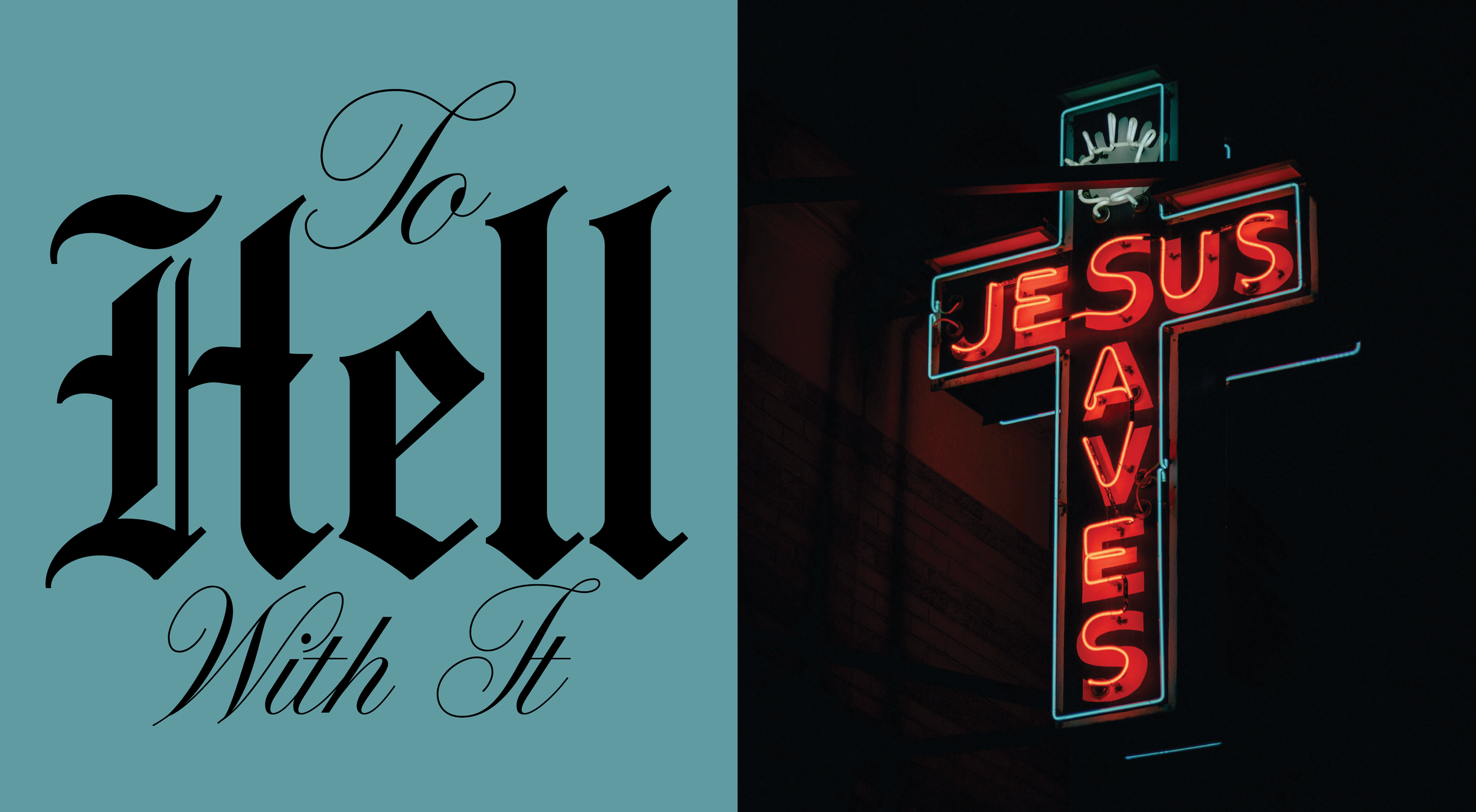
Words by Caleb Gayle
Photos by Jon Bilous & Jimmy Nicholson
August 14, 2026
—
Originally published in Issue No. 14 of The Bitter Southerner Magazine
I grew up in a church where Sundays were for avoiding Hell. Not metaphorically — practically. Sunday was our reminder of the ways we fell short Monday through Saturday and how much we needed redemption, not for redemption’s sake, but as an antidote for the sins of our week. It gave fear a shape and morality a recurring deadline. It echoed the Colonial-era homilies of Jonathan Edwards, who warned America that, if not careful, God could exact a vengeance from which we could not recover. We were, as Edwards called us, “sinners in the hands of an angry God.”
In New York, where I was born, the Sabbath would start early — as we navigated multiple boroughs in an old brown Plymouth van to pick up my grandfather’s congregants, most of them either Jamaican, like him, or first-generation Americans of Caribbean descent, like me. Sunday school, followed by devotion, followed by singing and my grandfather’s preaching — sometimes my father’s, who was relatively, and graciously, succinct in his homiletic delivery.
Afterward, we would gather in the church basement for a spread so wide and sumptuous that it could make anyone forget just how long the service was. Caribbean dishes like bully beef sandwiches on hard dough bread, rundown stew of mackerel and veggies, fried dumplings, “festival” bread, and plantains. On special occasions, there would be ackee and saltfish, the Jamaican national dish, jerk chicken, curried goat, rice and peas. Sometimes this holy after-party would flow into the homes of church attendees. Other times, we’d load back into the van to attend more church with people like us in a different borough, or even in Connecticut or New Jersey. The kids would play outside (not too rough, suits needed to be kept clean) while the adults would argue endlessly over theological minutiae like whether women should be allowed to wear pants and makeup to church.
Now, as a first-generation Jamaican-American, I can’t help but wonder if, in some important way, my family was on their own puritanical immigration and assimilation process — if religious conservatism made us feel somehow more American.
Otherwise, our move to the buckle of the Bible Belt, Tulsa, Oklahoma, home of Oral Roberts University, when I was seven years old, would be nearly impossible to rationalize. My grandparents had listened to radio broadcasts by Oral Roberts, the famous Pentecostal preacher and faith healer, while they still lived in Jamaica, and my uncle was named for him. Tulsa was home of the famous annual Azusa Conference, which also launched the careers of larger-than-life televangelists like T.D. Jakes — founded by Bishop Carlton Pearson, Roberts’s “Black Son.”
Like many Black Tulsans, we attended an offshoot of Pearson’s church — one that was smaller and a touch more Caribbean. But we would join the larger fellowship at least once or twice a month. And we embraced the burgeoning wellspring of Christian cable channels — from Trinity Broadcasting Network, to the WORD Network, to Daystar, and eventually GOD TV, not to mention BET’s string of Christian shows like the Bobby Jones Gospel Hour (which always lasted many hours).
I was enrolled in a private Classical Christian school, where I learned to quote the Westminster Catechism; to serve as a culture warrior under the school’s motto, “Reclaim Our Culture for Christ”; and also to stay quiet about some of the more charismatic inclinations of my Holiness tradition. Going to movies, bowling alleys, and theaters was prohibited in my household, as was listening to secular music and playing card games. As a teenager, I saw my first movie, The Lord of the Rings: The Fellowship of the Ring, which was allowed only after I penned an exhaustively researched, multipage essay explaining the theological training of the book’s author, J.R.R. Tolkien. I had to agree that I would enter the theater only after the trailers, which might inspire inappropriate thoughts.
Every Sunday on the way home from church, we would stop by QuikTrip, where my dad would retrieve a copy of the town’s flagship paper, Tulsa World. Usually, he’d go straight to the classifieds looking for open house tours, another effort toward our becoming true partakers in the American Dream. One Sunday in 2002, he came out of the store transfixed by the front page headlines. When he reached our car, he appeared completely crestfallen. Dad talked somberly to Mom and then turned around to us kids in the backseat. For purposes of journalistic brevity, I’ll summarize the news: Carlton Pearson had announced he no longer believed Hell exists.
I was too young then to process the significance of this man — Bishop Carlton Pearson — coming to that conclusion. How could a preacher, a bishop no less, who founded one of the largest churches in America, not believe in Hell? Wouldn’t this condemn Pearson himself to eternal damnation?
My people never really bought into the “once saved, always saved” affirmation. It was the prospect of losing your salvation, as scary as it might appear, that created a rhythm and a routine to every week. Sure, living right was hard, but knowing what was right was not. The stakes were clear, whether you were talking about white lies or jealousy or murder. Eternity in Hell was on the line.
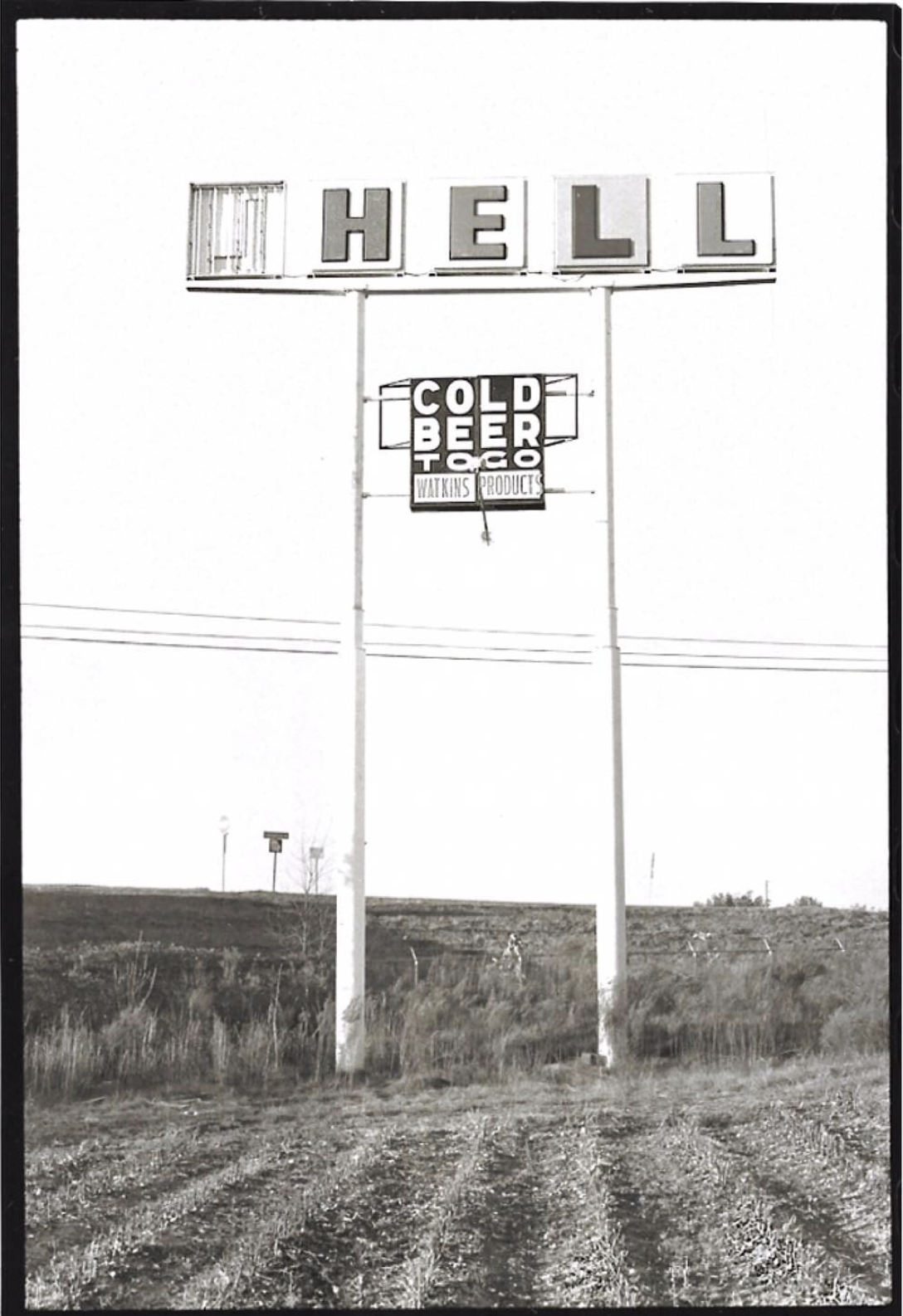
Photo by Jimmy Nicholson
It would be 20 years before I’d get a chance to ask Pearson what happened. In 2022, now a professional journalist, I convinced him to talk to me about his life after Hell. But, honestly, what I wanted to know was not really the magazine profile I had pitched to my editor, or even the one I had described to Pearson. My goal was not a neatly reported account of his rise — his megachurch, his Azusa conference, his Grammy-nominated choir and praise team, his multicultural appeal, his audiences with U.S. presidents and religious luminaries like Billy Graham. Nor was it an account of his fall — losing all that, plus his money, his cars, and his wife. I was not as interested in his fall as I said I was.
Over the last two decades, I too had begun to have questions. I didn’t wonder so much whether Hell exists in the afterlife — or whether it’s even possible to know on this earth — but whether Hell was already overtaking us here, in the present, in history, in my own life. What am I supposed to do when life itself starts to feel like Hell?
I never got to ask him. Before I could finish the story, he died suddenly of bladder cancer.
• • •
Nowadays, fewer people grow up feeling the urgency of divine judgement that I did as a child. Three years before Pearson became a heretic, 70 percent of Americans reported attending church weekly. That number dipped below 50 percent for the first time in 2020, according to Gallup. In January, Pew found that only 55 percent believe in Hell at all. Sunday’s monopoly has weakened.
But that clemency has not produced the kind of relief you might imagine it would. It has not ushered in a gentler, secular morality, a less punitive public life, a more humane arrangement of the week. What has emerged instead feels more like drift, with nothing sturdy to replace the structure that Sundays once provided.
We didn’t stop believing in Hell because the world got infinitely better. It’s hard to look at the news and come to that conclusion honestly. Perhaps, we stopped believing in Hell because we’ve allowed the world to make the concept redundant. Hell has transformed from the eternal torture chamber Pearson once railed against, into something we see around us.
Hell has become more visible.
Since Pearson died on November 19, 2023, the world has only witnessed more catastrophe. Donald Trump returned to the presidency in 2025 and began systematically reversing many human rights advances. Ukraine has become not an interruption but a background condition, with the monthly rate of civilian casualties often continuing to rise. Trump has threatened to wipe out Iran’s entire civilization, and we’ve been encouraged by our Secretary of Defense to pray for destruction. Measles has returned amid falling vaccination rates and widening confusion.
Catastrophe no longer shocks us with the force it ought to. We live in a world where mass suffering is quickly absorbed, narrated, justified, routed around, and folded into the normal texture of the day.
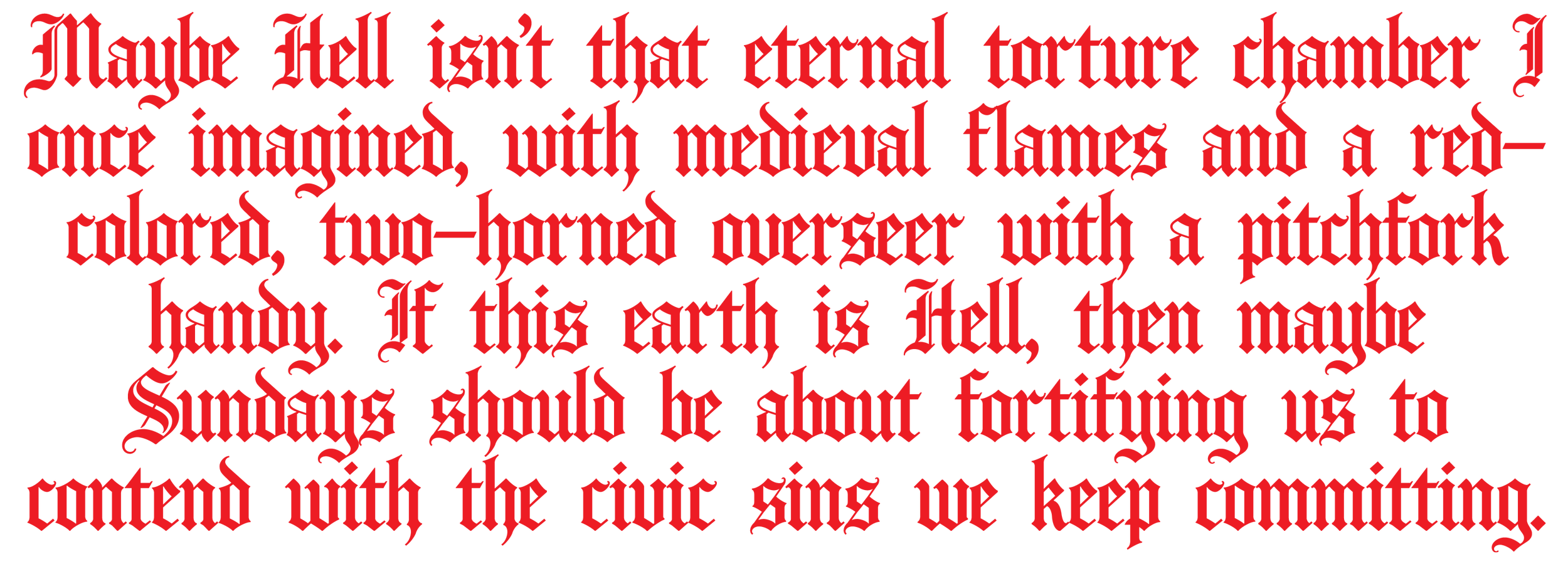
Maybe Hell isn’t that eternal torture chamber I once imagined, with medieval flames and a red-colored, two-horned overseer with a pitchfork handy. If this earth is Hell, then maybe Sundays should be about fortifying us to contend with the civic sins we keep committing. Why can’t Sundays, inside of houses of worship and beyond them, offer us some sort of sacred and secular reinvigoration to keep trying to make this world better?
There is hope in the ways people still gather — not to promise eternal salvation so much as to offer presence. The Atlantic’s Adam Serwer observed Minnesota’s spontaneous response to protecting the vulnerable after the heinous killings of Alex Pretti and Renée Good. He called it “neighborism”— “a commitment to protecting the people around you, no matter who they are or where they came from.” We saw it when Jackson, Mississippi, residents organized mutual aid societies to help the 150,000 residents who didn’t have access to potable water. We see it in people who stock street refrigerators with free food.
Pearson claimed to me that Hell, whatever it may be, is misunderstood and it’s here on Earth. He came to that conclusion after witnessing the genocide in Rwanda and refusing to accept the “inerrant” logic that would have subjected each victim to eternal damnation. But if Hell is on Earth, there are many people who refuse to let it stay that way. We can’t let pain and suffering have the final word.
But this essay isn’t just about Pearson, and it’s not a think piece about civic engagement. It’s about when Hell isn’t “out there” or it’s “in the Great Hereafter,” but when it’s right here, seemingly all-around us, as we try to live every day.
Not long after Pearson and I met, I was sitting in a doctor’s office, listening to a urologist explain, with a kind of practiced calm, my major contribution to the infertility that my wife and I were experiencing. His hands were on my body as he spoke. Gently, he said, “A varicocele.” Something that could be fixed, or improved, or maybe not. The doctor told me that the procedure — an embolization — might help, might not. As I was learning, fertility is less a predictable science than a sequence of attempts, a series of guesses disguised as plans.
You try and then you wait. You hope, and then if it doesn’t work, you try again. With each attempt and accompanying loss, the odds get worse.
I had been raised to believe that suffering, when it came, would make sense, that it would reveal where I had fallen short of holiness. That there could be some level of holy living that would rid me of the pain I had earned. But fear works best when the thing you fear most remains hypothetical. When suffering inhabited my life, when it became a suffocatingly atmospheric condition, fear of the thing I couldn’t prove or disprove — eternal Hell — lost its power.
There were moments, later, when sitting across from another doctor, absorbing another quiet disappointment dressed up in clinical language, I found myself thinking about this bishop who’s now been dead for two-and-a-half years, Pearson, about the costly question he asked, and about how little the old answers on Hell would help me.
Even if Hell isn’t on the other side of life, we have often depended on its logic: We sort, we stigmatize, we accuse. We insist that people must’ve deserved whatever misery has engulfed them.
It wasn’t until Pearson’s rebellion that I realized the faith I inherited was built to address the wrong Hell. Mine was ill-prepared to address the misery that arrives now — in procedure rooms, in news alerts, in casualty reports, in deportations, and killings by those who seek to deport. My faith was built to contend with eternal consequences, but not daily battles. I didn’t know how to organize grief that didn’t fit the formula.
The grief, the pain, and the procedures guaranteed nothing. Yet now, as I write this, we prepare to welcome a miracle: our child.
I still have faith. I still attend church, but I’ve left room for my moral logic to be overwhelmed by the difficulty of living. Sundays have become days with a little less certainty. On the other side of what has often felt like a life organized by tinier forms of Hell, it seems that there’s something that looks like Heaven.
Neither this child — nor the courageous acts to protest, to act up, to look for good trouble, to organize, to choose hope — resolved the problem of human suffering or even the suffering we experience personally. But all these make it impossible for me to ever consider that trying isn’t worth it.
To hell with it, we try. ◊
A professor at Northeastern University and contributing writer for The New York Times Magazine, Caleb Gayle is the author of Black Moses: A Saga of Ambition and the Fight for a Black State, which was longlisted for the 2025 National Book Award for Nonfiction. His writing has been recognized by the Matthew Power Literary Reporting Award, the PEN America Writing for Justice Fellowship, the Center for Fiction Emerging Writers Fellowship, the New America Fellowship, and a fellowship at the Radcliffe Institute for Advanced Study. He has contributed to publications including The New York Times, The Guardian, The Threepenny Review, Pacific Standard, The Root, and The Daily Beast.
Jon Bilous focuses on Americana, architecture, and the human-built landscape, exploring how communities express identity through their structures, signage, and commercial design.
Jimmy Nicholson describes his photographs as “a diary of the places I’ve gone, the people I’ve met, and the events I’ve witnessed in North Floriday and Southwest Georgia.”