
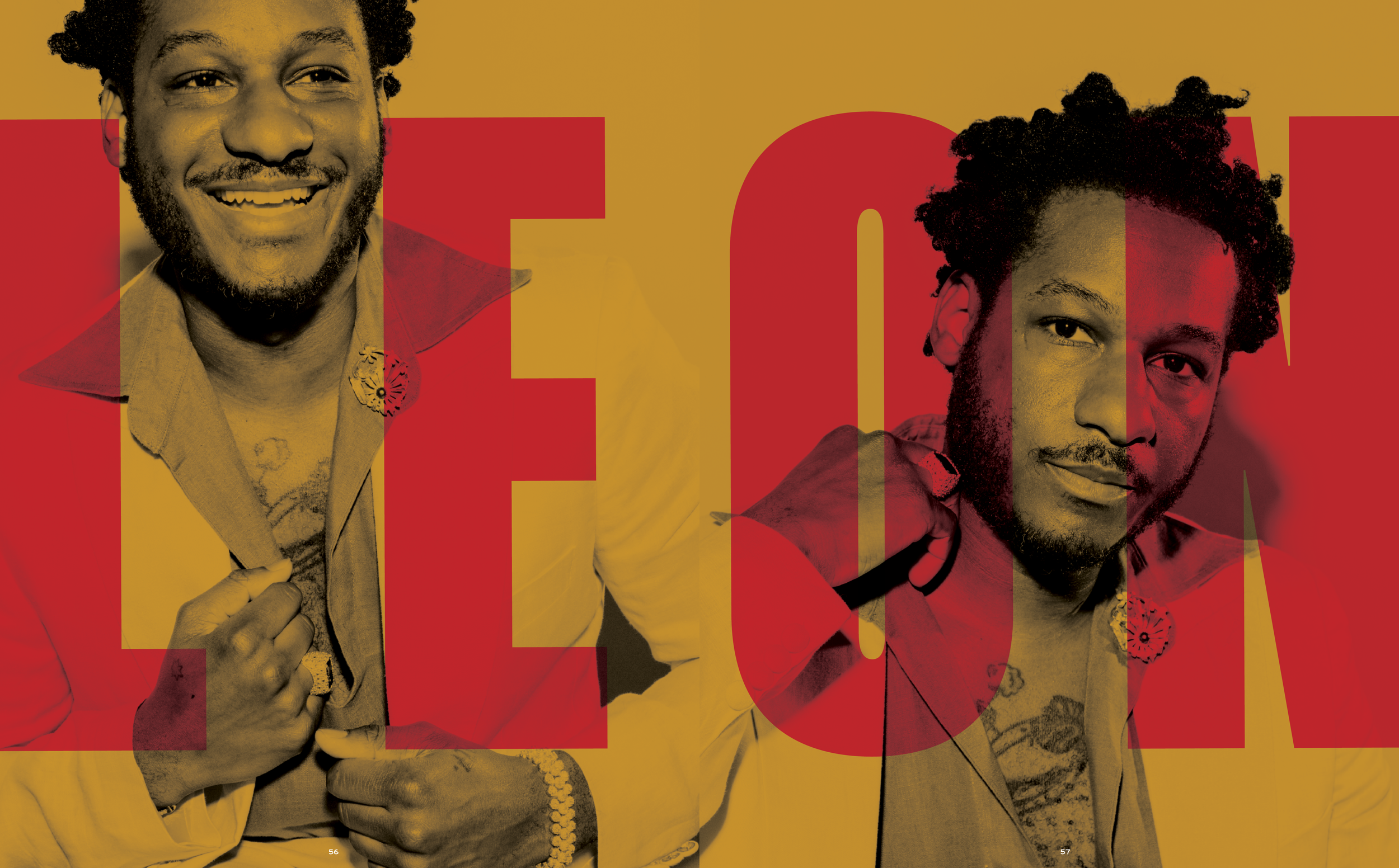
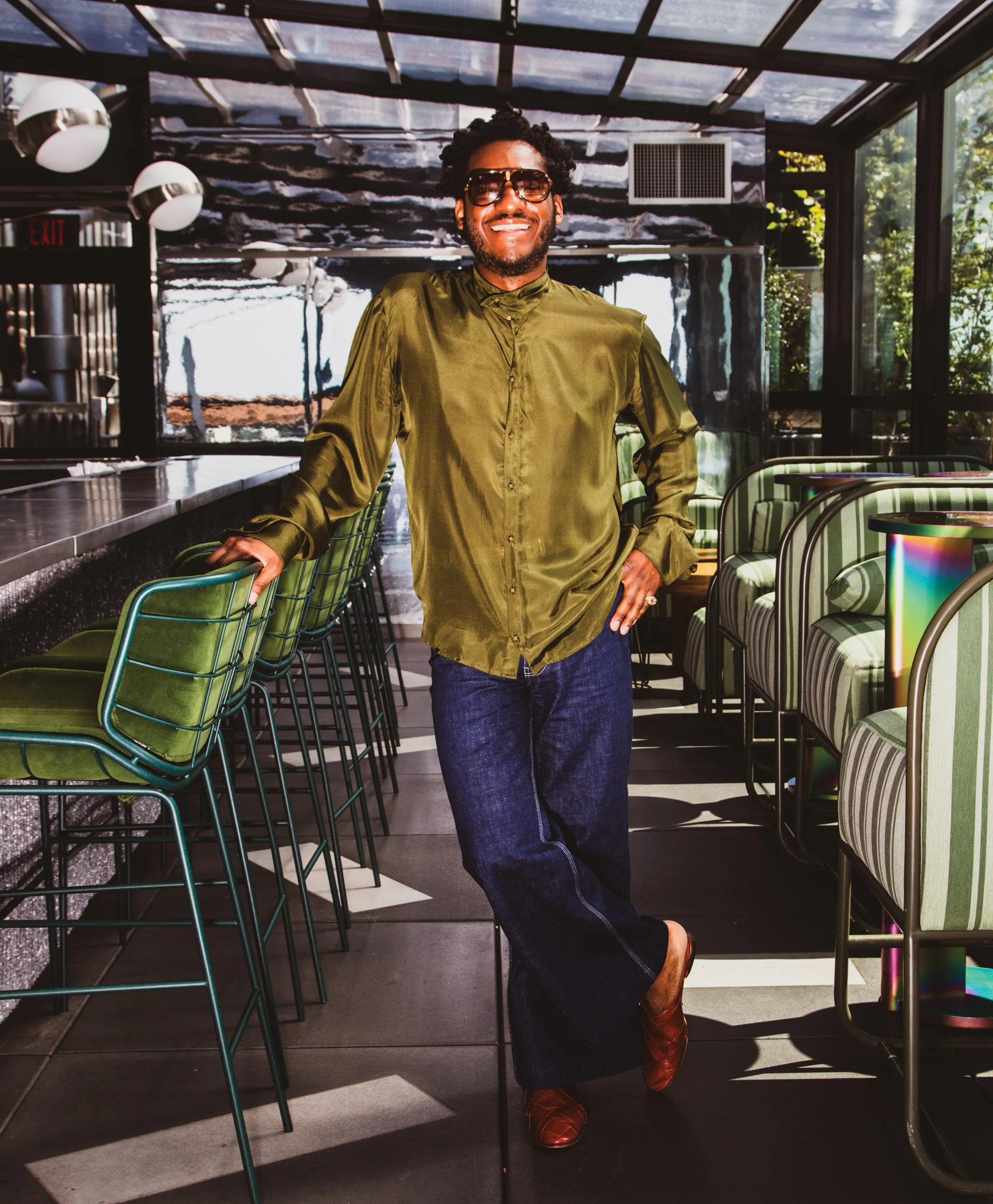
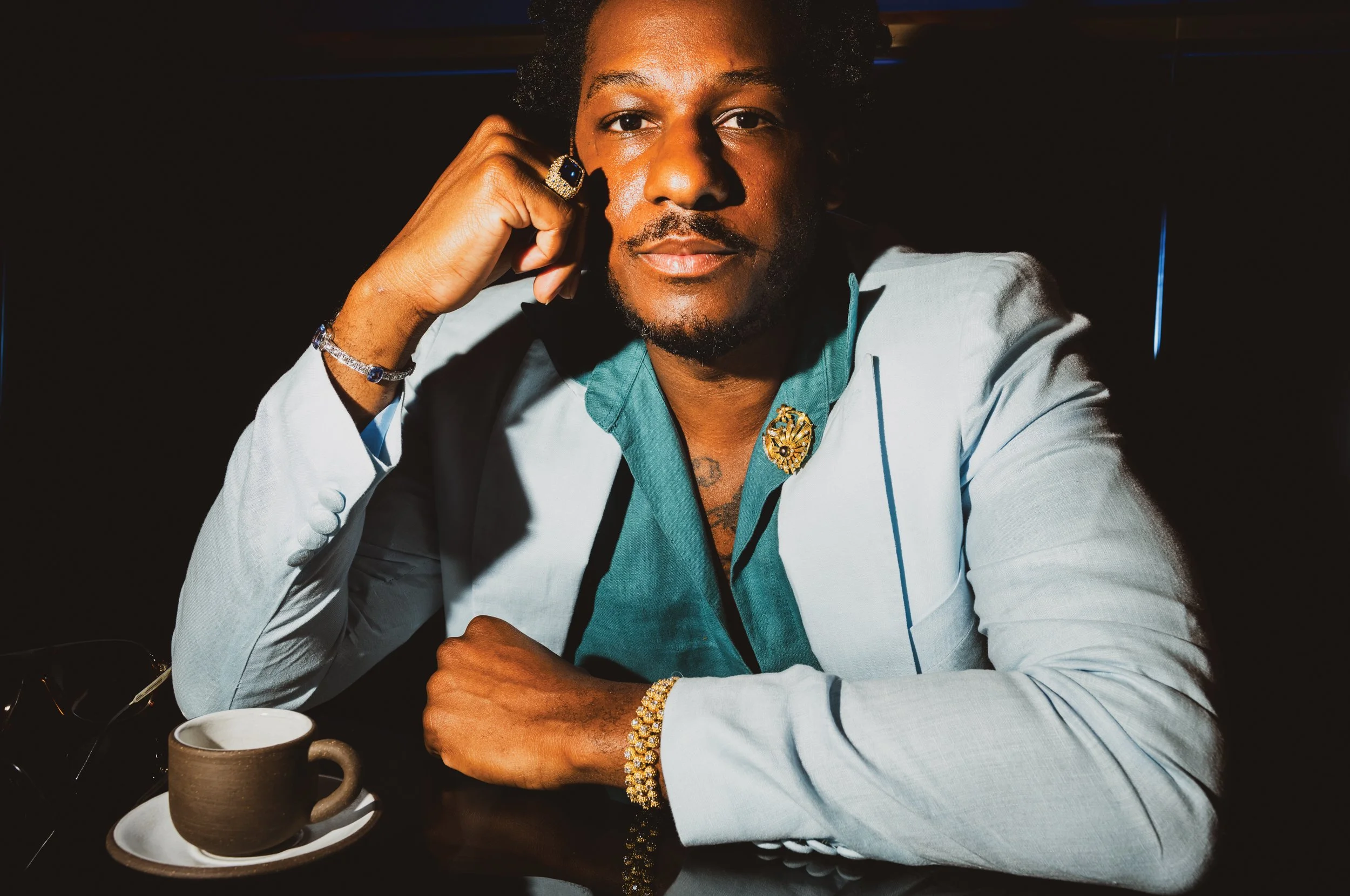
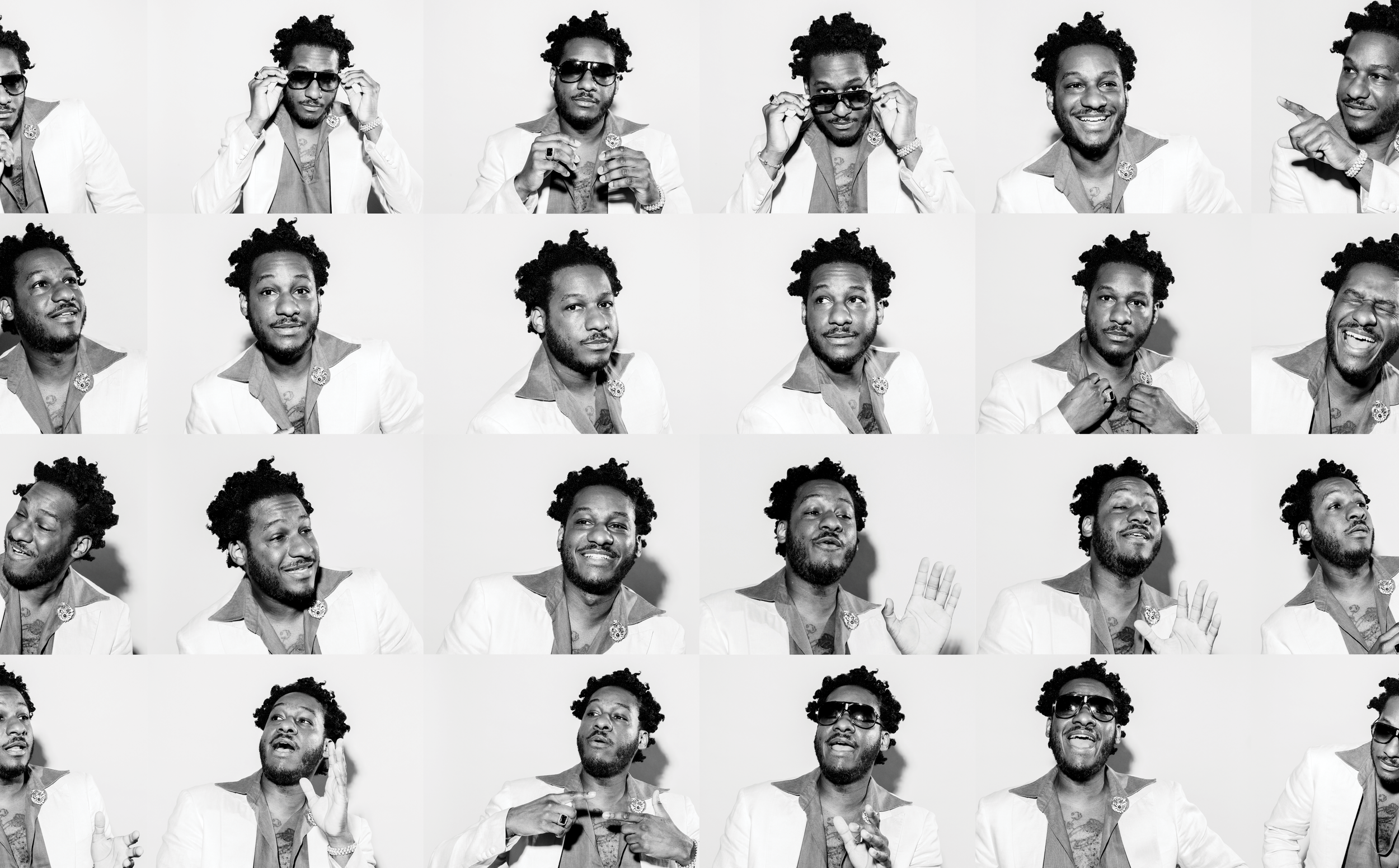
Photos by Landon Nordeman
November 26, 2026
—
Originally published in Issue No. 15 of The Bitter Southerner Magazine
The Declaration of Independence uses the word “pursuit” when mentioning happiness. It invites us to see it beyond a simple state of being and, instead, as a Creator-endowed, inalienable right. It implies a freedom to seek joy but offers no contractual guarantee of such vibes actually being secured in this nation.
Black American men born and raised in the South have a special understanding surrounding the challenges of chasing elation in this country. It’s perhaps why the harmonies, melodies, and lyrics of often-sorrowful songs made by Black people become reliable places to seek and find refuge.
Leon Bridges has his own declaration to make. These days, the ancestrally voiced soul singer, now 37 and living in his hometown of Fort Worth, Texas, is pursuing quietly — and maybe a little defiantly — a life open to jubilance.
Eleven years have passed since Bridges gave the world his soulful debut album, Coming Home. With a convincing and innocent air of optimism, Bridges says he’s all about positivity. At a time when we could all easily run back to the sound of sorrow and human suffering, today, he is choosing to sing of happiness so that joy might find us anywhere we are ready to move.
Happiness Anytime, Bridges’ sixth album, arrived in September of this year. Funky, festive, and full of good feeling, it gives those of us still audacious enough to believe in joy what we are looking for. It’s an album that has the energy and spirit to put a battery in your back, in case you’re ready for a revival.
And while Bridges doesn’t see his music as a platform for political declarations, he does believe there’s something to be said about the subversive power of joy, and the fact that Black men, too, were endowed with an inalienable right to be a reflection of light.
—Mike Jordan
September 20, 2026
Atlanta
MIKE JORDAN
When I turn on a new album or record, I don’t know if I’m gonna dance necessarily, or how. With Happiness Anytime, the shoulders start moving naturally. It’s a beautifully natural sound and I just get into that feeling.
LEON BRIDGES
A lot of my songs are ballads, and I wanted to try to cultivate something completely new within this album. I didn’t necessarily know what that was, but at the start of this we did reference a lot of Fela Kuti, George Benson, and a lot of obscure records, to get the sonic palette.
MIKE
Another thing that’s dope about the album is the cover photo. It matches the album really well. It reminds me of Southern hip-hop and its connection to car culture, like when someone gets dressed up to match their car, except in this case it’s a boat on water. It’s almost like a Southern hip-hop postcard — kind of a flex, but less egotistical and more like, “Look at me. I look good out here.” Where did the idea for that image come from?
LEON
That’s cool that you made that connection. Shoutout to my friend Joshua Kissi, the creative director on this project. We went out to Miami, and the whole vibe was to shoot in a place that could be anywhere in the world.
MIKE
Your voice is unmistakably your own, and you have such a gift for comfortably and consistently delivering it. It sounds effortless, but does it ever become challenging to match your voice and tone to certain words and expressions when the moment is a little different?
LEON
Yeah, in the most, kind of like minuscule parts in the song, like a hum. You know, a lot of singers kind of lean on the big vocal acrobats. I try to find beauty in the subtle moments, [especially] in my writing.
Early on in my career I had the choice to either stay within the retro lane or continue to grow. I wanted to just be honest about the influences in my journey. This thing, it’s not really a competition, you know? I think we, as artists, we all have our purpose. It’s all about reinventing. I’m always trying to keep people guessing.
MIKE
We’re in a time where so much of life has become political and those with big voices are often expected to speak out. Do you ever feel pressure to weigh in on political topics? Do fans ask why you don’t make more political music?
LEON
I think being in this lane of soul music and being a Black man making positive music is powerful in itself. Sometimes I think going that route is something I don’t have the capacity to do. But [I’m] always looking for different themes to incorporate in my music.
MIKE
You were in your mid-20s when you debuted in 2015 but you’re now leaning closer to 40. How are you taking care of you with all of the change that’s happened around you? Do you find yourself having to protect your peace more often?
LEON
Having my foundation and being grounded by faith, I look at it like you can have all the muscle in the world, and all the resources, but when it all boils down, God is the only reason I even have this opportunity. For me, having community and friends around me I can trust has really helped me navigate through this thing.
I think to have longevity you’ve gotta have an immense amount of discipline. For me it’s about staying on that straight and narrow.
MIKE
It’s beautiful when Black men visibly and unabashedly promote positivity. It’s almost like an optimistic defiance, a rejection of the pessimism the world sometimes wants us to feel. This seems like an interesting time and moment to be in, where Black men are breaking ideas, expectations and limitations around our outcomes. I’m wondering if you’re seeing and feeling some of this despite the times we’re in?
LEON
Yeah, there is definitely a shift happening in music. I think what people are seeing is that certain people were living a facade, and the veil is being kind of lifted on that. I love to see more music, especially within the hip-hop community, going in a positive direction. Larry June is real cool. I’m a big fan of Gunna and everything he’s doing. He had his [legal] situation but he came out of that and is doing a lot of good things in the community, like with his run club. He’s bringing people out, showing them how to be healthier and better themselves. We need more of that in the world. Anybody that’s putting positivity out there, I’m all on board and all in support of it.
MIKE
Talk about Fort Worth for a minute. Why has it remained home for you, rather than the Hollywood Hills?
LEON
I never really had the desire, you know? I love that living in Fort Worth is disconnected from the industry. I can go out and grind and do my thing, and come back, and there’s peace. Fort Worth is really my place of refuge... very grounding. I can come back here and revisit some of those old stomping grounds, and be around people who love me for who I am. It’s such a beautiful city.
MIKE
How would you describe the energy of Fort Worth for people who’ve heard about it but aren’t as intimately familiar as you?
LEON
Back in the 1800s there was a guy from Dallas who came to Fort Worth, and he said, “Wow, this place is so slow you can see a panther sleep out in the streets.”
It really holds that character. What I love about it is it’s a big city, but still has that small town feel. People here are salt of the earth and honest. In other places, you meet people who are enamored with the fame thing, and don’t treat you as a human being. It’s amazing that even with the fame, I can still move around, people are respectful, and I have the blanket of my family and friends that live here. That’s very important to have in this game, for sure.
MIKE
What kind of things do you get from your Fort Worth people that you wouldn’t get if you weren’t around here?
LEON
The biggest thing is people encourage me to continue being myself and trust my intuition. There are times when I’ll express to my friends that, you know, I have a little bit of anxiety going on, like doing a TV show or an interview, or anything like that. When I’m not in an album cycle, I get kind of rusty as far as, like, talking.
They continue to just encourage me, telling me I’m capable of doing all these things, and I’ve got this. They’re always very supportive. “You’ve made it this far, you know?” And I’ve gotten more comfortable.
MIKE
We’re also in an era of talking. Everyone is podcasting now.
LEON
Yeah, and I’m just super-introverted. I’m not outgoing unless you know… It depends on what circle I’m in. I would say I’ve conditioned myself to be an extrovert. It kind of comes with the territory a little bit. But my friends know, when my social battery is depleted, I just take it upon myself to just go find a quiet room. If I’m feeling exhausted over whatever, I just leave the party and go home.
MIKE
Are you paying more attention to any particular forms of art these days? Is there something creative that’s drawing you in?
LEON
Yeah, I love film. I really respect what Ryan Coogler is doing. I saw something online, a pilot he did for a new X-Files reboot. I love how he shoots everything on film. I feel like film and music are kind of synonymous. You can’t have one without the other. Good films inspire music. It’s like going in to make an album and creating visuals. That’s kind of the only thing I’ve been inspired by recently.
MIKE
I can totally hear your new music in movies. They’re the kind of songs that invoke not just feelings but scenic visuals in the imagination.
LEON
Yeah, there’s a few on the album that feel very cinematic. We’ll see what happens with that.
MIKE
What are some films that inspire you?
LEON
Man, I love the whole Christopher Nolan Batman series. That’s the kid in me. I always loved everything Batman. I also just watched Paid in Full and I thought it was cool to see the whole Black mafioso thing within New York culture. I had always heard about it, but I just watched it for the first time. That’s a really cool film. And like, some of the music placement in the scenes was super-tasteful, and, um, yeah, I really did like that one. And I think one takeaway is, as a leader of my family and community, people are looking up to me, and artists who have platforms. I think the whole thing is just living and leaving a good example, you know? Choosing and aligning myself with righteousness is something I feel is important, and the only reason why I have longevity, so far.
MIKE
I don’t know if this is birthright or a lowkey mandate, but when you’re of the South and in the South, there’s an understood responsibility to do the work, whatever that work is. What does doing the work, outside of your music, look like for you?
LEON
I always wanted a vehicle to give back in a big way, and my foundation [The Big Good] has been such a blessing, being able to give almost $5 million back into the community of Fort Worth. We picked our beneficiaries. I went with the UCC Polytechnic Center, which is in the Bethlehem community. [The Big Good has donated hundreds of thousands of dollars to the Center since 2023]. There’s also the Tarrant Area Food Bank and programs that help people get jobs. We’ve also been keeping our eyes open to the immediate needs in the city.
I grew up on the south side of Fort Worth. In the 90s, it was just a place that was the pinnacle of a lot of violence. My dad was a light in the community, essentially a cornerstone for kids who didn’t have their father in the household. This community center that I grew up going to as a kid, the Bethlehem Center, is a place my dad used to run, essentially like a YMCA kind of thing, with after-school education programs but also just a hangout for kids in the neighborhood. I contributed my Nintendo 64 when I was a kid so others could play. He really inspired me to give back in that way.
Moments like that of being selfless… I don’t know. I feel like good things transpire when you just show love. Sometimes you kind of feel helpless, you know? Like you have to fix all the problems of the world. That can feel debilitating. But I think you can really make an impact by just being positive and putting out that joy.
MIKE
Are you finding more problems to address in the community than you might have expected, or would you say you were already aware of the scope of things, coming from the vantage point of growing up there?
LEON
It’s something I was aware of, but it definitely opened me up to some of these issues. I look at those moments when I was a kid, and we didn’t have the most growing up, but those times when we didn’t have anything, God always provided. I also think about my mother and her resilience through those hard times.
MIKE
What are you most proud of about yourself?
LEON
We have to do the right thing even when nobody’s looking, you know? I’m most proud of giving my friends opportunities. It really keeps me grounded to bring family with me everywhere.
MIKE
Certain music goes well with a meal, whether date nights, family dinners, or whatever. You make that kind of nourishing music. Being from the South, I’m sure you have a perspective on food. What’s your relationship with food? Do you cook at all?
LEON
I would consider myself a foodie. I love good food. I’m so grateful to be able to travel and see the world, and experience different cultures and dishes unique to those places. And I’m really proud of my roots. My folks, my whole lineage is from New Orleans, so you know, I love a good gumbo, red beans and rice. I mean, I could eat that all the time.
But also, being from Texas, my art, my music is from a Texas lens. Being in Texas, Tex-Mex food is a thing. Growing up, you’re always in close proximity with Mexican culture, so I appreciate authentic Mexican food. But as far as, like, in the kitchen? Man, it’s funny because I wanted to be a chef when I was younger. But these days I’m super-incompetent in the kitchen. I mean, like, sardines is my thing. Sardines on a cracker with some Crystal Hot Sauce.
MIKE
So, no longer a chef, but do you think you might try again?
LEON
Well, that’ll be my next hobby, to get good at cooking. ◊
Mike Jordan is a Nashville-born, Alabama-raised, Atlanta-based writer and editor whose work has been featured in Bon Appétit, National Geographic, Rolling Stone, ProPublica, The Wall Street Journal, and others. Jordan has served in a variety of leadership positions in journalism, including founding editor and bureau chief at Thrillist Atlanta, co-founder of nonprofit community journalism organization Canopy Atlanta, digital program director at Atlanta radio station V-103, senior editor for Black culture at The Atlanta Journal-Constitution, and 2024-2026 board chair at the Atlanta Press Club. Jordan was also a 2023 finalist and 2024 winner of the James Beard Foundation’s Jonathan Gold Local Voice Award for food journalism.
Landon Nordeman a photographer living and working in New York City, began his photographic journey working at newspapers in Virginia. Since then, assignments have taken him around the globe covering subjects such as sea turtles, barbecue, Easter, the sheep of New Zealand, the martini, the Oscars, and the World Dog Show in Helsinki. His current series of photographs “Last Night,” which was shown at the Leica Gallery in 2025, will be exhibited at the Museum of the City of New York this coming November, as part of the museum’s photography triennial, New York Now: After Dark.
Stylist: Gabriela Tena • Grooming: Lindsay Rogers • Photographed on location at The W New York – Union Square
Featured in Issue No. 15